
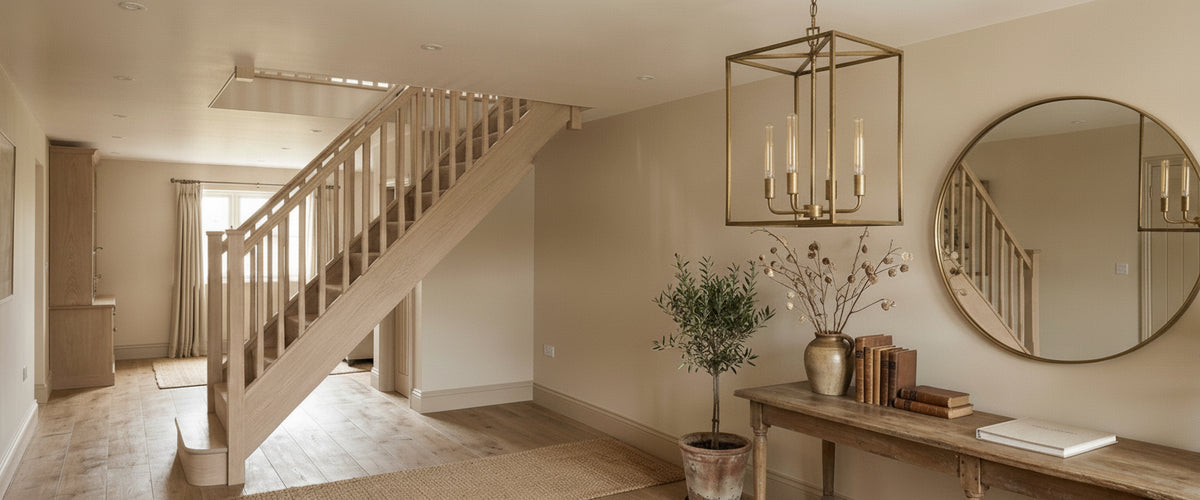

Aged brass at its best looks as though it came with the house. At its worst it reads as a sprayed-on brown that never quite convinces. You usually find out which one you have the first evening you switch an aged brass chandeliers on. By then the fixing is in the ceiling, the plaster is patched and the piece is yours. At Niori we routinely pair brass with alabaster and natural stone, so we see both outcomes. Here is how to end up with the good one.

Quick Answer
- Know the finish: aged, antique and living brass are three different products. Only living brass keeps changing after installation.
- Test under your bulbs: patina that looks honeyed at 2700K can look olive or grey in cool north light.
- Size by room, then by frame: open frames can go slightly larger than solid ones; dense, dark frames in low rooms drag.
- Choose bulbs as part of the design: an open frame shows every lamp, so shape, colour temperature and dimming matter.
- Inspect before you commit: check lacquer, relief and joints on the actual piece, especially if it is made to order.

Aged, Antique and Living Brass: What You Are Actually Buying
Brass is an alloy of copper and zinc, and the Copper Development Association is a useful starting point if you want to understand why it darkens the way it does. Left alone, the copper content reacts with air, moisture and skin oils, moving from bright yellow towards warm brown and, eventually, greenish tones in damp spots.
An aged brass chandelier fast-tracks that process in the workshop. The metal is treated with an oxidising solution to darken it, then hand-relieved so the high points of the frame show brighter gold against deeper recesses. A clear lacquer locks the result in place. Done well, the relief follows the form the way real wear would: brighter on edges and curves, darker in the joints.
"Antique brass" is a looser term. Sometimes it means a darker, brown-black patination; on lesser pieces it can mean a plated or painted effect over another metal. Ask which it is. Living brass, also sold as unlacquered, has no protective coat at all and keeps changing for as long as you own it.
The difference matters most when you buy in stages. A common mistake is adding living-brass wall lights some months after a lacquered aged chandelier. Within a season the wall lights have darkened and read as a different metal entirely. Lacquered finishes stay put; living finishes drift. Pick one approach per room. When wall lights follow the chandelier, a sconce sold in the same aged brass finish, such as the Aegean 2 Light Wall Light in Aged Brass, is a safer match than a living-brass piece. It is still worth confirming the lacquer with the maker before it goes up. If you do choose living brass, resist aggressive polishing; the Institute of Conservation is a sensible reference for why abrasive cleaners do more harm to metal surfaces than good.
How Patina Behaves Under 2700K Bulbs and Afternoon Daylight
Warm white LEDs at 2700K push an aged brass chandelier towards honey and amber. The brown recesses deepen, the relieved highlights catch small points of light, and the frame looks richer than it does in the showroom. This is the finish at its most flattering.
Daylight is less forgiving. In a north-facing sitting room, cool afternoon light can flatten the same patina into something closer to olive or pewter. A south-facing room in late afternoon does the opposite and turns it gold. If you can, look at a finish sample in the room itself at two times of day before ordering.
Go too warm and you lose the balance. At 2200K the brown tones turn muddy and any alabaster diffusers glow orange rather than cream. For kitchens and working spaces, 3000K keeps the brass warm while keeping food and surfaces true. Alabaster adds its own warmth as light passes through the stone, so a brass frame holding alabaster bowls can take a slightly cooler bulb than bare metal.
Scale, Drop and Ceiling Height for an Aged Brass Chandelier
The familiar rule still works: add the room's length and width in feet, and the total is a good starting diameter in inches. In metric, add length and width in metres and multiply by about 8 to get centimetres. A 4 by 5 metre room (roughly 13 by 16 feet) suggests a chandelier around 72 cm (29 in) across.
Frame density changes that answer. An open, airy aged brass chandelier reads lighter than its diameter, so you can go a size up. A heavily detailed frame in dark patina carries more visual weight and should stay at or below the number. Dense aged frames under 2.4 metre (8 ft) new-build ceilings tend to make the whole room feel lower. In those rooms a flush fitting usually earns the space better: something like the Fletcher 26" Flush Ceiling Light in Aged Brass with Ivory Shade keeps the warmth of the metal at a generous diameter, while its ivory shade softens the light rather than hanging another dark frame into the room.
For drop, keep at least 2.1 metres (7 ft) of clearance under the lowest point in walkways, and 75 to 90 cm (30 to 36 in) above a dining table. For taller Victorian and Georgian ceilings of 2.7 to 3.2 metres (9 to 10.5 ft), add roughly 7 to 8 cm (3 in) of drop for every 30 cm (1 ft) above 2.4 metres. Browsing the wider lighting range by fixture type makes it easier to compare suspended and ceiling-hugging options side by side.
Brass is heavy. Any chandelier needs a fixing rated for its weight, and installation should always be carried out by a qualified electrician registered with a competent person scheme.
Where Weathered Warmth Works, and Where It Fights the Room
An aged brass chandelier lands best against surfaces with some texture and warmth of their own: lime plaster, limewash, oak and walnut, deep greens, terracotta, and natural stone. Veined marble and alabaster are especially good partners because the stone softens the metal and the metal gives the stone an edge. Our alabaster lighting leans on exactly this pairing, with brass detailing framing translucent stone.
It competes in cool grey schemes with chrome hardware, in stainless-steel kitchens, and in high-gloss white rooms where the patina looks dirty rather than deliberate. It also struggles when a room already holds several brass finishes. Polished taps, satin handles and an aged chandelier in one sightline look accidental. Two metal finishes per view is a sensible limit.
Hospitality is a slightly different case. Restaurants and bars often choose an aged brass chandelier precisely because it hides fingerprints and dust between cleans better than polished metal. In busy venues, that practical advantage can matter as much as the look.
Lumens and Bulbs for an Open Brass Frame
An open-frame aged brass chandelier shows every bulb, so the lamp is part of the design. Candle bulbs suit traditional multi-arm frames; small globes suit modern ones; clear filament LEDs add sparkle but can glare on a stairwell viewed from above. Where arms carry alabaster or glass shades, opal or frosted lamps avoid hot spots through the stone.
For output, a living room generally wants around 1,500 to 3,000 lumens from all sources combined, with the chandelier providing part of that alongside lamps and wall lights. On a five or six arm frame, bulbs of about 250 to 470 lumens each (the old 25 to 40 watt equivalents) usually strike the right balance. Look for a CRI of 90 or above so wood, stone and skin look natural, and pair dimmable LEDs with a compatible trailing-edge dimmer to avoid flicker.
What to Inspect Before You Commit
A made-to-order aged brass chandelier is rarely easy to return, so inspect properly. Ask for daylight photographs of the actual piece or batch, not catalogue imagery. Check that the relief is consistent across every arm. Watch for lacquer that has pooled at the elbows: the amber drips are easy to miss in studio light and obvious in daylight.
Look for orange-peel texture, dust trapped under the lacquer and bare patches around joints. Hold a magnet to the frame: solid brass is not magnetic, so a strong pull means plated steel. No pull is not proof on its own, since plated zinc ignores a magnet too. Make sure the chain, canopy and ceiling rose match the body rather than arriving in a brighter or flatter tone. Confirm UKCA or CE marking on the electrical components.
A Pre-Purchase Checklist
- Lacquered aged, antique or living brass confirmed in writing
- Finish sample viewed in the room under daylight and at your chosen Kelvin
- Diameter checked against room size and frame density
- Drop and clearance measured from the finished floor
- Other metal finishes in the room limited to one more
- Bulb shape, lumens, CRI and dimmer compatibility decided
- Daylight photos of the actual piece requested
- Ceiling fixing and installation booked with a qualified electrician
An aged brass chandelier rewards buyers who treat the finish as seriously as the shape. If you are weighing brass against stone or want to see how the two work together, request a tailored quote from Niori. Budget depends on material, scale, engineering, finishing and installation, and we would rather price your room than guess.