

Order two oil rubbed bronze fittings from the same workshop six months apart, stand them side by side on a table, and they will not match. One leans chocolate with a warm copper flare along the edges. The other reads almost black until you tilt it into the light. Clients occasionally ring us about this, convinced something has gone wrong. Nothing has. Oil rubbed bronze is a chemically darkened surface that is then relieved back by hand, and a hand is not a machine.
That variability is exactly why the finish looks expensive in a room and why it punishes careless specification. Get the bulb wrong, or hang it against the wrong wall colour, and a deep, complex bronze collapses into flat grey-black. At Niori, where most of the range is built around alabaster and natural stone, we care about this because bronze detailing is so often the metal sitting against a translucent stone shade. When the metal dies, the stone loses its frame.

Oil Rubbed Bronze at a Glance
- What it is: a dark, chemically induced surface on bronze or brass-plated metal, hand-rubbed so the high points show warmer copper tones underneath.
- How it behaves: batch to batch variation is normal; some versions are sealed with lacquer, some are left to keep ageing.
- Best light: 2700K warm white. Anything from 4000K upwards strips out the red and the finish reads grey.
- Works hardest in: hallways, staircases, panelled rooms, kitchens with timber or stone, and covered outdoor entrances.
- Disappears in: very dark walls, unlit corners, and cold north-facing rooms lit only by daylight.
- Pairs well with: alabaster, honed marble, onyx, aged oak, limewash, unlacquered brass used sparingly.

Why No Two Oil Rubbed Bronze Finishes Look Identical
The darkening comes from a chemical reaction on the metal surface rather than from pigment. Temperature, humidity, the age of the solution in the bath and how long the piece sits in it all shift the result. Then a finisher takes an abrasive pad or cloth and rubs the raised areas back, deciding by eye where the highlights fall. Two people relieving the same casting will produce two different pieces.
Solid cast bronze and plated steel also age differently. A solid cast component wears into the metal itself, so a scuff on a knurled ring after five years still reads as bronze. Plated work is a thin skin; wear through it and you hit the substrate, which is usually a pale silvery grey. This matters most on the parts people touch: switch collars, pull chains, the shoulder of a table lamp where a hand reaches for the rotary switch.
Historic bronze surfaces were never uniform either. Museum conservators treat patina as evidence of a specific process and a specific age, which is why the Metropolitan Museum of Art's account of bronze casting and surface treatment is worth ten minutes of any specifier's time. The modern finish borrows that logic. If you want perfect consistency across twelve fittings, you want a powder-coated surface, not a bronze one. Order all your pieces together and note the request when you place the order.
The Colour Temperature Trap
Here is the mistake we see most often. Someone chooses a dark patinated bronze for its warmth, then installs 4000K LED lamps because the packaging said "bright white". The finish has almost no red left to reflect. What looked like burnished chocolate in the showroom now looks like a dull gunmetal, and the client assumes they were sent the wrong item.
Dark metal finishes are reflective surfaces with a narrow tonal range, so they depend heavily on the spectrum hitting them. Warm white lamps at 2700K bring out the copper undertones and the hand-rubbed highlights. Cooler sources flatten them. Colour rendering matters just as much as colour temperature; a lamp with poor rendering will mute the copper even at a warm setting, which is why lighting researchers such as the Lighting Research Center keep pushing spectral quality rather than brightness alone. Look for a high CRI figure, ideally 90 or above.
Dimming adds a second layer. Good warm-dim LED lamps drop towards 2200K as they dim, which is flattering to both bronze and alabaster; cheap drivers simply reduce output and leave the colour flat and slightly green. Buy the lamps and the dimmer module as a pair, and test one fitting before the electrician commits to the whole circuit. Any hard wiring, dimmer module selection or outdoor installation should be signed off by a qualified electrician.
Rooms Where Oil Rubbed Bronze Deepens a Scheme, and Rooms Where It Vanishes
Hallways and staircases. This is the finish's home ground. Against limewash, plaster pinks, muted greens or stone floors, oil rubbed bronze gives weight without the brashness of polished brass. A run of bronze wall lights at roughly 1.6m to 1.7m (around 5ft 3in to 5ft 6in) to centre throws light up a wall and lets the metal catch the spill. Where the aim is a soft wash across plaster rather than a hard pool of downlight, an uplighting form such as the Alderley 2 Light Art Deco Wall Uplighter is closer to the right design language, because the bronze body sits in shadow while the light it throws falls behind it.
Kitchens. Bronze suspension rods over an island read beautifully with walnut, unfilled travertine or a honed marble worktop. Keep the pendant bottoms around 75cm to 90cm (30in to 35in) above the surface. If the kitchen is all cool white lacquer and stainless steel, bronze will look like a visiting relative who did not get the dress code.
Bathrooms. Handsome, but check the finish's suitability for damp zones with the maker before ordering. Lacquered bronze copes well; unsealed bronze in a steamy en suite will move faster than you expect, and near coastal air it moves faster still.
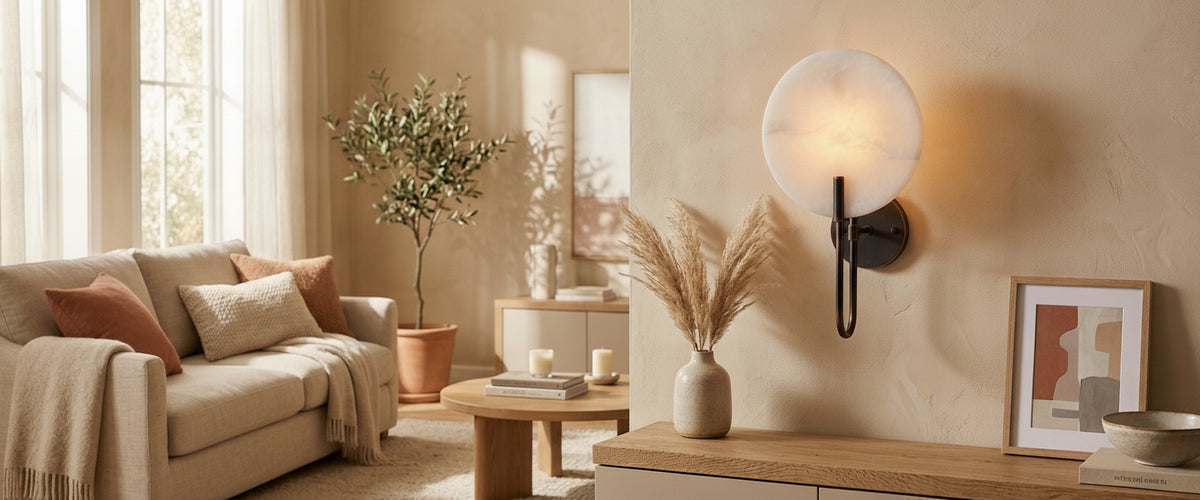
Bedrooms. Bronze bedside wall lights with alabaster shades are one of the most requested combinations we ship. The stone diffuses to a soft amber glow and the dark metal stops that glow floating shapelessly off the wall. Where there is no scope to wire into the wall and the bedside table has to carry the light instead, a modest patinated base with a fabric shade, such as the Amarilli 1 Light Table Lamp, keeps the same warmth at a scale that does not crowd the pillow line.
Where it vanishes. Charcoal or near-black walls swallow it whole. So do unlit alcoves and rooms that rely solely on north light, where the cool daylight cast drains the copper away by four in the afternoon. In those rooms, choose a lighter bronze with more relief, or switch to a brass or stone-led fitting instead. Browsing the range by material rather than by colour helps here; our alabaster lighting collection shows how a translucent shade can carry a dim room that dark metal alone cannot.
The Hardware Test
One mismatched socket plate can expose a whole finish strategy. A client fitting out a Georgian townhouse in Bath ordered dark bronze picture lights for a hanging of family portraits, then kept the builder's default brushed chrome sockets on the same wall. From the doorway, the chrome read as a bright dot and the bronze read as a smudge. Swapping the plates to a matched dark finish and dropping the downlights from 4000K to 2700K changed the wall completely. The fittings were never the problem.
Picture lights are unusually exposed in this respect, because the fitting is read against the wall rather than against its own light. For a mid-sized canvas where the housing should recede and the paint surface should lead, a slim dark bronze arm such as the Chawton Medium Picture Light holds the eye on the frame; a polished metal of the same shape does the opposite. Before you commit, do the test properly. Gather a socket plate, a door handle, a curtain pole finial and the fitting itself, put them on the floor of the actual room, and look at them at 9am and again after dark with the lamps on. Mixed metals are fine when the mix is intentional and one metal clearly leads. They look accidental when three finishes each take a third of the visual weight.
Lacquer, Patina and What the Surface Tells You Before You Hang It
Run a finger over an unpacked fitting. A slight waxy drag and an even sheen usually means a lacquered surface: stable, low maintenance, and it will hold its colour for years indoors. A drier, slightly grippy feel with tonal variation across a curve suggests a living finish that will keep darkening and developing highlights where hands land.
Neither is better. Lacquered work suits hospitality and rental properties where consistency across a scheme matters and cleaning staff will be wiping surfaces weekly. Living finishes suit private homes where the owner wants the fitting to look older in ten years than it does today. Ask which one you are buying before you order a set, because you cannot easily convert one into the other later.
Care is short. Dust with a dry microfibre cloth. Avoid all-purpose sprays, glass cleaners and anything with ammonia or citrus; they cut through lacquer and blotch a living patina. For bronze against an alabaster or marble shade, dust the stone first, dry, and never let a damp cloth sit on stone, which is porous and will mark. If a lacquered fitting develops a water spot, a touch of clear microcrystalline wax buffed gently is usually enough.
A Buyer's Checklist for Oil Rubbed Bronze Lighting
- Order every fitting in the finish at the same time so they come from one production run.
- Confirm whether the piece is solid cast or plated, and whether the surface is lacquered or left to age.
- Specify 2700K lamps with a CRI of 90 or higher, and match the dimmer module to them.
- Hold a sample against your actual wall colour, not a paint chart, in both daylight and lamplight.
- Audit the room's other metal: sockets, switches, handles, hinges, taps. Pick a lead metal.
- For bathrooms, exterior porches or coastal properties, ask about suitability for that zone before ordering.
- Check fixing points and weight with your electrician before plaster goes on, especially for heavier stone shades.
- Ask for a tailored quote rather than assuming a flat finish premium; cost tracks the substrate, casting complexity, amount of hand finishing, engineering and installation.
Bronze Against Alabaster and Natural Stone
The reason oil rubbed bronze suits stone lighting so well is contrast of behaviour rather than contrast of colour. Alabaster is translucent and scatters light through its body, so the shade glows rather than reflects. Bronze absorbs. Put them together and the metal gives the glowing form an outline, a foot, a point of gravity. Pale polished chrome next to alabaster competes with it; bronze frames it.
That logic holds across fixture types. On a floor lamp, a bronze stem stops a tall alabaster column looking top-heavy. On a chandelier, bronze arms disappear into the ceiling shadow at night and let the stone read as floating light. If you are sketching a whole-house scheme, working across the full lighting range and holding one metal finish through the circulation spaces tends to produce a calmer result than changing metal room by room.
Treat oil rubbed bronze as a material with its own behaviour rather than a colour you pick from a dropdown. Specify the light that flatters it, keep the rest of the ironmongery in conversation with it, and let the variation between pieces be part of what you bought.