
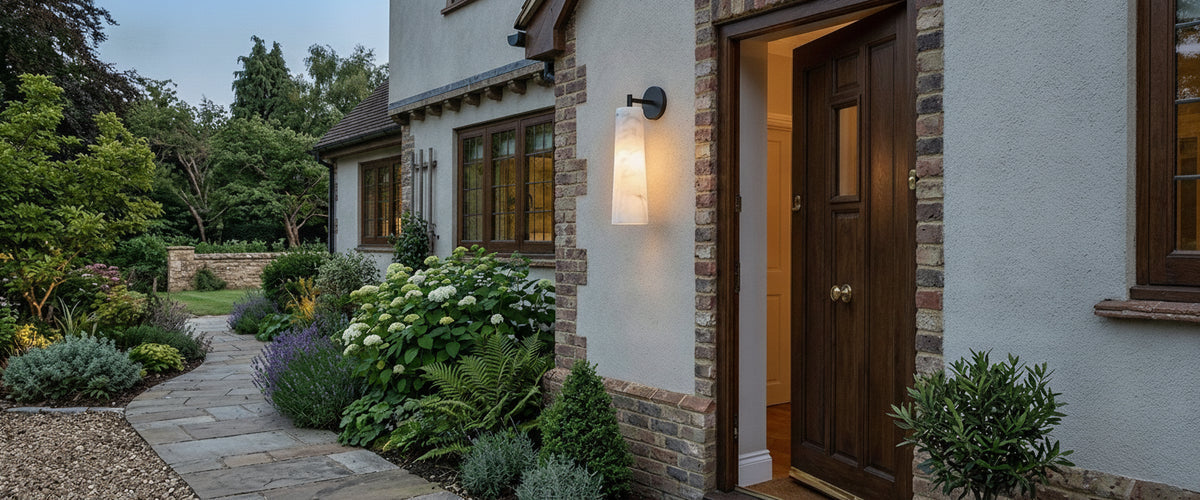

Brass that looks immaculate under showroom spotlights can look dull and blotchy by its second winter on a north-facing wall. That is the risk nobody mentions when you specify a polished brass exterior light: the finish is doing two jobs at once, reflecting daylight all day and carrying your light source all night. Get the pairing right and polished brass reads as warm, deliberate and expensive against stone or brick. Get it wrong and it reads as a plumbing fitting bolted to a facade.
At Niori we build our reputation on alabaster and natural-stone lighting, so brass is usually the metal we pair with stone rather than the star of the show. That perspective is useful here. A polished brass exterior fitting has to survive weather, and it has to agree with whatever the wall is made of.

At a Glance: Polished Brass Exterior Basics
Finish behavior: a polished brass exterior is a mirror outdoors. It picks up sky, foliage and pavement color, so it changes character through the day.
Best cladding partners: limestone, honed travertine, handmade brick, deep-toned painted render, oiled or silvered timber.
Mounting height: roughly 66 to 72 inches (1.7 to 1.8 m) to the center of the fitting for a front door; higher for gates and tall facades.
Weather protection: look for IP44 as a working minimum for sheltered walls, and more for exposed or coastal sites.
Bulb: 2700K is the default, but 2200K to 2400K often flatters brass and warm stone better after dark.
Long game: lacquer keeps the shine; unlacquered brass will patina, and on some houses that is the better outcome.

Why Polished Brass Behaves Differently on a Facade
Indoors, polished brass reflects a controlled set of surfaces: a painted ceiling, a rug, a piece of alabaster glowing three feet away. Outdoors it reflects the whole sky. On an overcast morning a polished brass exterior wall light can look cool and almost silvery. By late afternoon it turns amber and starts to look like the metal you chose. That swing is the first thing buyers underestimate.
Scale shifts too. A backplate that felt generous in a hallway can shrink against a two-story facade with wide stone coursing. As a rule, exterior fittings want to be a size up from what you would choose inside for the same visual weight. Sit a small polished brass exterior lantern next to a solid oak door and it reads as an afterthought.
Then there is glare. A polished surface next to a bare lamp throws hard specular highlights straight into the eye at approach height. This is where our work with stone helps: a frosted glass diffuser, an opal shade or a thin alabaster panel softens the beam so the brass glows rather than flashes. The best polished brass exterior lights pair a reflective body with a diffusing light-carrying element, not a naked bulb. Where an entrance needs a soft diffused glow rather than a hard point of light, a shaded form such as the Eliot Art Deco Wall Light in Polished Brass is closer to the right design language than an open-lamp lantern.
Stone, Brick, Render and Timber: What Polished Brass Actually Suits
A polished brass exterior has a yellow-gold bias, so it needs a wall color that does not fight it.
Stone
Limestone, sandstone and honed travertine are the natural allies. They share brass's warm undertone, and the contrast between matte stone and mirror metal is the whole point. Cool gray granite is harder work; the brass can look jarring unless you add something warm nearby, such as a timber door or terracotta planting pots. Marble and onyx around an entrance work beautifully too, because the veining sits in the same warm-neutral family as our alabaster pieces.
Brick
Handmade or reclaimed brick with visible color variation is a strong match. The brass picks up red tones and reads richer for it. Very orange modern brick is the exception: too much yellow-orange against a polished brass exterior and the whole entrance goes flat. A darker metal or an aged brass finish behaves better there.
Painted Render
Deep colors are where a polished brass exterior earns its keep. Off-black, bronze-green, charcoal, deep blue-gray: all of them make the metal snap. Brilliant white render is the trap. The brass loses its glow against a bright field and every water streak and fingerprint on the backplate becomes visible from the street.
Timber
Oiled cedar, oak and silvered larch give brass a cabin-meets-modern feel, and the gray in weathered timber stops the gold from tipping into pastiche. One point on timber cladding: it moves. Fixings need to be planned for that, and mounting into a batten or blocking rather than thin board saves you a wobbling fitting three years later.
How Mounting Height Changes the Way a Polished Finish Reads
Height does more than set light spread when the fitting is reflective. It decides what a polished brass exterior reflects back at you.
Mount a pair of polished brass wall lights at around 66 to 72 inches (1.7 to 1.8 m) to center beside a front door and you see the front face of the metal, lit from within, at eye level. That is the flattering view. Push the same fitting up to 90 inches (2.3 m) on a tall facade and you mostly see the underside and the shadow line, so shape matters more than shine. For garden walls and driveway piers, dropping to 60 inches (1.5 m) or below reads more intimate and keeps glare out of sightlines as people walk past.
At eye-level heights the shape of the shade matters as much as the height itself. A downward-shielded traditional form like the Carroll Traditional Wall Light in Polished Brass keeps the lit brass face visible while throwing the beam onto the threshold rather than into the eyes of whoever is walking up the path.
Two practical notes from projects we have shipped: single doors usually look better with one light on the lock side rather than a symmetrical pair, and any polished brass exterior mounted below about 40 inches (1 m) will get splashed by rain bouncing off hard paving, which means you will clean it more often.
IP Ratings and Lacquer Quality: What Separates Two Winters from Two Decades
Two fittings can look identical online and behave completely differently outdoors. With a polished brass exterior, the differences sit in three places.
Ingress protection. IP44 is a sensible working minimum for a sheltered porch or a wall under an overhang, because it covers splashing water from any direction. Fully exposed positions, coastal sites and anywhere hit by irrigation spray deserve a higher rating. Check the gasket and the lens seating, not just the number on the spec sheet. Fittings engineered to IP44 from the outset, such as the Dryden-3 Wall Light in Polished Brass, tend to have the sealing and glass detail designed in rather than added to an indoor body.
Metal thickness and construction. Solid brass castings and heavy-gauge pressed brass survive; thin brass-plated steel does not. Plating fails at edges and fixing points first, and once moisture reaches the steel beneath, you get rust bleeding through a gold finish.
Lacquer. A good baked or electrophoretic lacquer is what keeps a polished brass exterior light looking polished. A weak one clouds, then flakes in patches, and you end up with bright metal in some places and dulled metal in others. The Copper Development Association's guidance on architectural copper alloy finishes is worth a read if you want to understand why coatings, not the alloy itself, determine how long a bright finish lasts outdoors.
Any exterior fitting should be installed by a qualified electrician, with correct earthing, weatherproof connections and a cable route that does not trap water. This is not a DIY wiring job.
Bulb Color Temperature Outdoors: Why 2700K Is Not Always the Right Call
Indoors, 2700K is our standard recommendation because it flatters alabaster and skin tones. Outdoors the reference points change. Night skies, cool paving and dark planting all push perception colder, so 2700K can look surprisingly neutral against a warm brass and limestone entrance.
For a polished brass exterior on stone, brick or timber, we usually suggest trying 2200K to 2400K. That extra warmth reads as candlelight, keeps the gold tone alive and reduces the harshness of specular highlights. Save 3000K for modern facades in pale render or concrete where you want crispness rather than glow.
Three more things worth specifying: a CRI of 90 or above so the brass and stone colors hold up, dimmable drivers on a trailing-edge dimmer if the fitting allows, and identical lamps across a facade. Mixed batches of LED lamps at slightly different color temperatures are the single most common reason a beautifully specified entrance looks amateurish at night. Warmer light is also kinder to wildlife, since lower color temperatures and tighter beam control limit the spill that matters most on rural and garden boundaries.
When Unlacquered Patina Earns More Character Than Polish
Sometimes the right answer is to stop protecting the shine. Unlacquered brass tarnishes, then develops a mottled brown-gold patina that keeps shifting for years. On a weathered stone farmhouse or an exposed coastal property, that living finish looks considered in a way a factory-bright polished brass exterior never will.
Choose unlacquered if you want the polished brass exterior to age with the building, and if the client genuinely understands the finish will not stay even. Choose lacquered polished brass if you want consistency, if the entrance is the formal face of a house, or if the fitting sits near other bright metal that will stay bright.
Care is simple either way. For lacquered pieces, wash with a soft cloth, warm water and a drop of pH-neutral soap, then dry immediately and never use metal polish, which cuts straight through the coating. For unlacquered brass, a thin coat of microcrystalline wax slows the patina and makes rinsing easier; the Canadian Conservation Institute's notes on copper alloys are the clearest plain-language reference on what abrasives do to a brass surface. Coastal owners should plan on a freshwater rinse every few weeks; salt aerosol is far more aggressive than rain.
Buyer's Checklist for Polished Brass Exterior Fittings
Hold a brass sample against the actual wall, in daylight and after dark, before committing.
Confirm solid brass or heavy-gauge brass rather than brass-plated steel.
Ask what the lacquer is and how it is applied, not just whether there is one.
Match the IP rating to the real exposure, and step up for coastal and irrigated sites.
Check whether the fitting has a diffusing lens or shade; bare lamps plus mirror metal equals glare.
Size up. Exterior walls swallow small fixtures.
Set mounting heights on site with a cardboard mockup taped to the wall.
Buy all lamps in one batch, matched for color temperature and CRI.
Book a qualified electrician for installation and weatherproof terminations.
Agree a cleaning routine with the client so nobody reaches for abrasive polish.
Carrying Brass and Stone Across the Threshold
The most satisfying entrances we have worked on treat outside and inside as one sequence. Polished brass exterior wall lights flanking the door, then an alabaster pendant in the hallway picking up the same brass hardware, then a stone table lamp on a console further in. The metal provides continuity; the stone provides the glow. You can see how that pairing works across our alabaster lighting collection, where brass detailing is used to frame translucent stone rather than compete with it.
One recent project makes the point. A client on an exposed coastal elevation asked for a bright polished brass exterior throughout, and we steered them toward an unlacquered finish outdoors with polished brass kept for the interior fittings. Two years on, the outside has settled into a soft bronze-gold that suits the salt-bleached timber, while the hallway stone pendants still read crisp and new. Same metal family, two very different jobs. If you are weighing options across pendants, wall lights and floor lamps for a whole-house scheme, the wider lighting range is the quickest way to see how finishes sit together.
Budget depends on material, scale, construction and installation, so send us the elevations and we will quote properly rather than guess. What matters more than the figure is that the polished brass exterior fitting you choose is built to stay handsome through the weather it will meet over the next twenty years.