
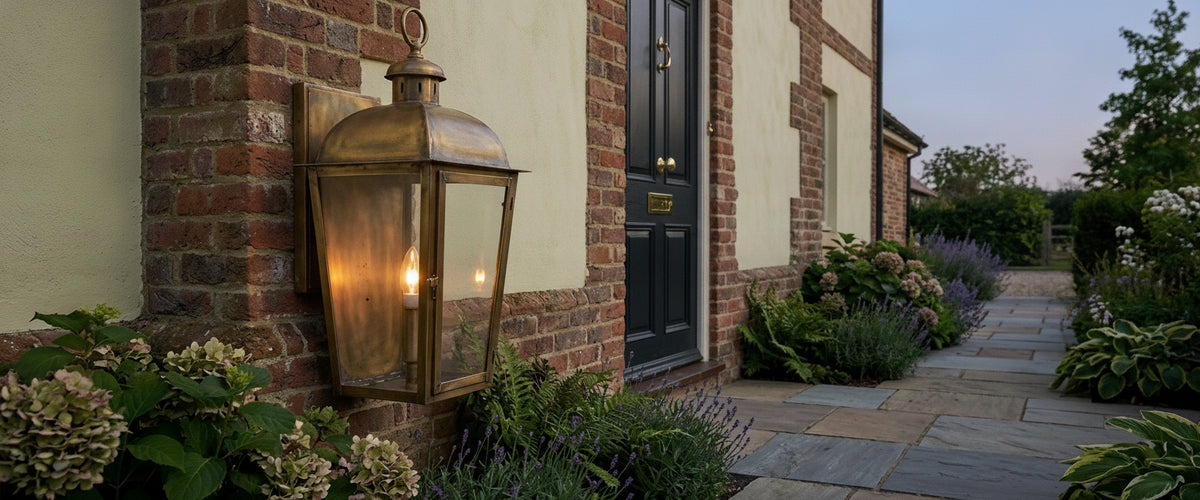

Brass looks effortless under showroom spots and considerably less forgiving on a north-facing porch in February. That gap is where most disappointment with an outdoor wall lantern brass purchase begins. The piece was chosen indoors, in daylight, next to a paint swatch, and nobody asked what two wet winters and a salt-laden wind would do to it. Get the specification right and a brass lantern becomes the most quietly confident detail on the front of a house. Get it wrong and you are looking at streaked lacquer on a backplate that reads like a postage stamp. After dark, the wrong lamp turns the metal faintly green.

At a Glance: What Actually Decides the Result
Finish behavior: outdoor wall lantern brass finishes come in two families. Lacquered brass holds its color then fails in patches. Unlacquered brass darkens gradually and keeps going. Choose the aging curve you can live with.
Scale: a lantern roughly a quarter to a third of the door height usually reads correctly from the street. Most people buy one size too small.
Mounting height: center the lantern around 6 ft 3 in to 6 ft 11 in (1.9 to 2.1 m) above the threshold so the glare sits above eye line.
Color temperature: 2200K to 2700K keeps brass warm and golden. Push past 3000K and the metal cools toward green.
Protection: confirm the IP rating against the exposure, and confirm fixings and cable entry before anyone drills.
Coherence: the brass outside should echo the metalwork and lighting inside instead of competing with it across the hallway.

Why Exterior Brass Behaves Nothing Like the Same Finish Indoors
Indoors, brass is essentially stable. Skin oils on a switch plate, a bit of dusting, and the finish you bought is broadly the finish you keep. Outside, an outdoor wall lantern brass fixture is a copper alloy sitting in a chemistry experiment. It faces rain, dissolved pollutants, salt aerosol, sap and pollen from whatever is planted near the door, and the thermal cycling of a facade that bakes at noon and drops below freezing at 3am. Copper alloys weather readily in exposed positions. That is why building conservation guidance treats external brass and bronze as maintained surfaces rather than fixed ones.
What that means practically: the phrase "aged brass" on an outdoor wall lantern brass product page tells you where the finish starts. Where it ends up is a separate question. A factory-applied antique finish gives you a warm, slightly dulled gold on day one. Where the piece goes determines what happens next. Sheltered under a deep porch in a Cotswold village, it may barely move for years. On a sea-facing gable in Cornwall, it will move fast. A pair of aged brass lanterns on a harbor-side house can reach a deep chocolate-bronze with faint verdigris in the seams inside a single winter, which is usually the point rather than the problem. The identical pair in a sheltered courtyard in Bath might look much as it did on the day it arrived. Same fixture, two climates, two different objects.
Lacquered or Living Finish: What Two British Winters Actually Do to Each
This is the single decision that most affects how you feel about an outdoor wall lantern brass choice in year three.
Lacquered brass
A clear coating holds the bright or antiqued color you chose. On an outdoor brass wall lantern, that coating usually performs well for the first winter. The trouble, when it comes, is localized breakdown. UV and water find the edges, seams and fixing points first, and moisture creeps under the film. You get a patch of dark metal surrounded by bright lacquered brass, which looks like damage rather than age. Restoring it means stripping and recoating in a workshop. A cloth and some polish will not fix it.
Unlacquered or living finish brass
Left bare, a brass outdoor wall lantern oxidizes across the whole surface at once. The color deepens from gold to honey to bronze, then toward a dark brown with green-blue notes in the recesses where water sits. It is uneven in an appealing way because the unevenness follows the architecture: rain runs, hand contact at the door, the drip line of a canopy. There is no repair bill because nothing has failed.
Our honest recommendation for outdoor wall lantern brass fittings on a UK exterior leans toward living finishes. That applies especially within two or three miles of the coast, where lacquer struggles. If you want the golden tone held for longer, keep the lantern under real shelter and accept an annual wipe with a soft cloth and a little light wax. If you want no maintenance conversation at all, buy unlacquered and let it do its thing. On a modest porch where the metal will be seen at close range, a restrained aged brass lantern such as the Hyde 1 Light Outdoor Wall Lantern starts warm and dull rather than mirror-bright. The first year of weathering then reads as continuity rather than change.
Scale, Backplate and Mounting Height: How the Lantern Reads from the Street
Almost every undersized outdoor brass wall lantern was chosen from a photograph on a phone. Held in the hand, a 16 in (about 40 cm) lantern feels substantial. Bolted beside a tall Victorian front door and viewed from the garden gate, it disappears.
Work from the door. For a standard 6 ft 6 in (roughly 2 m) entrance door, a lantern body somewhere between 18 and 26 in (about 45 to 65 cm) tall generally holds its ground. Grander openings, double doors, or a porch with a tall fanlight will take more. Some elevations are tall enough that a single-lamp fixture would look stranded. There, a deeper, more architectural form such as the Lambeth Palace 1 Light Outdoor Wall Lantern carries the height better than simply scaling up a small lantern. Then check the backplate, because on many outdoor wall lantern brass designs the plate is slimmer than the body suggests. A slim plate on a wide brick pier looks lost. A generous plate gives the fixture visual footing and hides any historic drill scars.
Mounting height for outdoor wall lantern brass fixtures is about glare as much as proportion. Center the lantern so the lamp sits above the sightline of someone standing at the door, usually 6 ft 3 in to 6 ft 11 in (1.9 to 2.1 m) above the threshold. Too low and guests squint into the glazing while they wait. Too high and the light pools on the lintel instead of the doormat. Where you have two lanterns flanking a door, keep the centers level to each other rather than level to the brick courses, which are rarely as straight as they look.
One more piece of geometry: the projection. A brass outdoor wall lantern that stands about 10 in (25 cm) off the wall beside a narrow path becomes a shoulder hazard. Measure the clear width of the route before committing.
Color Temperature After Dark and the Shift from Gold to Green
Brass is a warm metal, and it needs warm light to stay warm. Put a 4000K lamp behind an antique outdoor wall lantern brass finish and the reflected light cools the alloy visibly, pulling it toward a sallow green. It is the same effect that makes a gold picture frame look gray under a supermarket ceiling.
For an outdoor brass wall lantern, specify 2200K to 2700K. The lower end suits candle-style lamps in glazed lanterns beautifully and flatters brick and stone. 2700K is the safe general choice. Look for a high color rendering index, ideally CRI 90 or better. Low-CRI LEDs flatten the difference between the brass, the glass and the mortar behind it into one muddy tone.
Warm, well-shielded exterior light also happens to be the responsible choice. DarkSky International's lighting principles favor low color temperatures and downward-directed light to limit skyglow and disruption to wildlife. That is worth knowing if your outdoor wall lantern brass fitting sits near mature planting or a bat roost. Dimming helps too. A lantern at full output for security and 30 percent for evening ambience is a better arrangement than one flat setting, so confirm the lamp and driver are dimmable before installation rather than after.
Facades That Earn a Brass Lantern, and Ones That Fight It
Brass sits naturally on materials with warmth or age in them. Red and yellow stock brick, Bath and Portland stone, lime render, oak framing, painted timber in deep greens and blue-blacks: all of these pick up the metal and hold it. Georgian and Victorian frontages, farmhouse porches and coach-house entrances are natural homes for a glazed brass outdoor wall lantern with a proper hand-soldered look.
Where brass struggles is on cool, hard, monochrome facades. Gray composite cladding, blue-gray engineering brick, crisp white render with anthracite windows: brass can look like an accessory borrowed from another house. If that is your elevation and you still want outdoor wall lantern brass detailing, use it in small doses and pair it with black. A matte black lantern with brass accents, along the lines of the Buckley 1 Light Outdoor Wall Lantern, is often the smarter specification. The black tracks the window frames while the brass supplies the warmth. That combination gives a contemporary entrance some heat without tipping into pastiche.
Consistency across the plot matters as well. If you are buying outdoor wall lantern brass pieces for more than one entrance, the front door, side return, garage and garden wall should share a family language even if the fixture sizes vary. Browsing a full range in one place makes that easier. Start with our outdoor wall lanterns, then look at the wider lighting collection, which is organized so you can hold exterior choices against the interior pieces they will be seen alongside.
The Pre-Scaffolding Checklist for Outdoor Wall Lantern Brass Fittings
Confirm the IP rating against real exposure. IP44 is a reasonable minimum for a sheltered wall. More exposed positions, driving rain and coastal sites want IP54 or above. The IEC's IP rating guide explains what each digit covers. A deep porch and an open gable are very different exposures.
Check the fixings supplied against your substrate. Brick, stone, render over insulation and timber cladding all need different anchors. External-grade stainless fixings avoid rust bleeding down the wall.
Plan the cable entry. Rear entry through a drilled hole, sealed properly, looks better than a surface gland. Confirm the backplate has the cable route you need.
Size the canopy and drip detail. Water must shed away from the glazing and the fixing points. Any outdoor wall lantern brass seam that faces upward and stays open will collect water and eventually fail at the joint.
Specify the lamp before you order. Base type, wattage cap, color temperature, CRI and dimmability, all agreed in advance.
Book a qualified electrician. External circuits in the UK fall under Part P and BS 7671. Outdoor work involving RCD protection, correct cable type and earthing is not a DIY job. Have it tested and certified.
Agree a care rhythm. Twice a year, wipe the glazing, clear insects and cobwebs from the interior, check the fixings for movement and check the seals. That is honestly all most lanterns need.
Carrying the Warmth Through the Front Door
The best exterior lighting schemes we see are the ones where the threshold feels like a transition rather than a jolt. A warm brass outdoor wall lantern outside, then something with the same color temperature and a softer diffusion inside, and the eye reads the two as one idea. Alabaster is very good at that second job. It scatters light through the stone rather than bouncing it off a shade. A hallway pendant or a pair of wall lights in alabaster with brass fittings picks up the metal from the porch and turns it into a low, even glow with visible veining. Our alabaster lighting pieces are specified with that continuity in mind. Brass detailing is the thread that ties an exterior lantern to an interior chandelier or table lamp.
Niori works with alabaster, marble, onyx and natural stone alongside glass and brass, so we spend a lot of time on exactly this question. We look at how one warm metal behaves in daylight, under a lantern lamp at night, and against a translucent stone shade in a hallway. An outdoor wall lantern brass choice is the opening sentence of that scheme. Choose the finish you want to watch change and size it from the door rather than the photograph. Keep the light warm, and it will look better in year three than it did on the day the scaffolding came down.