

Most garden lighting fails quietly. It works in July, fades by October, and sits in a flowerbed through January as a small plastic reminder of a good intention. outdoor battery garden lights have a reputation for exactly that, and some of it is deserved. The better fittings now hold their own, though, if you buy them with the scepticism you would bring to any listing that promises "up to" anything.
At a glance
- Treat quoted runtimes as best-case figures measured on a fresh cell in mild weather. Expect noticeably less in a British winter.
- IP44 copes with rain on a covered terrace. For exposed beds, lawns and anything near standing water, look for IP65 or higher.
- Battery fittings excel in containers, trees, tables and rented gardens. Paths, steps and security lighting still belong on a wired circuit installed by a qualified electrician.
- Warm white (around 2700K) reads as intended. Cool white and multicolour read as seasonal.
- Budget for replacement cells. They are a running cost, not a one-off.

Why Outdoor Battery Garden Lights Became a Real Specification Option
Two changes did the work. LED efficiency improved to the point where a modest cell can drive a useful glow for an evening, and rechargeable chemistry became dense enough to fit inside a fitting that does not look like a torch. The result is a category that garden designers now specify on purpose rather than tolerate.
The appeal is obvious in British gardens, where running armoured cable to the far end of a lawn means digging, disruption and a qualified electrician. battery outdoor garden lights remove that barrier. You can light a pleached hornbeam, a stone urn or a table under an old apple tree in an afternoon, then move everything when the planting changes.

Lumens and Runtime: The Two Figures That Get Flattered
Lumen figures on outdoor battery garden lights are often quoted for the LED chip, not for the finished fitting. Once light passes through a frosted diffuser, a tinted lens or a woven shade, some of that output is lost. A fitting with a healthy lumen figure on the box can look far dimmer on the lawn.
Runtime is the bigger fiction. A listing that says "up to 20 hours" usually means the lowest brightness setting, a brand-new cell and a comfortable room temperature. Cold slows the chemistry inside the cell, so a December evening can cut usable runtime sharply. Ask three questions of any spec sheet:
- Is the runtime quoted at full brightness or the lowest mode?
- Is there a built-in timer, and what cycle does it run (six hours on, eighteen off is common)?
- Does the listing state the cell capacity and chemistry, or only the runtime?
If a manufacturer will not tell you the cell type, assume the runtime figure is doing more marketing than measuring.
What Survives a British Winter: IP Ratings and Enclosures
The IP code tells you how well a fitting resists solids and water. The first digit covers dust, the second covers water, and the International Electrotechnical Commission's IP ratings guide sets out what each level means. For garden use in the UK, IP44 handles splashing rain and suits a sheltered porch or covered loggia. IP65 resists low-pressure water jets from any direction and is the sensible floor for exposed borders. Anything sitting in a hollow where water pools deserves IP67.
The rating is only half the story. On outdoor battery garden lights, look at the battery compartment itself. A screw-down cap with a rubber gasket outlasts a push-fit clip, and a compartment that sits above the light source stays drier than one at the base. Polycarbonate and powder-coated aluminium handle frost well; thin, unstabilised plastics go brittle and cloudy after a couple of winters of UV and freeze-thaw.
One failure catches people out more than any other: battery boxes tucked inside a terracotta planter for the winter. The fitting's rating may be perfectly adequate, but the planter traps condensation, and by spring the contacts can be corroded. Keep battery boxes off soil, out of pots and somewhere air can move.
Where Battery Fittings Beat Wired Lighting, and Where They Don't
Outdoor battery garden lights win wherever flexibility matters more than hours of light. They suit:
- Containers and topiary. Battery topiary ball lights in warm white, draped through box balls or bay standards, give a soft point of light without cable across the lawn. For a pair of clipped balls either side of a covered doorway or under a loggia, a warm white set such as the LYYT 120 LED Battery Topiary Ball Light in Warm White does the job well, though its IP44 rating means it belongs under shelter rather than out on an exposed border.
- Dining tables and terraces. A cordless lantern can be carried out for supper and brought in afterwards.
- Trees and far corners. The back of a long London garden or a copse at the edge of a country plot is exactly where cable runs get expensive.
- Rented homes and events. Nothing to leave behind, nothing to make good.
They lose wherever reliability is the point. Steps, paths, gates and anything a guest relies on to avoid a trip need light that comes on every night at full output. The same goes for security lighting and large façade washes. Those jobs belong on a properly protected outdoor circuit installed by a qualified electrician, never improvised with extension leads.
Charging Cycles, Cell Replacement and the Hidden Running Cost
Every rechargeable cell has a finite number of charge cycles before capacity drops. Used nightly, that limit arrives faster than most buyers expect, and the first sign is a fitting that dims an hour earlier than it used to. Outdoor battery garden lights with a replaceable, standard-size cell are worth favouring for exactly this reason. A sealed unit that dies with its battery turns a consumable into landfill.
Factor in the charging routine too. USB-rechargeable fittings need bringing inside, which is fine for a table lantern and tedious for twenty stakes along a border. Fittings that take standard AA or AAA cells let you rotate a charged set in minutes. Whatever you use, spent cells should go to a proper collection point; Recycle Now's battery guidance lists where to take them in the UK.
There is no single running-cost figure worth quoting, because it depends on the number of fittings, how often they run and the cell chemistry. The pattern is clear enough, though: a cheap fitting with a sealed battery can easily cost more over a few years than a better-made one you can service.
Placement Logic That Looks Deliberate
The fastest way to make battery outdoor garden lights look like an afterthought is to scatter them. One lantern here, a stake there, a string in a hedge: the eye reads clutter. Structure fixes it.
- Repeat, do not sprinkle. Three identical fittings in a line or a triangle read as a plan. Five different ones read as a drawer emptied onto the lawn.
- Keep light low. Garden light looks natural at knee height or below, glancing across foliage and stone. Light at eye level glares.
- Light objects, not space. A lit urn, a multi-stem birch or a clipped yew gives the eye somewhere to land. Lighting empty lawn just flattens it.
- Hide the box. Turn battery housings away from the main view and tuck them behind stems or stonework, never inside wet planters.
- Stay warm. Cool white and multicolour have their place at Christmas, and a festive set like the LYYT 120 LED Battery Topiary Ball Light in Multicolour is best treated as exactly that: something brought out for December and packed away in January. For year-round use, warm white sits comfortably against brick, stone and planting.
Think about the view from inside, too. On a winter evening most people see the garden through glass, so garden light should balance the room behind it. If the interior is much brighter than the garden, the windows become mirrors and the outdoor lighting disappears.
Where Stone Lighting Fits the Picture
We are an alabaster and natural-stone lighting brand, so here is the straight answer: alabaster does not belong outdoors. It is a soft, slightly water-soluble stone, and rain, frost and garden humidity will dull and pit it. Marble weathers more slowly but still stains and etches in wet conditions.
Where stone earns its place is on the garden-facing side of the house. A warm alabaster pendant above a table by the French doors, or a pair of stone wall lights in a garden room, gives the same amber, diffused glow that good garden light imitates, and ties the two spaces together through the glass. If you are planning both at once, our alabaster lighting collection is a useful place to judge how much warmth the interior should carry before you set the brightness outside.
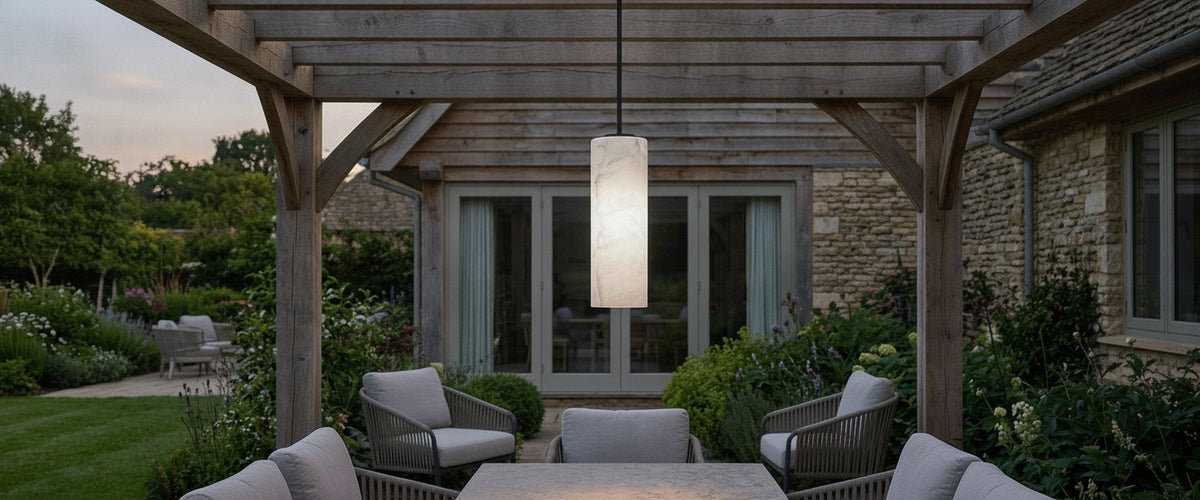
Picture a converted barn with glazed doors onto a terrace: two alabaster pendants over the dining table, a row of warm-white outdoor battery garden lights along the terrace wall beyond the glass. From the lawn, the whole scene reads as one composition rather than a lit house and a separately lit garden.
A Buyer's Checklist Before You Order
- IP65 or above for exposed positions; IP44 only under cover.
- Stated cell chemistry and capacity, not just "long-lasting".
- Replaceable standard-size cells, or a clear cell-replacement route.
- A built-in timer, so fittings do not drain before you are outside.
- Warm white colour temperature, around 2700K.
- Gasketed, screw-down battery compartments.
- UV-stable housing: aluminium, stainless steel or stabilised polycarbonate.
- A wired plan, installed by a qualified electrician, for paths, steps and security.
Buy outdoor battery garden lights for the jobs they do well, wire the jobs they do badly, and let the interior carry the warmth the garden borrows. That balance is what makes a British garden look lit in November, not just in June.