
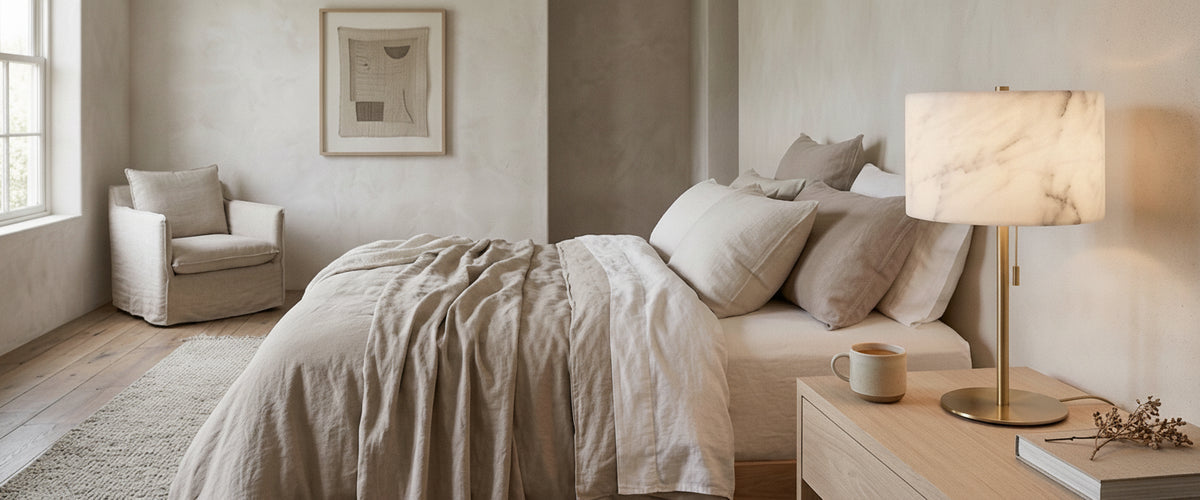

Put the same 2700K bulb into three lamps, one on an oak base, one on walnut and one on bamboo, and you will get three different bedrooms. wooden bedside table lamps don't glow through their bodies the way alabaster does. They catch the light that spills from the shade and throw it back, and every timber throws it back in its own colour. Pick the wrong pairing and a room that looked calm at noon turns brown and flat by ten at night.
At Niori we spend most of our working hours with alabaster and natural stone, materials that let light pass through them. Timber does the opposite: it absorbs, reflects and warms. That makes it a good partner at the bedside, and an easy one to get wrong.
At a Glance
- Pale timbers and bamboo (oak, ash, bamboo) bounce more light and keep a bedside bright and clean.
- Dark woods (walnut, ebonised timber) absorb light and need a slightly cooler, high-CRI bulb to avoid going muddy.
- Open grain shows texture under low, raking light; dense grain reads smooth and polished.
- Proportion matters more than species. A shade roughly as wide as the base is tall is the safest starting point.
- Care is mostly about heat, sunlight and water glasses, not polish.

Why the Same Lamplight Looks Different Through Oak, Walnut and Bamboo
Oak is a yellow-brown timber with a lot of reflectance. Under a warm bulb it picks up honey and gold tones and pushes them back into the room, so the pool of light around the bed feels wider than it is. It is the forgiving choice, and the reason oak has been a British bedroom staple for so long.
Walnut sits at the other end. Its chocolate and violet tones soak up light, so a walnut base reads as a dark silhouette with a sheen along its curves. That can look rich and tailored. It can also make a small bedroom feel dimmer than the wattage suggests, which is worth knowing if the lamp is your main reading light.
Bamboo is the odd one out because it isn't wood at all; it is a giant grass, cut into strips and laminated. The result is pale, linear and slightly glossy, with regular node marks that catch light in neat bands. It suits pared-back rooms and pairs well with linen shades, but it rarely carries a traditional scheme.

Dense Versus Open Grain: How Wood Structure Shapes the Glow
Species gives you colour. Grain gives you texture, and texture is what the eye reads on wooden bedside table lamps, where the light hits the base from above and slightly to the side.
Oak and ash are ring-porous, with visible open pores that run along the grain (the anatomy of hardwoods explains why some species look coarse and others silky). Under a lamp those pores become tiny shadows, so the base looks tactile and slightly rustic. Maple, beech and cherry are diffuse-porous and look far denser. Light slides over them evenly, which makes a turned or carved base look crisp and refined.
Finish changes the equation. A matt oil keeps open grain soft and visible. A high-gloss lacquer or a black ebonised finish with gold leaf turns the grain into a mirror and makes the silhouette the star. On a traditional urn shape such as the Narbonne Table Lamp, you feel the timber through the form and the weight of the base rather than reading it as grain, and the gilded detail catches the light. Neither approach is better; they simply belong in different rooms.
The Base-to-Shade Ratio That Makes Timber Look Handcrafted
There is a fine line between a lamp that looks handcrafted and one that looks home-made, and with wooden bedside table lamps it is almost always proportion. Timber is visually heavy. Undersize the shade and a wooden base looks clumpy; oversize it and the wood disappears into a stalk.
Start with these rules of thumb:
- Shade diameter roughly equal to the height of the base, measured from the tabletop to the bulb fitting.
- Shade height around two-thirds of the base height.
- The lower edge of the shade should hide the bulb when you are sitting up in bed, which for most beds puts it close to shoulder or chin level.
- Chunky or turned bases need a straight-sided drum or empire shade with real presence. Slim, tapered bases can take a tighter cone.
A common misstep: swapping the original drums on a pair of walnut-based lamps for smaller pleated shades to "lighten" them. The bases suddenly look twice their size. Put back a drum of the right width and the lamps look deliberate again.
Bulb Temperature and Wood Tone: Pairings That Sing and Pairings That Go Muddy
This is where most wooden bedside table lamps succeed or fail after dark. Warm light flatters wood, but past a certain point it simply turns everything the same shade of brown.
- Oak, ash and bamboo: 2700K is the sweet spot. Drop to 2200K amber and pale timber can look orange.
- Walnut and dark stains: go to 2700K or even 3000K. Very warm bulbs flatten the violet and grey undertones that make walnut interesting.
- Ebonised and black-lacquered wood: 2700K keeps gold leaf and brass details glowing without making black look brown.
- Any timber: choose a CRI of 90 or above. Low-CRI LEDs rob wood of its red tones, and grain can look grey.
For the bedside specifically, a dimmable LED with a dim-to-warm curve works well: bright and clean for reading, sinking toward candle tones as you turn it down. Check that the lamp's switch or inline dimmer is rated for LED, and if you are adding switched sockets or rewiring an older lamp, use a qualified electrician.
The muddy version is easy to build by accident: dark walnut bases, tobacco linen shades and 2200K filament bulbs. It can look beautiful in a styled photograph, but in a north-facing bedroom it reads like a sepia print. Switching to 2700K high-CRI bulbs brings the grain back in one evening.
When Wooden Bedside Table Lamps Anchor a Bedroom (and When They Fight It)
Wooden bedside table lamps anchor a room when they echo a second timber in the space: a headboard, floorboards, a chest of drawers. One echo is enough. They also work beautifully against stone and plaster, where the warmth of wood softens cooler surfaces. A pair of oak lamps under an alabaster wall light gives you two textures of warm light, one reflected and one diffused, and the combination feels layered rather than busy. Browsing our alabaster lighting alongside timber pieces is a useful way to test that contrast.
They fight a scheme when the wood tones almost match but don't quite. Honey oak lamps on a slightly orange pine bedside table look like a mistake. Either match closely or contrast hard: pale on dark, oiled on painted, wood with porcelain or glass. Mixed-material bedside table lamps, with a wooden base under recycled glass, blue-and-white porcelain or polished nickel, read as intentional because the materials clearly differ. Where a bedroom already has plenty of timber in its furniture and floors, a porcelain body on a turned wooden foot, like the Ying Table Lamp, keeps the wood as a supporting note rather than one more competing brown.
Size of room matters too. In a compact London or Manchester bedroom, dark wooden bedside table lamps on dark furniture can close the space in. Choose paler timber or a lamp that mixes wood with glass so some light passes through. A natural wood base carrying a recycled glass body, as on the Luga Table Lamp, keeps a small bedside feeling lighter than a solid dark base of the same height would.
How to Choose: A Buyer's Checklist
- Measure the bedside table and mattress height before anything else. The lamp should sit so the shade's lower edge hides the bulb from a seated position.
- Decide the job. Main reading light needs a paler base, a wider shade and a brighter bulb. Mood light can go darker and smaller.
- Pick one timber relationship: match an existing wood exactly, or contrast deliberately.
- Check the finish. Oiled bases need occasional attention; lacquered ones need almost none.
- Look at weight and footprint. A heavier base resists being knocked over in the dark.
- Confirm the switch. A switch on the base or cable within reach of the pillow saves a lot of fumbling.
- Buy in pairs from the same batch where possible, since bedside table lamp wood varies in colour and figure from one tree to the next.
If you are working on a wider scheme, our full lighting collection makes it easier to plan bedside lamps, wall lights and pendants together rather than one at a time.
Keeping a Timber Base Looking Considered for Years
Bedside lamps live a hard life: water glasses, hand cream, phone chargers, the odd elbow at 3am. What keeps wood bedside table lamps looking good is mostly prevention.
- Dust with a dry microfibre cloth. Skip spray polishes with silicone; they build a cloudy film and make re-oiling difficult later.
- Re-oil matt finishes once or twice a year with a hardwax oil suited to the original finish. Lacquered bases only need a barely damp cloth.
- Keep lamps away from radiators. Timber moves with heat and humidity, and a base parked beside a column radiator all winter can open fine checks.
- Watch direct sun. Strong sun through a south-facing window will lighten walnut and yellow pale oak faster than most people expect.
- Use a coaster for glasses and felt pads under the base to protect both lamp and table.
- Inspect the cable and plug now and then. Any fraying, scorching or loose fittings should go to a qualified electrician, not a DIY fix.
Look after the finish and the proportions you chose on day one will keep doing their job. That is the real case for well-made wooden bedside table lamps: they age into a room instead of dating it.