
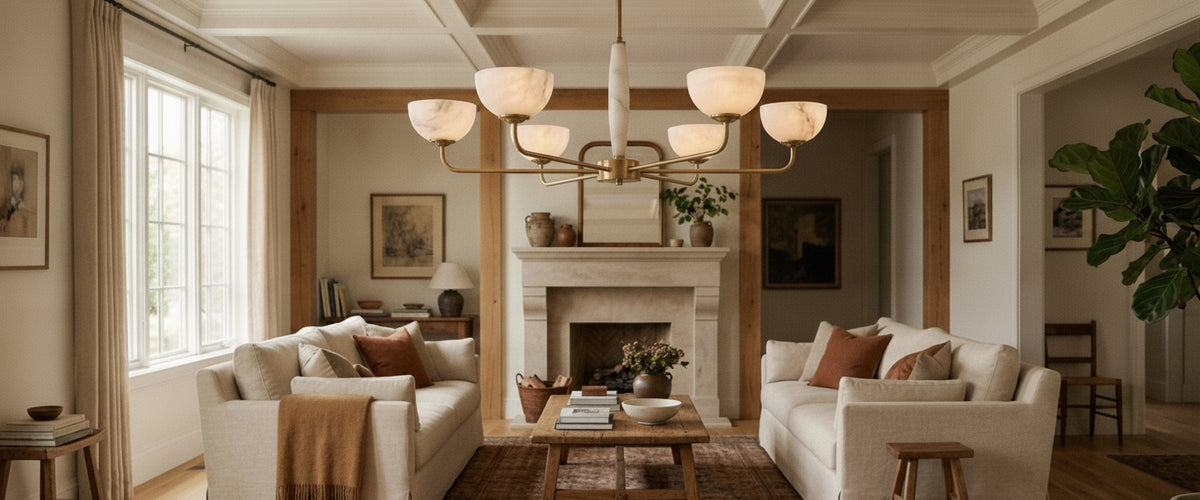

Most chandelier regrets are not failures of taste. They are failures of height, diameter and dimming, discovered three weeks after installation when the fixture is already wired in and the ceiling is already patched. A traditional living room chandelier has to do more work than the one over your dining table, and it has to do that work at three different times of day, from four different seating positions, in a room where nobody is sitting upright and attentive. That is a harder brief than it sounds.

At a Glance
Clearance: keep the lowest point of a traditional living room chandelier at least 7 ft (2.1 m) above any floor people walk across, and lower it only over furniture.
Diameter: add the room's length and width in feet and treat the total in inches as your minimum diameter (the metric version: add length and width in meters, multiply by roughly 8, and read the result in centimeters).
Finish: aged brass warms, bronzed iron recedes, polished chrome and nickel sharpen. All three behave differently once the sun goes down.
Light quality: 2400K to 2700K, CRI 90 or better, and a dimmer that reaches genuinely low output without flicker.
Position: center it on the seating group or the room's visual axis, not automatically on the existing ceiling box.

Why the Living Room Punishes a Traditional Chandelier
Dining rooms are forgiving. The table fixes the center point, everyone faces inward, and the fixture hangs over a surface nobody walks on. A traditional living room chandelier gets none of that structure. Sofas face each other or the fireplace, circulation runs around the edges, sightlines cross the room at seated eye level, and the space usually does three jobs: reading, conversation, and television at low light.
That is why a traditional living room chandelier so often ends up either marooned near the ceiling like a smoke alarm with ambitions, or dropped so low that it slices the room in half when you look across it. The fixture has to read as a considered object from a standing position and disappear from the conversation line when you sit down. Both, at once.
There is a second complication specific to period-style pieces. Traditional forms carry visual weight: multiple arms, candle tubes, shades, bowls, drops. A modern flush ceiling light can be ignored. A chandelier cannot, so anything slightly wrong about its placement stays slightly wrong every single evening.
Drop Height Over a Seating Group: The Sightline Problem
Start with the number nobody argues about. Anywhere a person walks, the lowest point of the fixture should clear 7 ft (2.1 m). In a room with an 8 ft (2.4 m) ceiling, that leaves you very little to play with, which is exactly why low-ceilinged rooms suit a shallow, wide traditional living room chandelier rather than a tall tiered one.
Over furniture, the rules change. If your traditional living room chandelier sits above a coffee table rather than a walkway, you can bring the base down to around 6 ft 3 in (1.9 m) and gain real intimacy. Before you commit, do the test we ask clients to do: sit on the sofa, look straight at whoever normally sits opposite, and have someone hold a broom handle at the proposed base height. If the fixture crosses that line of sight, raise it. Conversation should not happen through a set of candle arms.
For ceilings above 8 ft (2.4 m), give the fixture roughly 3 inches of extra chain or stem for every additional foot of height (about 7 cm per 30 cm). Double-height spaces need a different approach entirely: hang the piece so it relates to the upper-floor sightline as well as the ground floor, because in a galleried room people will see it edge-on from above, where the top cap and chain suddenly matter.
Scale From Below: Why Diameter Rules and Ceiling Height Is Only Half the Sum
Buyers consistently choose traditional living room chandeliers that are too small. Showrooms and photographs are partly to blame; a fixture photographed alone always looks larger than it will feel under a 10 ft (3 m) ceiling with a four-seat sofa underneath it.
Use the diameter formula as a floor, not a ceiling. A 16 ft by 20 ft room (4.9 m by 6.1 m) gives you around 36 in (90 cm) as a minimum diameter. If the room has heavy furniture, a large fireplace or a deep bay window, go wider. If the chandelier will sit above a coffee table, keep the diameter under the table width so the two objects read as a pair rather than a collision.
Ceiling height controls the fixture's vertical proportion, not its width. Allow roughly 2.5 to 3 inches of overall fixture height for every foot of ceiling height (6 to 8 cm per 30 cm). A 10 ft (3 m) ceiling comfortably takes a piece around 24 to 30 in (60 to 75 cm) tall. Trying to solve a wide room with a tall narrow fixture is the most common scale error we see with a traditional living room chandelier, and it is unfixable after installation. The clearest way to understand this is to compare two versions of one design: a modest seating group is well served by something like the Kula 5 Light Chandelier, while a room with a deep sofa and a generous fireplace usually needs the arm spread of the Kula 9 Light Chandelier before the fixture stops looking apologetic. Judge the full lighting range on shape and arm spread rather than light count, because spread is what your eye measures from the sofa.
Aged Brass, Bronzed Iron, Polished Chrome: What Each Finish Does After Dark
For a traditional living room chandelier, finish is a daylight decision with a nighttime consequence. Aged and antiqued brass absorbs light and returns it warm, which flatters plaster, oak and wool and suits rooms with a fireplace. Bronzed and blackened iron almost vanishes against a dark ceiling once the lamps are lit, leaving you with points of light and a suggestion of structure. It is the quietest option for a room with a lot going on at eye level.
Polished chrome and nickel behave in the opposite way. They pick up every light source in the room, including the television, and throw back small hard highlights. In a crisply detailed room with pale walls that reads as precision. In a heavily layered traditional interior it can read as restless. Where you want the cool clarity of nickel but not the glare, a shaded form such as the Lucerne 6 Light Chandelier in Brushed Nickel is closer to the right design language: the metal stays crisp while the fabric keeps the light soft at seated eye level.
Stone changes the equation again. Alabaster and marble components turn the fixture itself into the diffuser, so instead of bare filaments you get a glow that comes from the material's interior. Alabaster is a form of fine-grained gypsum, soft enough to be worked into thin translucent sections, and its natural veining reads as movement in the light rather than as pattern on a surface. That is the reason a traditional living room chandelier in alabaster feels older and calmer than the same silhouette in cut crystal. Niori's alabaster lighting pairs those stone elements with aged brass and bronze detail for exactly this reason: warm metal and warm stone agree with each other after dark.
One care note that matters for long-term ownership. Gypsum alabaster is water-sensitive and easily etched by acidic cleaners, so dusting with a dry soft brush and an occasional wipe with a barely damp cloth is the whole regime. Conservation bodies such as the Getty Conservation Institute publish guidance on how soft stones respond to moisture and cleaning agents, and the principle applies as much to the bowl of a traditional living room chandelier as to a sculpture.
Bulbs and Dimming Make a Traditional Living Room Chandelier Feel Authentic
Form gets you halfway. Light quality does the rest. A traditional living room chandelier lit at 4000K looks like a reproduction of itself; the same fixture at 2400K to 2700K looks like it has always been there. Specify a color rendering index of 90 or above so timber, textiles and skin tones hold their color, and check the beam behavior of candle lamps, which should glow rather than glare.
Dimming is where most schemes fall down. Not every LED lamp dims smoothly, and not every dimmer talks to every driver. Warm-dim lamps that shift toward 2200K as they lower are worth the extra cost in traditional living room chandeliers, because they mimic the way candle and filament light behaves as it fades. Test the exact lamp and dimmer combination before the wiring is made permanent, and leave the final connection to a qualified electrician; the Energy Saving Trust has plain guidance on LED performance and compatibility worth reading before you buy a boxful of lamps.
Never run a traditional living room chandelier at full output as the only light in the room. Layer it with wall lights at around 5 ft (1.5 m) and a table lamp or floor lamp near the seating, then hold the chandelier at 30 to 40 percent in the evening. It becomes the room's center of gravity instead of its interrogation lamp.
When Off-Center Placement Serves the Room Better
The existing ceiling box is a historical accident, not an instruction. We shipped a nine-light alabaster and brass traditional living room chandelier to a Georgian drawing room in Bath where the original plaster rose sat roughly 12 in (30 cm) off the room's true center. Hung dead on the rose, the chandelier looked skewed against the chimney breast. Moved to the center of the seating group, it looked inevitable.
Center the fixture on whichever element dominates the room: the seating arrangement, the fireplace axis, or the window wall. In long rectangular rooms, two smaller traditional living room chandeliers on the axis often work better than one oversized piece, particularly where the space splits into a conversation end and a reading end. In open-plan layouts, hanging the chandelier over the seating rather than the geometric center of the whole floor is what tells guests where the living room actually is.
Whatever you choose, mark it out first. Any living room chandelier traditional in form deserves this rehearsal: cut a paper disc at the intended diameter, tape it to the ceiling, and live with it for two days.
Buyer's Checklist Before You Commit
Measure ceiling height at the intended position, not at the doorway. Old ceilings sag.
Confirm the base clears 7 ft (2.1 m) over circulation and sits no lower than about 6 ft 3 in (1.9 m) over furniture.
Run the diameter formula, then go one size up if the room has heavy furniture or a large fireplace.
Check the ceiling fixing. Stone and multi-arm metal fixtures need a joist or a proper brace, confirmed by your electrician.
Ask about the weight of any traditional living room chandelier before you plan the fixing, and about chain or rod options for higher ceilings.
Choose the finish against your existing metals: door hardware, fire tools, curtain rods.
Specify lamp color temperature, CRI and a tested dimmer combination at the same time as the fixture.
Plan two more light layers before you order.
Budget realistically. Cost tracks material, scale, hand-finishing, engineering and installation, so ask for a tailored quote rather than assuming a flat figure.
Get the drop and the diameter right and almost everything else becomes a matter of taste. Get them wrong and no amount of beautiful metalwork rescues the room. If you are weighing a traditional living room chandelier in stone against one in crystal or glass, sit with the light quality question first; it is the part you notice every evening for the next twenty years. Niori works largely in alabaster and natural stone for that reason, and our team is happy to talk through drop, scale and finish for a specific room before anything is ordered.