
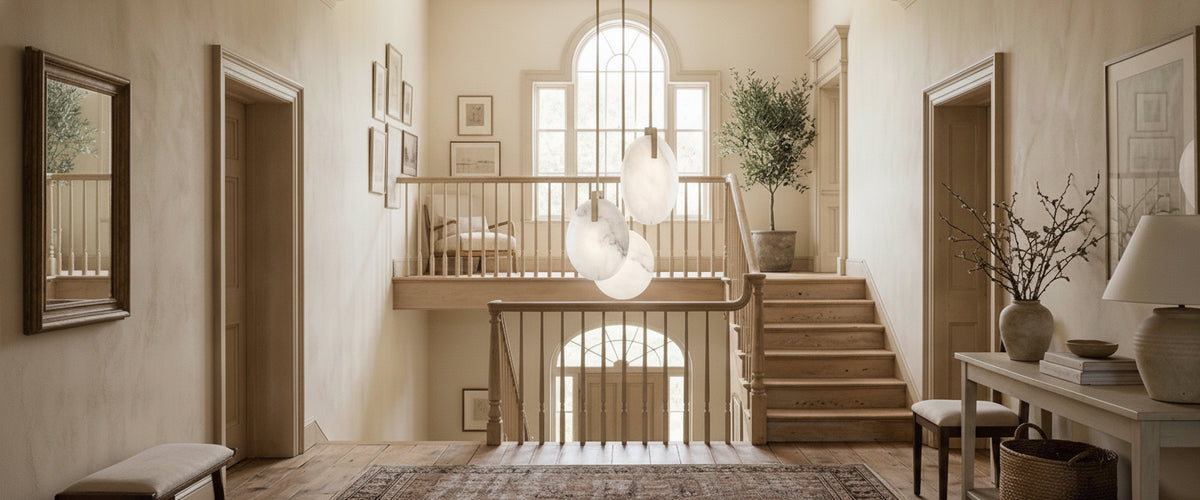

A single pendant is one decision. Cluster pendant lights are five or six decisions stacked on top of each other, and each one can quietly sabotage the others. Get the drop right but stagger them badly and you get a tangle. Space them beautifully but fit the wrong bulbs and you get a row of hot spots instead of one generous pool of light. The good news: the rules are few, they are numerical, and most of the pain happens before anyone drills a hole.

Key Takeaways
- Clusters are about overlap. The goal is one soft, continuous pool of light, not several separate spotlights.
- Three numbers control the result: ceiling height, canopy width, and drop length. Settle those before you fall in love with a shade.
- Material decides the edge quality. Alabaster and onyx glow through the body of the shade, so the cones of light blend rather than collide.
- Staggered drops read as intentional; random drops read as a mistake. Work to a rhythm, not a whim.
- One dimmer, one bulb type, one color temperature. Mixed bulbs in a cluster are painfully obvious.

What a Cluster Does That One Pendant Cannot
A single large pendant gives you a fixed disc of light and a fixed silhouette. It is decisive, and over a round table it is often the correct answer. What it cannot do is describe a volume. Cluster pendant lights occupy vertical space; the eye reads the gaps between shades, the varied heights, the way light falls at three different levels. That is why a cluster makes a double-height entry or a stairwell feel resolved when one pendant just looks stranded.
There is a practical gain too. Splitting the output across several smaller shades lowers the brightness of each one, which means less glare at eye level when you are seated. A 200-lumen glow inside a translucent stone shade is comfortable to look at directly. The same total output crammed into one bulb behind a narrow aperture is not. Over a dining table, where guests stare straight at the fixture for two hours, that difference is the whole ballgame.
The trade-off is complexity. More shades means more cords, more canopy hardware, more chances for a level to be off by half an inch. Clusters reward planning and punish improvisation.
The Three Numbers That Decide Everything
Ceiling Height
Below about 8 feet (2.4 m), a tight cluster of two or three small shades is usually the ceiling of ambition. Anything with real vertical spread will crowd the room and block sightlines across an open-plan kitchen. In that situation a two-shade fixture such as the Duo 2 Light LED Cluster Pendant gives you the grouped effect without the vertical bulk that low ceilings punish. At 9 to 10 feet (2.7 to 3 m) you can start staggering drops meaningfully. Above 12 feet (3.7 m), in a stairwell or a vaulted great room, a cascading cluster of nine, eleven or thirteen shades finally has the air it needs.
Canopy Width
The ceiling plate is the anchor and the constraint. A compact round canopy pulls the cords into a tight bouquet, which suits an entry or a corner reading nook. A long linear canopy spreads the same number of shades along an axis, which is what you want over a kitchen island or a rectangular table. Buyers routinely choose a fixture by the look of the shades and then discover the canopy shape fights the room geometry. Check the plate first.
Drop Length
Cluster pendant lights are specified from the bottom up. Over an island or counter, the lowest shade should sit roughly 30 to 36 inches (76 to 91 cm) above the work surface. Over a dining table, aim for around 30 to 34 inches (76 to 86 cm) to the bottom of the lowest shade so conversation runs underneath it. In a stairwell, the lowest point should clear head height on the upper landing with room to spare, and the group should be visible from both floors. Write these numbers down before you shortlist anything.
How Shade Material Changes the Overlap of Light
This is where a cluster is either quietly beautiful or a set of competing lamps. An opaque metal shade throws a hard-edged cone straight down. Line up three of them and you see three distinct circles on the counter with dim valleys between. Clear glass does the opposite, exposing the filament and putting three bright points of glare at eye level.
Alabaster behaves differently. Light does not simply pass through it; it travels a short distance inside the stone and scatters, so the shade itself becomes the light source. The result is a soft-edged pool with no hard boundary, and when three or five of those pools meet, they knit together instead of overlapping like Venn diagram circles. It is the main reason so many cluster pendant lights are specified in stone. Museum holdings of ancient alabaster objects show the same optical quality that made the stone prized for window panes long before electricity: it admits light while holding onto it.
Each slab is also different. Veining in alabaster and onyx runs in unrepeatable patterns, so a cluster of natural-stone shades reads as a family rather than a set of clones. Some clients want that variation pushed forward with heavily figured onyx. Others want a calmer white alabaster with a faint honey cast when lit. Both work; just decide which before you order, because you cannot un-see strong veining once it is hanging over your breakfast. The alabaster lighting collection is the easiest place to compare how different stones behave when lit versus unlit.
Islands, Tables and Stairwells: Where Cluster Pendant Lights Earn Their Place
Kitchen Islands
A kitchen cluster pendant lights scheme is the most requested version of this and the easiest to overdo. On a long island, resist filling the full length with one enormous group. Concentrate the cluster over the seating end and let discreet recessed or under-cabinet light do the prep work: atmosphere where people sit, task light where people chop. Three shades is usually the sweet spot at this scale, and a smoked-glass grouping such as the Opaz 3 Light Cluster Pendant keeps the filaments veiled so nobody seated at the counter looks straight into a bare lamp. We see plenty of plans that start with a run of five separate pendants spread along an island; pulling them into one group almost always frees up a sightline to the window the island was positioned for in the first place.
Dining Tables
Rectangular tables want a linear canopy; round tables want a radial one. In an open-plan room where a cluster pendant light kitchen scheme sits in full view of the dining table, keep the two fixtures in the same material family but do not match them exactly. Identical clusters twelve feet apart look like a showroom display.
Stairwells and Entries
This is where cluster pendant lights genuinely outperform everything else. A vertical cascade turns dead airspace into architecture and gives you something worth looking at from three different levels. This is also the one place where a high shade count earns its keep: something on the scale of the Ovila 13 Light Glass Cluster Pendant only makes sense where there is double-height volume to fill. Plan for maintenance access before you commit. If the only way to change a bulb involves scaffolding, choose a fixture with generous LED life and a serviceable design.
Where Clusters Strangle a Space
Low-ceilinged corridors. Small bedrooms where a cluster becomes a head-height obstacle on one side of the bed. Above coffee tables in rooms where people walk through. If a fixture would sit inside the path a person takes to cross a room, it belongs on the wall or on a table instead. The broader lighting range covers wall lights and floor lamps that solve those rooms far better than a forced cluster.
Why the Wrong Bulb Hurts a Cluster More Than a Single Shade
One bulb with a slightly green cast is a mild annoyance. Five bulbs from two different batches, hanging within a foot of each other, is a visible defect. Buy every lamp for your cluster pendant lights at once, from the same product line, in the same color temperature.
For alabaster and natural stone, stay between 2400K and 2700K. Cooler light fights the warm mineral tone and makes cream stone look gray. Aim for a high color rendering index, ideally 90 or above, so food, timber and textiles hold their color underneath. Clear or lightly frosted lamps inside a stone shade give the most even internal glow; heavily coated bulbs can leave a visible bright spot through thinner sections of the slab.
Dimming is where clusters get exposed. Every shade should be on the same circuit and the same dimmer, and the dimmer must be rated for the LED driver in the fixture. Mismatched trailing-edge and leading-edge hardware causes flicker that the eye catches as a shimmer across the whole group rather than in one lamp. Research from the Lighting Research Center has documented how flicker in dimmed LED systems contributes to eye strain and headaches, which matters most in the rooms where people linger. Always have a qualified electrician confirm the driver, dimmer and circuit combination before installation.
Spacing Errors Buyers Only Spot After Installation
These are the faults that stay invisible on a product page and become obvious the day your cluster pendant lights are finally level and lit.
- Drops that are close but not equal. Two shades 3 inches apart in height look like an accident. Either match them exactly or separate them by a clear 8 to 12 inches (20 to 30 cm).
- Shades that can touch. Stone shades swinging into each other chip. Leave enough horizontal clearance that a breeze or an opening door cannot bring them into contact.
- Centering on the room instead of the furniture. A cluster should center on the island or table, even if that is not the center of the ceiling.
- Ignoring cord color. Against a white ceiling, black cords draw hard lines. Against a dark ceiling they disappear. Brass or fabric-wrapped cords soften the geometry.
- Forgetting the view from the stairs. Clusters are seen from above more often than people expect. Check what the top of the fixture looks like.
A Pre-Order Checklist for Cluster Pendant Lights
- Measure the ceiling height and the surface below, then set your target drop to the lowest shade.
- Confirm the canopy shape matches the room axis: linear for islands and long tables, round for entries and square rooms.
- Decide on stone character first: calm white alabaster, or figured onyx with visible movement.
- Check ceiling structure and weight. Stone shades are heavier than glass; a qualified electrician should verify the fixing point and the junction box.
- Specify all bulbs together, matched in color temperature and CRI.
- Pair the dimmer to the driver, and test on site before final positioning.
- Plan bulb-change access for anything above 12 feet (3.7 m).
- Budget for the whole configuration rather than the headline shade. Stone selection, shade count, canopy hardware and installation all move the final figure, so price the specification you actually intend to hang.
Living With a Stone Cluster
Alabaster is a soft stone and it does not like water. Dust each shade with a dry microfiber cloth; skip household sprays, vinegar and anything abrasive, all of which will dull a polished surface permanently. In a kitchen, airborne cooking grease is the real enemy, so wipe shades more often than you think you need to and run the extractor. Sealed surfaces resist marking better, but nothing replaces regular dry dusting.
One small thing we have learned in the studio: photograph your cluster from the doorway once it is hung and level. Six months later, when a shade has drifted a fraction after a bulb change, that photo tells you exactly where it belonged. It sounds fussy. It has saved more than one client a service call. If you are still deciding where cluster pendant lights fit in your project, start from the Niori homepage and work backward from the room rather than forward from the fixture.