
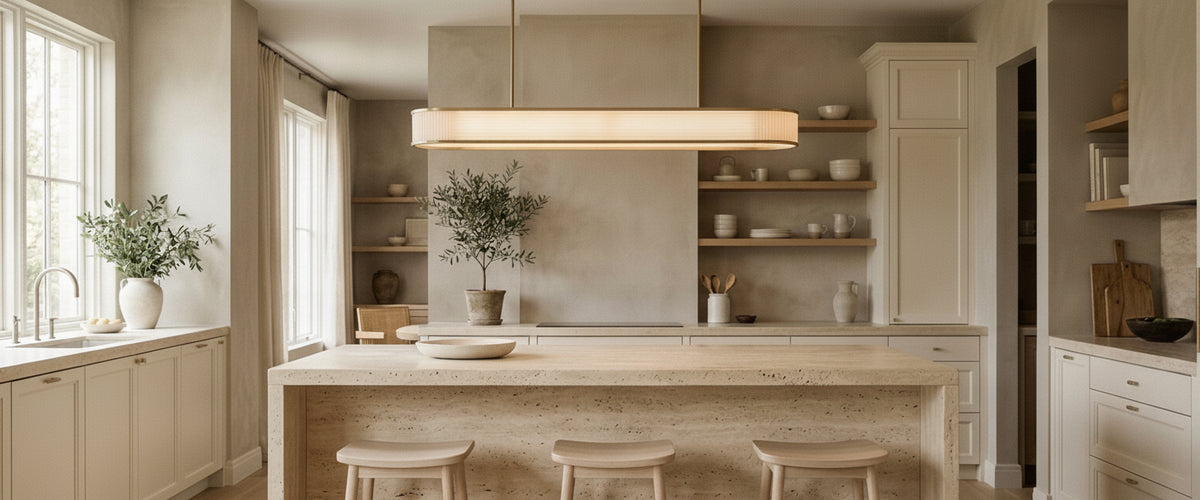

Most linear pendants are bought for how they look switched off and then judged for years on how they behave switched on. A glass linear pendant lights is especially prone to this. In the product photo, it is a clean horizontal line of glass and metal. Over a real kitchen island at nine in the evening, it is either a soft, even band of light or a row of bright hotspots with dark gaps between them. The difference comes down to a handful of decisions you can make before you order. Most of them concern the glass, the length and the hardware, not the style.
At a glance
- A true glass linear pendant light uses the glass as the diffuser. If the glass is only decorative, expect harsher light.
- Opal and ribbed glass spread light along the span. Clear and smoked glass concentrate it.
- Size the fitting to roughly two-thirds of the island or table length, leaving at least 15cm (6in) clear at each end.
- Hang the bottom of the fitting around 75 to 90cm (30 to 36in) above an island worktop. Go lower over a dining table.
- Check where your ceiling supply sits before you choose a canopy layout.

What Makes a True Glass Linear Pendant Light
Plenty of fittings sold as a glass linear pendant light are really metal bars with glass accents. A few small shades hang off a steel rail, or a strip of LEDs points straight down while a thin glass fin sits alongside for effect. Neither is wrong, but they light a room very differently from a fitting where every lumen passes through glass on its way out.
The quick test is to find a photograph of the fitting lit. If the glass glows, it is doing the work of a diffuser and you will get soft light with gentle falloff. If the glass stays dark while a bright line shines beneath it, the glass is decoration and the light will be direct and more glaring. That matters for anyone sitting at an island who looks up. It also matters in an open-plan room where the fitting is visible from the sofa.
A true linear glass pendant lights also tends to be heavier. Solid or hand-blown shades add real weight across a long bar, which affects the ceiling fixing and the suspension (more on that below).

How Each Glass Type Spreads Light Along the Span
Buyers usually think about light going down onto the worktop. With a glass linear pendant light, the more telling question is how the light travels sideways along the length. A long pendant that pools light under each shade and leaves gaps between them makes an island look striped.
- Opal or frosted glass scatters light in every direction, so neighbouring shades blend into one continuous glow. It behaves most like alabaster, and it is the safest choice if the fitting sits in your eyeline.
- Ribbed or fluted glass breaks up the image of the lamp and throws light laterally along the ribs. On a multi-shade bar, it closes the gaps between pools better than almost anything else.
- Clear glass gives sparkle and crisp shadows but hides nothing. The lamp becomes the feature, so choose filament-style LEDs you are happy to look at, and expect more contrast between lit and unlit zones.
- Smoked or amber glass tints and absorbs light. It looks rich but cuts useful output noticeably.
That last point catches people out. A smoked-glass bar can look irresistible in photographs, then prove too dim for chopping and prep once it is installed. If you want tinted glass over a working surface, plan a separate task layer such as recessed downlights or under-cabinet strips, or treat the pendant as mood light only. A fitting built around smoked grey and brandy glass, such as the Ovila 13 Light Glass Cluster Pendant, sits firmly in that mood-light category: it earns its place through colour and depth, not prep-level brightness. Glare from exposed lamps is a common comfort complaint in domestic lighting, and the Society of Light and Lighting is a useful starting point if you want to understand why diffusion matters so much at eye level.
For lamps, a warm white around 2700K suits most kitchens and dining spaces, and warmer still reads well through amber glass. Use dimmable LED lamps or a dimmable integrated fitting, and check that the dimmer is compatible with the LED driver. Mismatched dimmers are the usual cause of flicker and buzzing.
Size the Length to the Surface Below
The most common sizing mistake with a glass linear pendant light is choosing a length that suits the room rather than the island or table under it. A long open-plan space can make a 1.2m (4ft) fitting look modest, so buyers size up. Then the pendant overhangs the ends of the island, lights the floor and looks unanchored.
A reliable rule is to aim for about two-thirds of the surface length, with at least 15cm (6in) clear at each end. Around 30cm (12in) is better on dining tables, where chairs pull out at the ends. On a 2.4m (8ft) island, that points to a fitting of roughly 1.5 to 1.8m (5 to 6ft). Depth matters as well. A slim bar over a deep island can look spindly, while a chunky glass tube over a narrow table can crowd it.
Mounting Height: Island versus Kitchen-Diner Run
Over an island, people stand, so a glass linear pendant light can sit relatively high. With the bottom of the glass 75 to 90cm (30 to 36in) above the worktop, the light reaches the surface without blocking the view across the kitchen. On a standard 90cm worktop, that puts the underside of the fitting at roughly 1.65 to 1.8m from the floor. That is fine because nobody walks under an island.
A kitchen-diner run changes the maths. Over a dining table, people are seated and their eye level drops, so the fitting usually comes down to around 70 to 80cm (28 to 32in) above the tabletop. This keeps the glass out of direct view and makes the table feel enclosed and intimate. If one continuous run of fittings spans both the island and the table, you cannot hang them all at one height and get both zones right. Either choose separate fittings on independent drops, or pick a fitting with adjustable cable suspension so each can be set individually.
Also watch for circulation routes. If any part of the fitting overhangs a walkway, it needs full head clearance, and in a UK home with 2.4m ceilings, that leaves little room for a long drop.
The Canopy and Hardware Nobody Checks Until It Is Live
Most long fittings hang from two suspension points, but the electrical supply usually comes from one. Some designs use a single long canopy that hides both. Others use two small round canopies, one live and one purely structural. The problem arises when the ceiling supply is not centred over the island. Picture a 3m island in an older house with the supply sitting about 40cm off-centre. The only neat solution is a fitting with a separate live canopy that can be positioned independently, with the cable running discreetly along the bar. It is far easier to solve this at the ordering stage than with a ceiling patch afterwards.
Finish is the other overlooked detail. From a dining chair, the canopy is often more visible than the bar itself, and a chrome canopy against a brass-detailed fitting or brass taps looks like an afterthought. Check that the canopy, suspension and end caps all come in the same finish. A heavy glass linear pendant light also needs fixing into a joist or a proper noggin, not just plasterboard. In England and Wales, domestic electrical work must comply with Part P of the Building Regulations, so use a qualified electrician; the government's Approved Document P sets out what counts as notifiable work.
One Linear Pendant or a Repeated Run?
A single glass linear pendant light is the stronger call when the surface is up to about 2.5m (8ft) long and you want one calm horizontal line. It reads as architecture rather than decoration. Where a kitchen already leans on chrome taps and handles, a five-shade bar such as the Priscila 5 Light Glass & Steel Bar Pendant keeps that single line and the hardware finish consistent, which matters more than it sounds once the canopy is in view from the table.
Beyond that, a single fitting gets unwieldy, heavy and hard to source at the right length. Two matching linear pendants hung end to end with a clear gap, or a run of individual pendants, often looks more deliberate on a 3m-plus island. A repeated run also suits islands with a hob or sink break, because each fitting can be centred on its own zone. For that zoned approach, a single textured-glass shade like the Priscila 1 Light Textured Glass Pendant, repeated at even spacing, gives you the diffusing benefit of patterned glass while letting each drop be set to its own height. If you are weighing single against multiple fittings, it helps to browse the full lighting range side by side and compare how the proportions change.
Where Alabaster Fits into a Glass-Led Scheme
As an alabaster and natural-stone lighting brand, Niori tends to see a glass linear pendant light as one layer in a room, not the whole story. Opal glass over an island pairs naturally with an alabaster pendant over the dining table, because both give soft, diffused light, but the stone adds warmth and visible veining that glass cannot. Alabaster wall lights on either side of a kitchen-diner opening can bridge the two zones without introducing a third style. If you want the glow of opal glass with more character, the alabaster lighting collection is worth a look, particularly for the dining end of an open-plan room. Keep brass detailing consistent across glass and stone pieces, and the scheme will hang together.
A Buyer's Checklist Before You Order
- Confirm the glass glows when lit, rather than sitting beside a bare light source.
- Match the glass type to the task: opal or ribbed for working surfaces, smoked or clear for mood.
- Measure the surface and aim for about two-thirds of its length.
- Set drop heights by zone: standing at the island, seated at the table.
- Locate the ceiling supply and check whether the canopy layout can reach it.
- Check that the canopy, suspension and end caps share one finish.
- Ask for the fitting's weight and plan a joist fixing.
- Confirm lamp type, colour temperature and dimmer compatibility.
- Book a qualified electrician for installation.
Budget for a glass linear pendant light depends on the shade itself (hand-blown versus pressed), length, engineering, hardware finish and installation complexity. For a bespoke length or a project with several matched fittings, request a tailored quote before committing to a layout.