
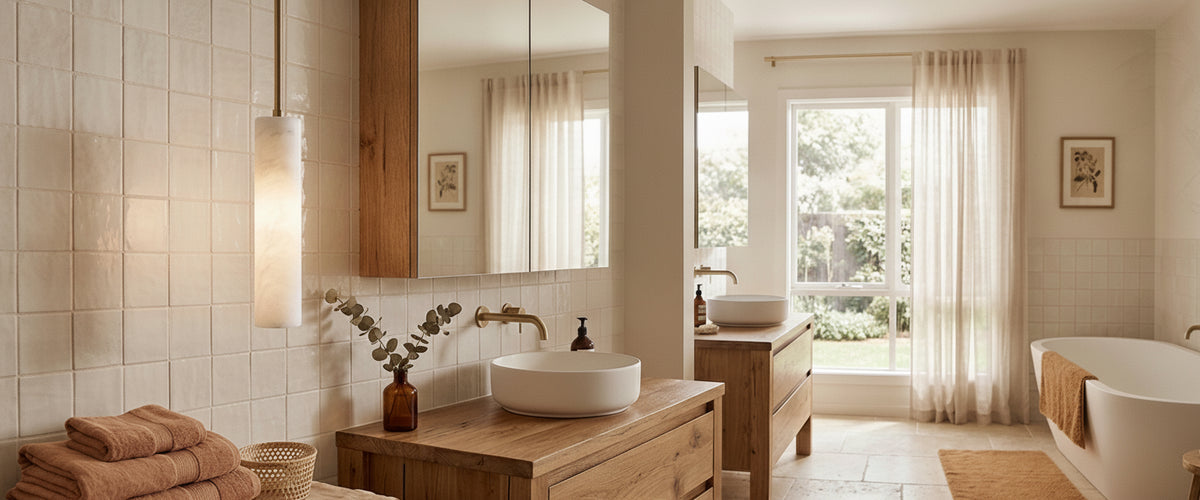

Most people buy a mirrored cabinet for the storage and judge it, six months later, on the light. A bathroom mirror storage lighting has to do two jobs at once: hide toothpaste, razors and prescriptions, and light your face well enough to shave, apply makeup or check a mole without shadows. Get the numbers and the height wrong, and you end up with a well-organised box that makes you look tired every morning.
At a glance
- Check three numbers first: IP rating, cabinet depth and shelf load.
- Mount the cabinet so the centre of the mirror sits near the main user's eye-line, not wherever the old tiles stop.
- Use warmer light (around 2700K to 3000K) for the room and save cooler task light for the mirror face, if you need it.
- Only take integrated demisters and shaver sockets if you are prepared to service them.
- Match finishes and light colour with your wall lights so the cabinet looks planned, not added.

Why an Illuminated Mirror Cabinet Is Not a Vanity Light
A vanity light is a single object with one job. You choose its brightness, its colour and its position, and you can change it later without touching anything else. An illuminated cabinet fixes all three decisions into a box that also holds your belongings, sits flush or proud of the wall, and often carries its own power supply, switch and heating pad. Replace the light and you usually replace the cabinet.
That changes how you should shop. With a bathroom mirror storage light, the storage dimensions and the light position are fixed relative to each other, so you are really choosing where the light will fall on your face for the next ten years. Treat it like a light fitting first and a cabinet second. The shelves can be reorganised; the LED strip cannot be moved.

The Three Numbers That Govern the Choice
IP Rating
Bathrooms are divided into zones based on distance from the bath and shower, and each zone calls for a minimum level of protection against water. A bathroom mirror storage light usually sits above a basin, typically in Zone 2 or outside the zones altogether, where IP44 is the sensible minimum. The second digit is the one that matters here: a 4 means protection against splashing from any direction. The zones and requirements come from the IET Wiring Regulations, and any hard-wired cabinet should be connected by a qualified electrician who can confirm the zone on site. This is not a weekend DIY job, whatever the fitting instructions imply.
Cabinet Depth
Surface-mounted cabinets project from the wall, and every centimetre of depth pushes the mirror face closer to you and further from any wall lights beside it. A deep cabinet flanked by slim sconces can throw a shadow line down each side of the mirror. Recessed cabinets avoid this but need a stud wall with enough void and no pipes or cables in the way. Measure the wall cavity before you fall for a recessed design, and with a surface-mounted cabinet, check that its depth still leaves room for your head when you lean over the basin to rinse.
Shelf Load
Glass shelves look light and hold less than you think. Check the manufacturer's stated load per shelf, then picture what actually lives there: full bottles of cleanser, a hair clipper, a heavy glass jar. The fixing matters as much as the cabinet. Plasterboard alone rarely holds a loaded cabinet safely, so plan for proper fixings or a timber pattress behind the board.
Mounting Height and Eye-Line for a Bathroom Mirror Storage Light
Here is where most cabinets go wrong. They get mounted to line up with a tile course, the top of a window, or the holes left by the previous cabinet. None of those has anything to do with your face.
A good rule is to set the centre of the mirror close to the average standing eye-line of the people who use it most, usually somewhere around 160 to 165 cm (roughly 5 feet 3 inches to 5 feet 5 inches) from the floor, then check that both the tallest and shortest regular users can see their whole face. It is a familiar story on guesthouse refits: a tall owner has the cabinets fitted to his own eye-line, and guests of average height see their hairline and not much else. The fix means new holes, patched tiles and repositioned wall lights, all because the height was set before anyone asked who would be standing there.
Leave enough clearance above the tap for the door to swing, and keep the lower edge high enough that you are not staring into the integrated light strip when you bend over the basin.
2700K Versus 4000K Inside a Bathroom Cabinet
Colour temperature is where warmth and accuracy pull in different directions. At 2700K, light has the honeyed quality you get from an incandescent bulb or from light passing through alabaster. It is flattering, calm and right for a late-evening bath. At 4000K, light is cooler and closer to daylight, which makes it easier to judge foundation shades or see a missed patch of stubble.
The mistake is using one colour for everything. If your bathroom mirror storage light runs at 4000K and the rest of the room glows at 2700K, the mirror reads as a cold blue rectangle on a warm wall. Better options, in order of preference:
- A cabinet with tunable white, so you can set it warm for evenings and cooler for task work.
- A cabinet at 3000K, which is a sound middle ground for most homes.
- A warm cabinet paired with a separate task light you only switch on when you need accuracy.
If you would rather keep the cabinet itself unlit and run a single band of light above it, a long linear fitting at the same middle-ground temperature, such as the Noctra White LED Bathroom Wall Light 24W 3000K, spreads light evenly across a wide mirror without introducing a second colour into the room.
Look for a high colour rendering index too. CRI 90 or above shows skin tones naturally, which matters more than raw brightness in front of a mirror.
Demister Pads and Shaver Sockets: When Extras Earn Their Place
A demister pad is a low-wattage heating element behind the glass that keeps a patch of mirror clear after a shower. In a small bathroom with poor extraction, it is useful. In a well-ventilated room, it is one more component to fail. Shaver sockets are similar: handy if you charge a toothbrush or razor daily, redundant if you already have a shaver supply unit elsewhere.
The problem is servicing. When a demister or driver fails inside a sealed cabinet, you may need to take the whole unit off the wall to reach it. Before you buy, ask three questions: can the driver be replaced without removing the cabinet, does the demister have its own switch or is it tied to the light, and is there an access panel? If the answers are vague, keep the extras separate. A shaver socket must be a purpose-made bathroom unit, fitted by a qualified electrician.
Matching the Cabinet to Your Wall Lights
A bathroom starts to look assembled in parts when the cabinet frame, the wall lights and the taps each come from a different finish family. Pick one lead metal (polished chrome, brushed brass or matte black) and repeat it across the cabinet trim, wall-light bases and brassware. In a scheme led by black brassware, a splash-rated sconce like the Bowtie 1 Light Wall Light in Matte Black IP44 carries that finish onto the wall beside a black-framed cabinet. Then match the light colour: if your cabinet runs at 3000K, choose wall lamps at 3000K.
This is also where natural stone earns its place. Alabaster wall lights either side of a mirrored cabinet soften the hard reflective box with a warm, diffused glow, and the natural veining breaks up all that glass and chrome. One caution: the alabaster used in lighting is typically a form of gypsum, which is soft and slightly soluble in water. Left unsealed in a steamy, poorly ventilated room, its surface can lose its sheen within weeks. Keep alabaster fittings outside the splash zones, choose versions with an appropriate IP rating for their position, and make sure the room has good extraction. Placed beside the basin rather than over the bath, they wear well. You can explore suitable styles in our alabaster lighting collection.
If you prefer a cleaner look, a slim glass or ribbed-glass sconce in chrome can sit beside a cabinet without competing; the fluted shade on the Carroll 1 Light Bathroom Wall Light in Polished Chrome with Ribbed Glass diffuses the lamp enough to avoid hard reflections in the mirror. Keep the wall lights at roughly the same height as the mirror's centre so they light your face from both sides, the most flattering arrangement there is. For more fixture types across the home, the wider lighting range is a good starting point.
Buyer's Checklist Before You Order
Run through these points before you order a bathroom mirror storage light.
- Zone confirmed: your electrician has identified the zone, and the cabinet's IP rating meets or exceeds it.
- Depth measured: surface depth checked against head clearance over the basin and wall-light positions; recessed voids checked for pipes and cables.
- Load rated: shelf loads suit what you actually store, and the wall fixing is specified.
- Height planned: mirror centre set for the main user's eye-line, with door clearance above the tap.
- Colour set: cabinet colour temperature matches or complements the room, with CRI 90 or above.
- Servicing clear: driver and demister access understood before purchase.
- Finishes aligned: one lead metal repeated across cabinet, wall lights and brassware.
Common Mistakes Worth Avoiding
Buying a bathroom mirror storage light before planning the wall lights is the big one; you lose the chance to centre everything on one line. Close behind are choosing the brightest light strip available (glare off a mirror is punishing at 7am) and forgetting the switch position, so the cabinet light ends up on the same switch as the extractor and the fan runs every time you brush your teeth. Talk to your electrician about separate switching early, while the walls are open.
Choose the bathroom mirror storage light that suits your face and your wall, then build the rest of the lighting around it. If you are planning a full bathroom or a hospitality project and want advice on pairing stone wall lights with a mirrored cabinet, Niori's team can help you plan the scheme and prepare a tailored quote.