
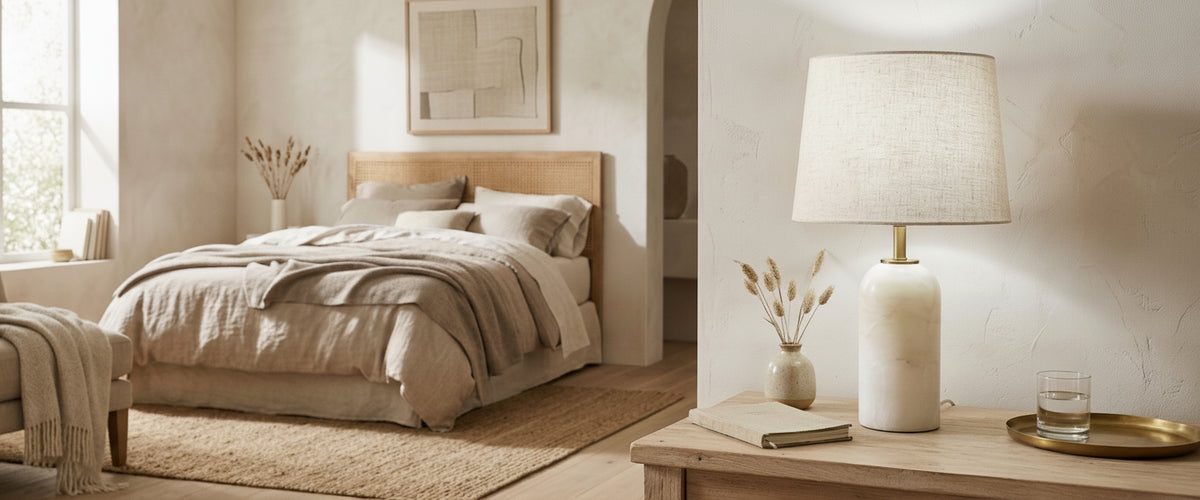

Most wooden table lamps bedroom shoppers bring home look good in daylight and let you down at night. Switch off the ceiling light and the base sinks into shadow while the shade takes over, so the grain you paid for disappears. This guide shows how to choose wooden table lamps bedroom by bedroom so they still pull their weight after dark. It comes down to four decisions: the finish on the timber, the shape of the base against your nightstand, the shade fabric, and a warm dimmable bulb (2700K for pale woods, up to 3000K for walnut) on a switch you can reach lying down.
So judge any lamp by how it behaves at night. The showroom tells you very little. Watch how the timber catches spill light and how the shade filters the bulb, then check you can reach the switch without sitting up.

At a Glance
Finish matters more than species at night. Oiled and waxed timber holds a soft sheen under lamplight. Heavy lacquer gives hard glare.
Turned and slender bases suit most nightstands. Chunky block and raw-edge forms need a wide surface and a calm room.
Match bulb to wood tone. 2700K flatters oak and pale ash. Dark walnut usually looks better nearer 3000K with a high color rendering bulb.
Check height and switch position before you buy. Among the wooden table lamps bedroom shoppers send back, these cause more returns than the finish does.
The wooden table lamps bedroom designers return to most often share one pairing: turned bases under linen shades, which keep the grain visible once the overhead light is off.

How Wood Species and Finish Change the Base at Night
By day, species is the headline: the open grain of oak, the tight chocolate figure of walnut, the near-white calm of ash or beech. At night the surface treatment does more of the work. In most wooden table lamps bedroom setups, the base is lit mostly by its own spill, a small pool of warm light that hits it at a low angle. That grazing light picks up texture and sheen far more than color.
Oiled or hard-wax finishes give a low, satin glow that reads as warm and hand-finished. High-gloss lacquer catches a single bright hotspot and can look plasticky from the pillow. Ebonized and painted timber works on another principle. On a black urn-shaped base with gilded detailing, such as the Narbonne Table Lamp, the dark body falls into shadow and the gold catches the light, so the lamp reads as a silhouette with a few glints. In a bedroom that can feel quietly theatrical.
Timber also changes over the years. Pale woods tend to deepen and yellow and dark woods can lighten with exposure to light, a process documented in the USDA Forest Products Laboratory's Wood Handbook. A lamp near a sunny window will drift faster than one in a shaded corner. If you are buying a pair of wooden bedside lamps, place them where they get similar light, or expect one to age ahead of the other.
Turned, Block and Raw-Edge Bases: Proportion at the Bedside
Nightstands are small, and a wooden bedroom table lamp shares its surface with a phone, a glass of water and whatever you are reading. Base form decides whether the lamp sits comfortably or crowds everything else.
Turned Bases
Lathe-turned columns, spindles and urns are the safest choice among the wooden table lamps bedroom designers specify. They take up little surface, hold their proportion beside a headboard, and the curves catch light in soft bands. A turned base about a third of the total lamp height, under a generous shade, almost always looks balanced.
Block Bases
Solid cubes and thick slabs have presence, and that is the risk. On a narrow nightstand a block base looks heavy, and its flat faces give none of the tonal gradation that makes wood appealing at night. Keep blocks for wide bedside chests or a low bench, and pair them with a slimmer shade so the whole lamp doesn't turn into one mass.
Raw-Edge and Live-Edge Bases
Bark edges and split timber bring texture, but they carry a strong rustic signal. In a paneled cabin bedroom or a pared-back loft they look intended. Next to an upholstered headboard and a silk throw they can look like a craft-fair purchase. Raw-edge bedroom wooden table lamps also tend to rock slightly on a glossy surface; check that the underside is flat or felted.
Shade Material and Opacity Against a Timber Base
For the wooden table lamps bedroom owners rely on after dark, the shade is in charge: it decides how much of the base you actually see once the room is dark.
Linen diffuses gently and sends light both up and down, so the base stays visible in a warm wash. It is the most forgiving partner for a timber base at the bedside.
Parchment and paper-lined shades glow amber and throw a stronger pool downward. They suit honey-toned oak and pine, where the extra warmth deepens the grain.
Solid or opaque shades (card, metal, dark silk) push all the light down and out. The top of the base disappears and the tabletop becomes a bright stage. That works for dark ebonized bases but hides most pale woods.
A lot of people set a warm timber lamp against cooler, more luminous materials elsewhere in the room. Alabaster does this particularly well. Its translucent stone spreads light through the full body of the fixture rather than from a single hotspot. An alabaster wall light or pendant above a bedroom wooden table lamp gives the room two kinds of warmth: one reflected from grain, one glowing from within the stone. If you are planning the whole scheme, it is worth looking at bedside and ambient pieces together across the niori lighting range.
Bulb Temperature Against Wood Tone: Why 2700K Flatters Oak and Fights Walnut
Put two wooden bedroom table lamps side by side in the studio, one oak and one walnut, under the same 2700K bulb and the difference is obvious. The oak turns honeyed and glowing. The walnut goes flat and muddy, its cool purple-brown pushed toward orange until the figure is hard to see.
The reason is simple. Very warm light is heavy in red and yellow and light on blue. Oak, ash and pine already carry yellow undertones, so warm light reinforces them. Walnut and other dark woods rely on subtle cool undertones for depth, and a 2700K bulb gives them very little to reflect.
Pale oak, ash, beech, pine: 2700K, dimmable.
Walnut, wenge, smoked oak: 2700K to 3000K with a color rendering index (CRI) of 90 or above, so the undertones survive.
Ebonized or painted bases with gilding: 2700K. Warm light brings out gold leaf.
Stay warm whatever the wood. Cooler, bluer light late in the evening can affect how easily you fall asleep, as the Sleep Foundation explains, so bulbs in any wooden table lamps bedroom scheme should never drift toward daylight white. Choose a dimmable LED and check it works with your dimmer, whether that is an inline cord dimmer or a touch fitting. If a lamp needs rewiring or a switch replacing, use a qualified electrician rather than taking the base apart yourself.
Height, Switch Reach and Cord Position
This is the spec almost nobody checks on the wooden table lamps bedroom buyers order online; most find out once the box is open. We once shipped a pair of tall turned lamps to a client whose nightstands sat an inch or two below mattress height. From bed, the bare bulb was in her eyeline and the switch was at the neck of the lamp, out of reach lying down. The lamps were beautiful. They went on inline dimmer cords within a week.
Shade height: sitting up in bed, the bottom of the shade should sit around chin to shoulder level. For most beds that means a lamp roughly 24 to 30 inches (61 to 76 cm) tall on a nightstand level with the mattress top.
Switch position: a base switch or inline cord switch is easier to reach from the pillow than a rotary switch under the shade.
Cord exit: a cord leaving the back of the base runs neatly behind the nightstand. One leaving from the side drapes across the surface.
Cord length and socket: measure from the nightstand to the nearest outlet, especially if sockets sit behind a headboard.
Base footprint: leave at least a hand's width of clear surface beside the lamp for everything else.
When a Wooden Bedside Lamp Looks Deliberate and When It Looks Like Filler
A bedroom wooden table lamp looks deliberate when the timber repeats something else in the room, such as the bed frame, a mirror surround or picture frames, or when it is a clear counterpoint, like a single dark urn in a pale plaster bedroom. It looks like filler when the wood matches nothing and contrasts with nothing: a mid-tone generic finish chosen because it seemed safe.
Sometimes the better answer is not another piece of timber at all. If the bed frame and nightstands already carry plenty of wood, a pale ceramic base under a brown shade, such as the Victor Large Table Lamp, picks up the warmth of the furniture through the shade while keeping the bedside from turning into a wall of grain.
A few quick tests help. Does the grain or finish show from the bed at night? Does the shade suit the base in weight and color? Would the lamp still be chosen if the nightstand were twice as wide? If the answers are yes, you have one of the wooden table lamps bedroom stylists would pick on purpose, a lamp with a point of view.
Wood also pairs well with stone. A timber lamp on one side and natural materials in the ceiling or wall lights, such as alabaster, marble or onyx, gives a bedroom depth without clutter. Niori works mainly in alabaster and natural stone, and the alabaster lighting collection is a good place to find pieces that sit alongside wooden table lamps in the bedroom.
Wooden Table Lamps: Bedroom Buying Checklist
Pick a finish for how it looks at night: oiled or waxed for warmth, ebonized for silhouette.
Match base form to nightstand width: turned for most, block or raw-edge only with space to spare.
Choose linen for versatility, parchment for pale warm woods, opaque for dark bases.
Set bulb temperature by wood tone and buy dimmable, high-CRI LEDs.
Check lamp height against mattress height and sitting eye level.
Confirm the switch is reachable lying down and the cord exits where the socket is.
For matched pairs in wooden table lamps bedroom schemes, check both sides get similar daylight so the timber ages evenly.
Caring for Wooden Table Lamps in a Bedroom
Most wooden table lamps bedroom owners keep for years need very little care. Dust with a soft dry cloth; avoid silicone polish sprays, which leave a film that grabs dust and dulls oiled finishes. Refresh oiled bases with a thin coat of the matching oil once or twice a year. Keep wooden bedroom table lamps away from radiators, where dry heat can open small cracks along the grain. Always switch off and unplug before cleaning, and let LED bulbs cool before touching the shade.