
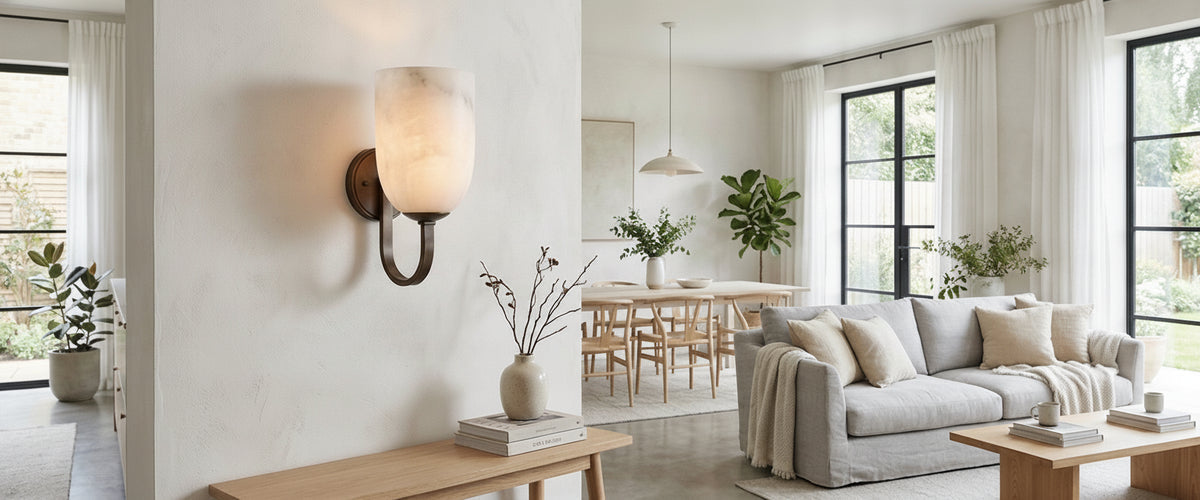

Bronze is the finish buyers misjudge more often than any other. On a product page it looks deep and quietly expensive; on the wall, under a warm lamp, it can slide towards brown, orange or something closer to old plastic. That gap between expectation and reality is why bronze indoor wall lights are worth thinking about properly before you commit. The metal is only half the story. The other half is what your walls, your bulbs and your dimmer do to it once the circuit is live.

Key Takeaways
- Bronze is a family of finishes, not a single colour. Vintage, old, dark and weathered bronze can sit several shades apart.
- Wall colour changes the read more than the fitting does: warm against chalky plaster, almost black against deep green.
- Match distribution to purpose first. Uplight for atmosphere and height, downlight for task and texture, diffused for corridors and bedrooms.
- Alabaster and honed marble diffusers flatter bronze indoor wall lights because both materials carry warmth. Cool white glass fights them.
- Check backplate size against the existing back box, plus lamp cap, maximum wattage and IP rating if the fitting goes near water.
- Always use a qualified electrician for wall light installation and alterations.

Bronze, Antique Brass or Dark Nickel: Telling Them Apart Under Artificial Light
In daylight these three finishes separate easily. Bronze is warm and dark with a coppery undertone. Antique brass is lighter, yellower and usually carries polished highlights on raised edges. Dark nickel is grey-brown and reflective in a colder way. Switch on a 2700K lamp at dusk and two of those distinctions collapse: warm light pushes antique brass towards bronze and pulls dark nickel towards charcoal, which is precisely why so many buyers order one sample and end up wishing they had the other.
So look at the finish twice, once in north-facing daylight and once under the lamp you actually intend to use. A client fitting out a hotel snug sent us two paint drawdowns alongside a bronze sample; under the room's 2200K filament lamps the finish flattened out and read as plain orange-brown against the wall colour. A 2700K lamp brought the depth straight back. Nothing about the fitting changed; the light source did all the work.
Texture matters as much as tone. A hand-patinated surface with visible tonal variation stays interesting under a single source because it creates its own shadow, while a flat sprayed coating goes dead once the room is lit. Where one lamp has to carry a whole wall, bronze indoor wall lights with worked-in variation, such as the Amarilli 2 Light Wall Light in bronze with gold patina, hold depth that a uniform finish rarely does. Metalworkers have patinated and waxed this alloy for centuries, and the V&A's metalwork collections show how varied those historic surfaces really are.
How the Finish Shifts on Pale Plaster, Deep Paint and Natural Stone
Put the same bronze indoor wall lights on three different walls and you effectively get three different products.
Pale plaster and off-white. This is where the finish performs best. Contrast is high enough to draw the eye to the silhouette, and the warm undertone picks up the pink or yellow in a limewashed surface. Arms, knuckles and backplate detailing all read clearly.
Deep paint. Against inky blue, forest green or dark clay red, bronze quietly disappears into the wall. That can be exactly the point: if you want the light rather than the fitting to be the feature, it is a disciplined combination. If you paid for sculptural detail, you have just hidden it. Decide which outcome you want before you order.
Natural stone. Marble, travertine and limestone tend to be the happiest pairing. The metal's warmth sits comfortably with the beige, cream and grey veining in most British stone specifications, and the difference in reflectivity keeps the two materials separate rather than muddled. On polished surfaces, watch for reflected glare from the lamp itself; a shielded or diffused fitting solves it.
Uplight, Downlight and Diffused: Matching Distribution to the Room's Purpose
Most bronze indoor wall lights fall into three distribution types, and this is the decision that changes how a room feels. It is regularly made last when it should be made first.
Uplighters throw light onto the ceiling and let it bounce back down. They raise perceived height, soften faces and create almost no glare, but they are unforgiving of poor plaster, because grazing light shows every ripple. A shallow-shelled Art Deco shape such as the Alderley 2 Light Art Deco Wall Uplighter in vintage bronze pushes light up cleanly without projecting far into the room, which suits a double-height stairwell or a drawing room.
Downlighters and half-shaded fittings push light onto the wall below and the floor. Use them where you want texture: a stone-clad chimney breast, a run of panelling, a corridor with a rug. They are better company for artwork than uplighters, because the light lands where the frames are.
Diffused fittings, where the source sits behind alabaster, opal glass or fabric, give low-intensity light in all directions. These are the workhorses for bedrooms, landings and long corridors. Alabaster scatters light through the stone rather than off it, which is why the glow stays soft at the edges and never shows a hard rim.
Why Placement Logic Changes Between a Hallway, a Living Room and a Bedroom
Hallways and Stairs
A run of bronze indoor wall lights down a corridor needs rhythm more than brightness. Spacing of roughly 2m to 2.5m (about 6ft 6in to 8ft) gives soft pools without the strip-lit effect. Mount at around 1.5m to 1.7m (roughly 5ft to 5ft 7in) from the finished floor so the source sits above eye level on the approach. On a staircase, keep a consistent height above each nosing rather than from the floor, otherwise the run visually stumbles.
Living Rooms
Here, bronze wall lights indoor should do the job a central pendant cannot: fill the corners and lift the walls so the room reads generous after dark. Flank a fireplace, bracket a pair of bookcases, or light a console where a table lamp would get in the way. For a symmetrical pair either side of a chimney breast, a twin-arm fitting such as the Cromwell 2 Light Wall Light in old bronze balances the mantel without crowding the wall. Keep them on a separate dimmed circuit from the ceiling light.
Bedrooms
Bedside fittings free up the nightstand and solve the problem of two lamps that never quite match the bed height. Mount so the bottom of the shade sits roughly 500mm to 600mm (20in to 24in) above the mattress top, and choose either an adjustable arm or a shade that shields the lamp from someone lying down.
Bathrooms and Dining Rooms
Bathrooms bring zone requirements into play, which we cover below. Dining rooms benefit from fittings mounted lower than you would use elsewhere, so light sits closer to the table plane and the ceiling stays dark and intimate.
Shade Pairings That Flatter Bronze Indoor Wall Lights
What works. Alabaster, honed marble and onyx diffusers are the natural partners, because the stone transmits a warm, slightly amber light that agrees with the metal's undertone. Antique or seeded glass does something similar with more sparkle. Parchment, linen and silk in ivory or oatmeal give a soft-edged glow and keep the fitting looking considered rather than showroom-fresh. Across our alabaster lighting collection, the pairing that consistently works hardest is a darker metal arm with a pale translucent stone shade, largely because the contrast keeps the stone looking like stone.
What undermines it. Bright white acrylic, cool-toned frosted glass and crisp white card all introduce a blue-grey cast that drains the copper and leaves the finish looking simply brown. Heavy crystal is another mismatch; the refraction wants a bright, reflective metal behind it. A very glossy black shade turns the whole fitting into a silhouette, at which point you may as well have specified something cheaper.
Backplate Sizing, Lamp Compatibility and Damp Ratings: The Checks Worth Making Before You Order
- Backplate versus back box. If you are replacing existing fittings, measure the current backplate. A smaller replacement can leave an unpainted ring or an exposed metal box on the wall, and on wallpaper that is an expensive discovery.
- Cable entry position. Check whether the fitting takes cable centrally or from one side. Existing cable in a stud wall is rarely easy to move.
- Lamp cap and maximum wattage. Confirm the cap type and the stated maximum. On enclosed or stone-shaded fittings, heat management matters more than on an open shade.
- Dimming compatibility. Match a trailing-edge dimmer to LED lamps and check the minimum load. Two low-wattage LEDs on a dimmer built for filament lamps is the usual cause of flicker and buzz.
- Colour temperature. Specify 2700K for living spaces, and 2200K to 2400K only where you want a deliberately candlelit effect. Keep every lamp on the circuit identical.
- IP rating for bathrooms. Zones dictate the minimum ingress protection required, and most decorative bronze indoor wall lights will not be rated for Zone 1 or 2. The Lighting Industry Association publishes plain-language guidance, and any installation should follow the current wiring regulations.
- Installation. Fixed wiring is involved. Use a qualified electrician; it is not a weekend job.
Living With Bronze: Patina, Cleaning and the Long View
This is one of the few finishes that improves with age, provided you leave it alone. A waxed or unlacquered surface develops small tonal shifts over years of handling, especially around switches and adjustable arms. Dry-dust with a soft cloth. Skip household sprays, cream cleaners and anything abrasive, all of which cut through wax and lacquer alike and leave dull patches no amount of polishing will restore.
If the fitting carries an alabaster or marble shade, treat the stone as porous and keep it dry. A soft brush lifts dust from the veining; water and detergent can mark the surface permanently. Switch off and let the fitting cool before handling any stone component, and support the shade rather than the arm when you remove it.
Chosen well, bronze indoor wall lights do something a ceiling fixture cannot: they put warm light at the height people actually occupy, and they give a room shape after dark. Get the finish, the wall colour and the diffuser talking to each other, and the fitting stops being a fixture and starts being part of the architecture. If you are still weighing formats, look across the full lighting range first, since a pair of wall lights often works hardest alongside a pendant or floor lamp rather than instead of one.