

Most rustic chandeliers fail at the ceiling, not on the product page. They photograph beautifully in a double-height barn conversion with a roughly 15ft (4.5m) ridge, then arrive into an 8ft (2.4m) dining room and turn into a low-hanging obstacle course of iron arms and candle sleeves. The material is rarely the problem. Scale is. Get the proportion right and a rustic chandelier becomes the one fixture in the house that people remember; get it wrong and it reads like a stage prop hung by mistake.
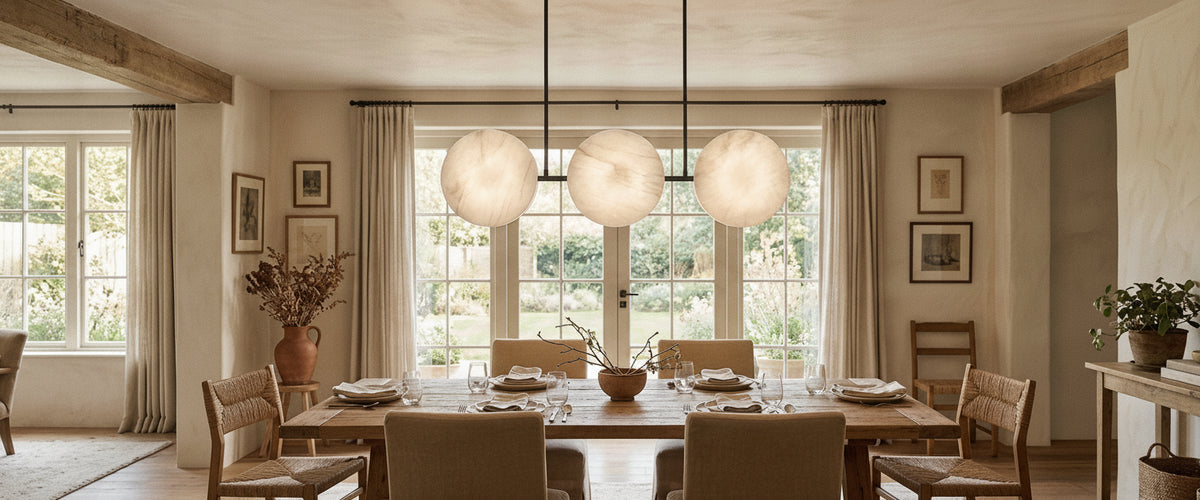
At Niori we build our range around alabaster and natural stone, which puts us slightly to one side of the usual conversation about rustic chandeliers. That is exactly why we get asked about it so often. Designers working on farmhouses, lodges and converted agricultural buildings want the warmth and honesty of rustic construction without the heaviness, and stone-shaded light does that job with more subtlety than a bare bulb ever will.

Rustic Chandeliers at a Glance
Construction tells: visible forge marks, hand-riveted or welded joins, timber with genuine grain movement and old fixing scars.
Scale rule: diameter roughly half to two-thirds the width of the table below, never wider than the table.
Drop over a dining table: typically 30 to 34in (75 to 85cm) from tabletop to the lowest point of the fitting.
Bulbs matter enormously: in open-frame designs the lamp is visible decoration, so choose lamps that are warm, dimmable and identical across every socket.
Alabaster changes the mood: stone shades soften glare and give rustic chandeliers a calmer, more contemporary edge.
Price follows material and scale: ask for a tailored quote rather than guessing from a photograph.

What Genuine Rustic Construction Actually Involves
Real rustic work shows its making. On a forged iron frame you should see slight variation between arms, the faint ripple where the bar was drawn out under a hammer, and joins that were resolved by hand rather than bolted together from identical stamped parts. Cast reproductions of rustic chandeliers have a giveaway: every arm is perfectly identical, and the surface has a sandy, uniform texture with no tool history in it.
Timber is the other half of the vocabulary. A rustic wood chandelier built from reclaimed oak, elm or pitch pine carries old nail holes, saw kerfs and sometimes a beetle flight hole or two. Those are features, not faults, but they need to be stabilized. Ask how the timber was dried and whether the electrical channels were routed before or after seasoning. Reclaimed beams that were kiln-dried and then machined behave far better indoors than green or air-dried stock, because interior heating drives moisture content down hard in winter. Historic England's technical advice on building services in historic buildings is a useful background read on how heating changes interior conditions (historicengland.org.uk).
The joins are where honest rustic chandeliers and decorative copies part company. Look for mortises, through-bolts, forged collars or straps that are clearly doing structural work. Glue-and-screw joints hidden under a thick opaque finish are a sign the piece was designed to look rustic from ten feet (3m) away and nothing more. Where a scheme wants that timber language in a covered terrace or garden room, a weather-rated frame such as the Sawyer 6 Light Outdoor Chandelier in dark brown handles damp swings far better than an interior piece pressed into outdoor service.
Ceiling Height and Beams Decide the Scale
Before you shortlist anything, measure twice: floor to ceiling, and floor to the underside of any beam the fitting will hang near. Exposed beams are the complicating factor with rustic chandeliers. A fitting centered between two purlins can read comfortably even at a generous diameter, because the timber frames it. The same fitting hung directly beneath a beam loses 8 to 12in (20 to 30cm) of usable drop and starts to feel compressed.
As a rough working method in rooms without beams, allow around 3in (7.5cm) of chandelier height for every 1ft (30cm) of ceiling height. A 10ft (3m) ceiling comfortably carries a fitting around 30in (75cm) tall. In a barn or lodge with a vaulted ceiling, which is where rustic chandeliers most often end up, measure to the point where the roof pitch begins rather than the apex, otherwise the fixture ends up marooned in the void with nothing to relate to.
One caution from the studio. We shipped a large alabaster and blackened-brass piece to a Suffolk barn conversion where the client had measured to the ridge, not to the tie beam. The fitting was correct, the drop was not, and it hung about 16in (40cm) too low until the electrician shortened the chain. Before ordering rustic chandeliers of any size, measure the height of the visual ceiling, meaning the surface the eye actually reads as the top of the room.
Farmhouse, Nordic and Industrial: Three Rustic Idioms
Rustic Farmhouse Chandelier
Warm and slightly ornamental. Candle cups, curved arms, cream or bone-colored sleeves, often a distressed painted finish over iron. A rustic farmhouse chandelier suits paneled rooms, flagstone floors and anything with a Shaker or country-kitchen accent. It is the friendliest of the three and the most forgiving of mismatched furniture.
Nordic Rustic
Paler, plainer, more architectural. Bleached or limed timber, matte white metalwork, simple geometry, very little ornament. This is where alabaster works hardest, because the stone's soft translucency sits naturally beside pale wood and lime plaster. A rustic modern chandelier in this idiom looks calm in daylight and generous after dark. If the room calls for pale metalwork rather than blackened iron, the Balance 5 Light Chandelier in white and polished nickel is closer to the right design language than anything with candle sleeves and distressing.
Industrial Rustic
Raw steel, cage frames, exposed cable, heavy hardware. It photographs powerfully but is the least forgiving in person. Industrial rustic chandeliers need volume and hard surfaces around them; drop one into a soft-furnished sitting room and it looks borrowed from somewhere else.
Those three categories look almost interchangeable in a lit product shot. In a real room the differences are immediate, which is why we always suggest a buyer decides on idiom before diameter.
Why Filament Bulbs Do Most of the Decorative Work
Open-frame and candle-cup rustic chandeliers leave the lamp on show, so the bulb is part of the design, not a consumable. Choose a warm color temperature, ideally 2200K to 2700K, and check that every socket carries the same lamp type. Mixing filament shapes across eight arms is one of the most common self-inflicted faults we see in customer photos.
Dimming is non-negotiable on a rustic dining chandelier. Full output across ten exposed filaments at dinner is uncomfortable; at 25 to 35 percent the same fitting becomes the warm focal point people actually want. Confirm the driver or lamps are compatible with your dimmer before installation, and specify a trailing-edge dimmer for most LED filament lamps. If the fitting has alabaster shades, dimming matters even more, because the stone's veining only reads properly at lower output. Push too much light through it and the pattern flattens.
The Proportion Rule for Rustic Dining Room Chandeliers
Here is the rule that saves more projects than any other. The chandelier's diameter should be roughly half to two-thirds the width of the table, and never wider. On a 39in (100cm) wide table, that puts you between 20 and 26in (50 to 65cm). Go wider and diners knock their heads reaching across; the table stops working and the fitting takes the blame.
Arm count on rustic chandeliers follows the same logic. A six-arm frame sits comfortably over a standard four to six seater, while the nine-light version of the same design, the Sawyer 9 Light Outdoor Chandelier, needs a covered terrace or a long table with enough volume around it to absorb the extra spread.
For long refectory tables, two smaller fittings beat one enormous one. Space them evenly, center each over a seating zone and keep the drop identical. Rustic dining room chandeliers in pairs also solve the light-distribution problem that single central fittings create on tables over 8ft (2.4m) long. For rooms where a single statement piece is the right answer, our alabaster lighting collection is a good place to compare how stone shades change the spread compared with open candle arms.
How Iron, Oiled Wood and Wax Age Under Central Heating
Finishes on rustic chandeliers behave very differently over a decade of British winters. Raw or waxed iron will develop a warmer, slightly mottled patina and can bloom faintly in humid rooms; a light wax reapplication every couple of years keeps it stable. Powder-coated black stays flat and predictable but never gains character. Oiled timber darkens, especially oak, and will want a wipe of the same oil roughly once a year if the room is dry.
Alabaster and marble need a different approach entirely. Stone shades are porous and should be dusted with a dry, soft brush rather than a damp cloth, and never cleaned with anything acidic or with a general household spray. Handle by the metalwork, not the stone. That simple habit prevents most of the finger-oil marks we get asked about.
Buyer's Checklist Before You Commit
Measure floor to visual ceiling, plus beam underside if relevant.
Set diameter from table width, not from the room.
Decide idiom: farmhouse, Nordic or industrial rustic.
Check total weight (iron and timber rustic chandeliers are often heavier than they look) and confirm the ceiling structure or joist can carry it.
Confirm dimming compatibility and order all lamps together.
Ask whether chain or rod length can be adjusted on site.
Check the finish schedule, including what the maker recommends for reapplication.
Book a qualified, registered electrician before delivery, not after.
On that last point, mains wiring and fixing heavy pendants to ceiling structure is work for a competent professional. You can find a registered electrician through the Registered Competent Person Electrical scheme. Heavier rustic chandeliers frequently need a suitable ceiling rose plate, a load-rated hook or direct fixing into a joist, and that assessment should happen before you buy.
Where to Buy and What to Expect on Price
Quality rustic chandeliers come from three broad sources: specialist forges working to commission, restoration dealers selling reclaimed and rewired originals, and design-led retailers who pair traditional construction with modern engineering. Cost tracks the material, the span, the complexity of the metalwork and the finishing, so a genuine quote beats any published range. Ask about lead time on bespoke work, because hand-forged pieces are rarely quick.
If your scheme is closer to rustic modern than full farmhouse, stone gives you a route that iron alone cannot. Alabaster diffuses light into a warm, low-glare wash that suits timber and lime plaster far better than a naked filament does, and it stops a large fitting from reading as heavy. Browse the wider lighting range to see how stone shades, brass detailing and simple frames sit alongside more traditional rustic chandeliers. It is often the combination, rather than either extreme, that holds a room together.