
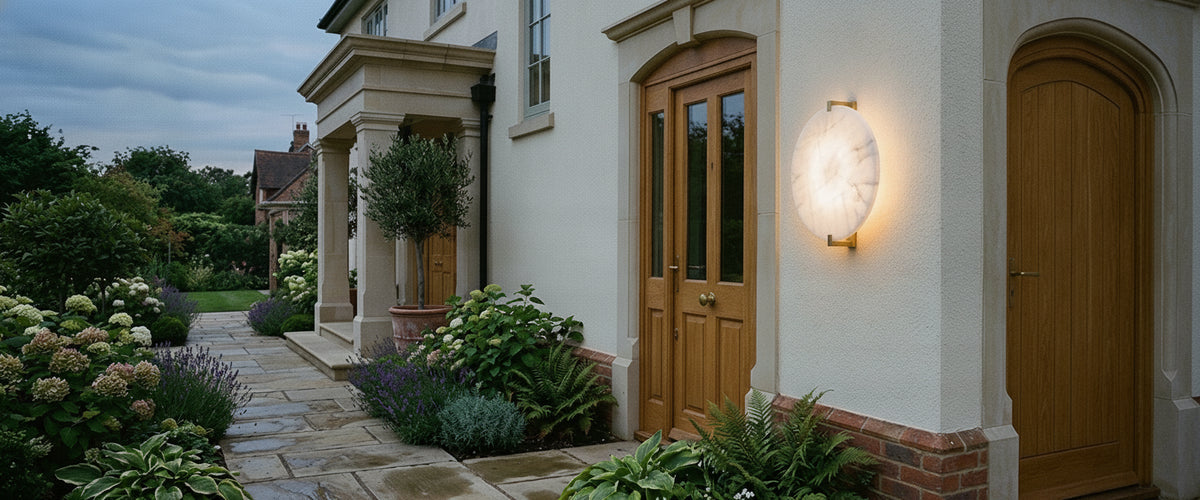

Walk any well-kept street after dark and you can tell which exteriors were lit from a catalog and which were lit from the building. The fittings are often identical. What separates them is height and the decision about where light should stop. This piece is about getting outdoor LED lights wall mounted in the right place: how high, how far apart, how warm, and in which finish. Outdoor LED wall lights at entrances, garden walls, courtyards and hospitality frontages have become the default exterior lighting choice, and they are genuinely good products, sealed against weather and cheap to run. They are also the easiest fitting to install badly, because nothing about the box tells you where it should go.
So before you compare wattages or IP ratings, read the wall. Every section below comes back to one question: on this particular facade, where do outdoor LED lights wall mounted at your entrance actually belong, and where should the dark begin?

At a Glance
Placement outranks specification. A modest outdoor LED wall light at the right height beats a high-output one aimed at the wrong plane.
Match mounting height to elevation, not to the door. Two-story facades need a different logic for outdoor LED lights wall mounted high than a garden wall does.
Stay at or below 3000K outside. Warmer light from outdoor LED lights wall mounted on masonry flatters brick, render, limestone and slate; cooler light makes masonry look damp.
Symmetry is not a lighting plan. Evenly spaced outdoor LED wall lights often create scalloped stripes and dark gaps between them.
Finish decides how the scheme ages. Coastal air and urban grime punish poor coatings within a couple of winters.
Get a qualified electrician involved early. Exterior circuits, IP ratings and cable routes for outdoor LED lights wall mounted on a facade are not DIY territory.

Why Position Kills More LED Wall Schemes Than Any Spec Decision
Most disappointing outdoor LED wall lights are technically correct. The IP rating is right, the output is sensible, the fitting is well made. The problem is that the outdoor LED lights wall mounted there were positioned by convenience: beside the door because there was already a cable there, or at 5ft (1.5m) because that is where the old lantern sat. Light does not care about convenience. It reveals whatever surface it lands on, including the pebbledash patch above the bay window and the downpipe nobody has looked at in a decade.
At Niori we spend most of our time with alabaster, marble and onyx, where the whole discipline is controlling how light travels through and across stone. Planning LED wall lights outdoor uses the same instinct in reverse. Indoors, alabaster softens light from within. Outdoors, the facade itself becomes the diffuser, and its texture does the work. Smooth render throws light back almost uniformly. Stock brick, knapped flint and rubble stone catch every ridge, which is why grazing light from outdoor LED lights wall mounted close to the surface looks dramatic on one house and merciless on the next.
Before anything gets drilled, and before you order a single outdoor LED wall light, stand where people actually arrive from. Sidewalk, driveway, garden gate, car door. That viewpoint tells you what the outdoor LED lights wall mounted at the entrance are for. Everything else follows.
Mounting Height Against Facade Scale: The Relationship Most Installers Ignore
There is a lazy default of roughly 6 to 7ft (1.8m to 2.1m) for outdoor LED lights wall mounted on any elevation, which is fine for a single-story flank wall and wrong for almost everything else. Height should be read against the building behind it.
The same outdoor LED lights wall mounted at door height and at first-floor level produce two completely different elevations.
Garden and boundary walls up to about 6ft (1.8m): mount low, well below the coping, so the light pool stays on the wall and the path rather than spilling into a neighbor's window.
Single-story entrances: just above head height works, positioned so the down-beam lands on the threshold rather than the visitor's face.
Two-story facades: lift the fitting. Outdoor LED lights wall mounted at door height on a 23ft (7m) elevation leave about 16ft (5m) of dark wall above them, and the building reads as a lit stripe floating in black.
Tall or gabled frontages: consider two tiers, or an up-down fitting with a wide upward throw so the lit portion covers roughly the lower third to half of the visible elevation.
That last case is where your choice of outdoor LED wall light and its mounting height stop being separate decisions. Where a gable or a tall render panel needs light traveling in both directions from a single point, something like the Mandal Outdoor LED Up Down Wall Light does the work of two fittings and keeps the elevation reading as one surface rather than two lit bands. Scale matters as much as direction: on a broad two-story frontage a larger-bodied fitting such as the Nocar LED Outdoor Large Wall Light holds the wall properly, where the medium version of the same design would simply be lost when seen from the sidewalk.
Distance off the wall matters as much as height for outdoor LED lights wall mounted on textured masonry. Mount an up-down outdoor LED wall light tight against uneven brick and you get a narrow, aggressive graze that exaggerates every mortar joint. Pull it forward slightly, or choose a fitting with a deeper back plate, and the beam opens into a softer wash. On a Bath stone frontage we advised on last year, moving the fittings up by about 16in (400mm) and swapping to a wider optic did more for the elevation than doubling the wattage ever would have.
How Color Temperature Shifts on Brick, Render and Stone After Dark
Color temperature is where good led outdoor wall lights quietly go wrong. Daylight flatters almost any masonry. Artificial light from outdoor LED lights wall mounted a few feet up does not, and every surface reacts differently.
Red and orange stock brick: 2700K keeps the clay warm. Push to 4000K and the brick turns brown and flat.
White or pale gray render: 2700K can read distinctly yellow across a large smooth plane. 3000K usually holds the color truer.
Limestone, Portland and Bath stone: 2700K to 3000K. Anything cooler drains the honey tone that makes the stone worth lighting.
Slate, granite and dark engineering brick: these absorb heavily. You need more output, not cooler light; cool white on dark stone looks like wet concrete.
Timber cladding: warm only. Cool outdoor LED lights wall mounted over cedar turn it gray overnight.
Keeping your outdoor LED lights wall mounted at the warm end is also the responsible choice. The Institution of Lighting Professionals recommends limiting blue content in exterior lighting to reduce sky glow and impact on wildlife, with warmer sources preferred in rural and sensitive settings, and their guidance note on the reduction of obtrusive light is worth reading before you finalize anything. Consistency helps too. If your interior is running warm alabaster pendants and wall lights, a row of 4000K outdoor LED wall lights visible through the same window will look clinical by comparison. Keeping the outside within a few hundred kelvin of the inside is one of the simplest ways to make a house feel coherent from the street, and it is worth auditing your interior fittings across the full lighting range before locking the exterior specification.
Glare, Pooling and the Blind Spots That Come from Symmetry
Symmetrical spacing is the most common instinct and the most common mistake. Five identical outdoor LED wall lights at equal centers along a long wall produce five identical scallops with five dark voids between them, and the eye reads the gaps rather than the light. Rhythm should follow the architecture: bays, piers, window reveals, a change of material. Light the structure and the spacing of your outdoor LED lights wall mounted along it looks deliberate.
Glare is the other failure. An outdoor LED wall light mounted at eye level on a narrow side return will be looked at directly every time someone walks past, which ruins night vision and makes the garden beyond look darker than it is. Aim for fittings where the source is recessed behind a shield or baffle, and check the view from the approach, from seating areas and from upstairs windows. Pooling deserves the same scrutiny. Overlapping beams from outdoor LED lights wall mounted beside a path are good. Bright pools separated by black gaps are worse for safety than a lower, more even wash, because the eye keeps readjusting.
One more habit worth forming: put your outdoor LED wall lights on a dimmable or two-stage circuit. Full output for arrival and deliveries, a lower level for the rest of the evening. Confirm driver compatibility first, because not every integrated LED will dim smoothly.
Which Finishes Still Look Intentional by Year Three
Finish is where the difference between a bargain and a considered buy becomes obvious, usually in the second winter. Salt air, road spray and urban particulates all attack coatings and fixings, and outdoor LED lights wall mounted on an exposed elevation take the worst of it.
Galvanized silver on outdoor LED lights wall mounted near the sea softens to a gray patina instead of failing visibly, which is why it suits exposed coastal sites.
Coastal sites: marine-grade stainless, or powder-coated aluminum with a coastal-rated warranty on the coating. We shipped fittings to a client on the Fife coast who had previously watched standard stainless bloom with rust spots within eighteen months. The metal was fine; the grade was wrong.
Urban and roadside: matte graphite and black hide grime better than polished finishes, which show water spotting fast.
Brass and bronze: will patinate. That is desirable if you want it and irritating if you did not plan for it. Decide in advance.
Galvanized silver: honest, industrial and forgiving, and it weathers into a soft gray rather than failing visibly.
Check IP rating against real exposure rather than the label alone. IP65 covers driven rain and low-pressure water jets from any direction, which is why it is the sensible baseline for any outdoor LED wall light on an exposed elevation. On a wall that takes weather from every angle, a sealed compact unit such as the Jens 10W LED Outdoor Wall Light in black IP65 is the safer specification than a decorative lantern rated for shelter it will never get. Also check gasket material and whether the fitting can be opened for servicing without destroying the seal.
Reading a Facade Before You Commit to a Fitting Count
Do this before you buy any outdoor LED wall lights. Go out at night with a decent flashlight and a helper. Hold the beam at different heights and angles and photograph each position from your normal approach. You will learn more about where outdoor LED lights wall mounted on your house should sit in twenty minutes than from any specification sheet.
Identify the two or three features genuinely worth lighting. A porch, a stone surround, a planted bed. Not every square foot.
Decide what stays dark. Meter boxes, drainpipes, that awkward extension joint.
Test mounting heights with the flashlight and take photos from the street and the front door.
Count fittings last. Most schemes need fewer than people assume.
Check neighboring windows and any sightlines into bedrooms.
Confirm cable routes, switching zones and dimming for outdoor LED lights wall mounted on the house with a qualified electrician before ordering. Exterior circuits must be installed and tested to current wiring regulations.
Where Alabaster Belongs in an Outdoor Scheme
Clients often ask whether we can supply alabaster fittings for a terrace or porch. The honest answer is no, and the reason is material science rather than caution. Gypsum alabaster is soft and slightly soluble in water, which is why conservators handle it so carefully; the Victoria and Albert Museum's guidance on caring for sculpture makes the point plainly. Rain will dull and eventually etch it.
What works instead is a threshold strategy. Sealed, weather-rated outdoor LED wall lights outside, warm and diffused. Alabaster and marble the moment you cross the door, where the glow becomes softer and more tactile. A hallway pendant or a pair of alabaster wall lights seen through a glazed entrance gives arriving guests something warmer to walk towards, and that contrast is what makes an entrance feel considered. Our alabaster lighting collection is built for exactly that interior role, and it pairs neatly with a restrained exterior scheme rather than competing with it.
Budget and Specification: What Actually Drives Cost
Cost on exterior schemes comes down to fitting quality, optics, finish grade, driver and control gear, and the electrical work behind the wall. A small number of well-engineered LED outdoor wall lights on a properly designed circuit will usually outperform a larger count of thin fittings, and will still look right in five years. Outdoor LED lights wall mounted at the correct height rarely need doubling in number. If you are working on a house, garden or hospitality frontage and want guidance on how an exterior scheme should meet the interior one, talk to us through the Niori studio and we will put together a tailored quote based on your elevation, exposure and the materials you are lighting.
Specify less, position better. That is the whole discipline.