
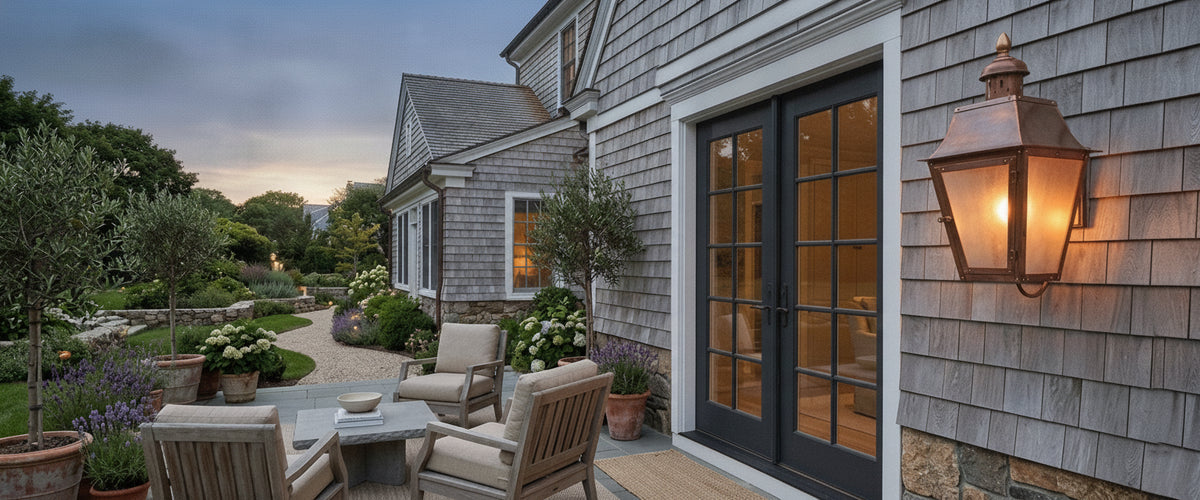

Copper is the only exterior metal that changes its mind about what colour it is. Buy a copper outdoor lights in October and it arrives the colour of a new penny; by the following summer it has gone bronze, then chestnut, then something closer to dark chocolate, and after a decade in the right air it may start edging towards green. That movement is the whole appeal, and it is also the reason so many buyers end up disappointed. They wanted the penny. Nobody told them the penny was temporary.
Key takeaways
- Solid copper mellows. Copper-plated steel or aluminium fails at cut edges and fixing holes, so check what the body is actually made of.
- Lacquer buys you two or three years of bright copper, then flakes unevenly. Unlacquered copper ages more honestly.
- Match format to setting: half lanterns and half-dome wall lights for tight thresholds, full lanterns for wide facades, pedestal lanterns for drives and garden paths.
- Specify IP44 as a minimum for a copper outdoor light under shelter, IP54 or better on exposed elevations, and use A4 marine-grade stainless fixings near the coast.
- Clean with warm water and a pH-neutral soap. Save salt and acid for unlacquered copper you actively want to brighten.

Alloy and Lacquer: What Separates Copper That Mellows From Copper That Corrodes
The first question to ask a supplier is blunt: is the body solid copper, or copper over something else? Solid copper sheet, typically spun or hand-seamed and joined with copper or brass rivets, will patinate evenly across every surface including the cut edges. Plating over steel behaves differently. The layer is thin, the drilled fixing holes and trimmed edges expose the substrate, and within a few winters you get rust bleeding through a finish that is otherwise still bright. Plated aluminium avoids the rust but tends to pit. A plated copper outdoor light can look identical to the solid version in a product photograph and behave nothing like it by year three.
Patina itself is not decay. Copper reacts with oxygen to form a brown oxide film, then with atmospheric sulphur and carbon compounds to build the protective carbonate layer that eventually reads as verdigris green. That green takes decades inland in the UK and arrives faster on the coast, where airborne chlorides speed the whole reaction and shift the colour slightly. The Copper Development Association has good technical material on how architectural copper weathers in different atmospheres, and it is worth ten minutes before you commit to a whole scheme.
Lacquer complicates the picture. A clear coat holds the bright finish for a while, but UV, rain and thermal cycling break it down, and it rarely fails uniformly. You end up with bright patches where the coating survives and dark patches where it has gone, which looks like neglect rather than age. Our honest position on copper outdoor lights: if you genuinely want permanent brightness, copper is the wrong metal and you should be looking at polished stainless or a powder-coated finish. If you want a copper outdoor light that gets better as it darkens, buy unlacquered and stop worrying.

Wall Lights, Lanterns and Post Lights: Matching the Copper Fixture Format to the Setting
Format matters more than most buyers expect, because copper outdoor light fixtures are usually seen from close range by anyone entering the house.
Half Lanterns and Half-Dome Wall Lights
Flat-backed fittings that project only a little are the right call for narrow porches, side returns, passageways and anywhere a shoulder might catch a full lantern. A copper half dome throws a soft downward wash that grazes the wall texture, which is flattering on brick, flint and render alike. Where the wall needs presence but not projection, something like the Paris Outdoor Large Wall Light in copper half dome holds a wide elevation without crowding the path beneath it. Mount at roughly 1.9 to 2.1 metres (about 6ft 3in to 7ft) so the source sits above eye line.
Full Lanterns, Up and Down
A traditional glazed lantern with a copper hood and top finial earns its place on a generous elevation where it can be read as an object. Up-facing lanterns lift light onto the soffit and are kinder to neighbours; down lanterns put light on the doorstep and the lock, which is what most people actually need. A downward-biased copper outdoor light such as the Chelsea Outdoor 1 Light Down Wall Lantern in copper keeps the light where hands and keys are, rather than scattering it across the facade. On a symmetrical front door, a pair reads better than a single fitting, even if one of them is barely doing any work.
Pedestal and Post Lanterns
For drives, gate piers and long garden paths, pedestal lanterns in copper give you height and rhythm. On wider piers and gravel turning circles, a larger body like the Chelsea Grande Pedestal Lantern in copper keeps the proportion right, where a slimmer post lantern would look undersized. Space them for pools of light rather than continuous coverage; gaps between pools make a path feel longer and more considered. Keep the run on one circuit with a single control so the whole approach behaves as one gesture.
Thresholds and Interior Continuity
Outdoor copper lights work hardest when they relate to something inside. We often see copper or antique brass exteriors paired with warm stone fittings in the hall, where the glow through alabaster picks up the same amber register as light bouncing off aged copper. If you are planning that kind of continuity, it is worth looking at the alabaster lighting range alongside your exterior shortlist rather than specifying the two separately.
When Copper Suits the House and When It Fights It
Copper is not neutral. Against red or orange brick a copper outdoor light can disappear entirely, because the metal and the masonry sit in the same part of the colour wheel; the fitting reads as a smudge rather than a detail. Against pale render, limestone, lime-washed walls, grey stone or dark painted timber, copper does exactly what you hoped, holding its own warm tone against a cool background.
Planting density changes the calculation again. A facade softened by yew, box or ivy gives copper a deep green foil and the pairing is hard to beat. Sparse gravel frontages with clipped topiary can make a heavily patinated fitting look tired rather than characterful, so on those schemes keep the copper cleaner for longer or choose a crisper form with less ornament.
One practical warning we give every client specifying a copper outdoor wall light above pale stone: rainwater running off weathering copper carries dissolved copper compounds, and those compounds stain porous limestone, travertine and light render with a greenish streak that is genuinely difficult to remove. If the fitting sits directly above a pale stone plinth, doorstep or sill, either detail a drip break, mount the light where run-off falls onto planting, or accept the staining as part of the look. We shipped a pair of copper down lanterns to a flint cottage on the north Norfolk coast a couple of seasons ago and flagged exactly this; the owners moved the mounting position 40cm (about 16in) to the side so the run-off landed on gravel instead of the Portland sill.
Patina or Polish: A Maintenance Framework for UK Exteriors
Decide which camp you are in before the fittings go up, because switching later is painful.
Letting it run. Do nothing except rinse off salt, bird mess and pollen two or three times a year with clean water and a soft cloth. Dry the fitting rather than letting it air dry, which avoids water spotting on early oxide. Expect bronze by year one, deep brown by year three, and green mottling much later, if at all, away from the coast.
Holding the colour. Clean quarterly, then apply a thin coat of microcrystalline conservation wax, the kind used on metalwork in museum collections, buffed out with a soft cloth. Wax is far more forgiving than lacquer because it wears evenly and can be topped up rather than stripped. Coastal properties will need this more like every eight weeks.
Somewhere in between. Most of our clients land here: let the copper darken, but keep the glass clean and the fixings free of green bloom so the fitting still looks maintained. That contrast between a warm dark body and crisp bright glazing is what separates a well-kept copper outdoor light from one that has simply been forgotten.
IP Ratings, Fixings and Earthing: The Specification Checklist
Copper outdoor light fixtures live or die on the details behind the wall. Work through this list before you order.
- Ingress protection. IP44 is the sensible minimum for a sheltered porch, IP54 or IP65 for exposed elevations and anything low to the ground where splashback is likely. The two digits cover solids and water separately, as set out in the IEC ingress protection code.
- Fixings. Use A2 stainless inland and A4 marine-grade stainless within a few miles of the sea. Never fix copper with galvanised or plain steel screws; the bimetallic reaction will chew through the cheaper metal and stain the wall.
- Isolation washers. Where a copper backplate meets an aluminium bracket or an aluminium window frame, separate them with a nylon or neoprene washer to interrupt galvanic corrosion.
- Earthing and class. Class I metal-bodied fittings need proper earth continuity to the copper body. Class II double-insulated fittings do not, but still need correct termination. Either way the circuit should be RCD protected.
- Cable and entry. Steel wire armoured cable to the point of entry, a weatherproof gland or junction box, and cable entries positioned so water cannot track into the fitting.
- Installation. Exterior lighting is notifiable work in many cases and should be installed and tested by a qualified electrician working to BS 7671. This is not a weekend job with a drill and optimism.
- Lamps and dimming. Warm LED at 2700K flatters copper; 3000K starts to look clinical against a patinated body. Confirm the lamp is rated for enclosed luminaires and that any dimmer is matched to the driver.
- Light spill. Shielded, downward-biased optics keep light on your property and off your neighbour's bedroom ceiling.
How to Decide: A Short Buyer's Framework
Start with exposure. A south-facing sheltered porch in a market town and a west-facing wall above a salt-laden garden are completely different specifications, and the second one needs a solid copper outdoor light, marine fixings and a higher IP rating whatever the style brief says. Then set your patina policy, because that determines lacquered versus unlacquered before you have even looked at shapes. Only then choose format, using projection and mounting height to suit the traffic past the fitting.
Budget sits last, and it depends on material thickness, whether the body is solid or plated, glazing quality, the engineering behind the seal, and installation complexity. Rather than quoting a band that will not fit your project, we would rather look at your elevations and give you a tailored quote. If you are building a whole scheme, browsing the full niori lighting collection alongside your exterior choices helps keep the metal tones and light temperature consistent from the drive to the dining room.
Niori works primarily in alabaster and natural stone, and that shapes how we think about metal too. Stone taught us that materials with visible age are more interesting than materials pretending to be new. A copper outdoor light follows the same logic: specify it properly, fix it sensibly, clean it without aggression, and let it get on with being copper.