
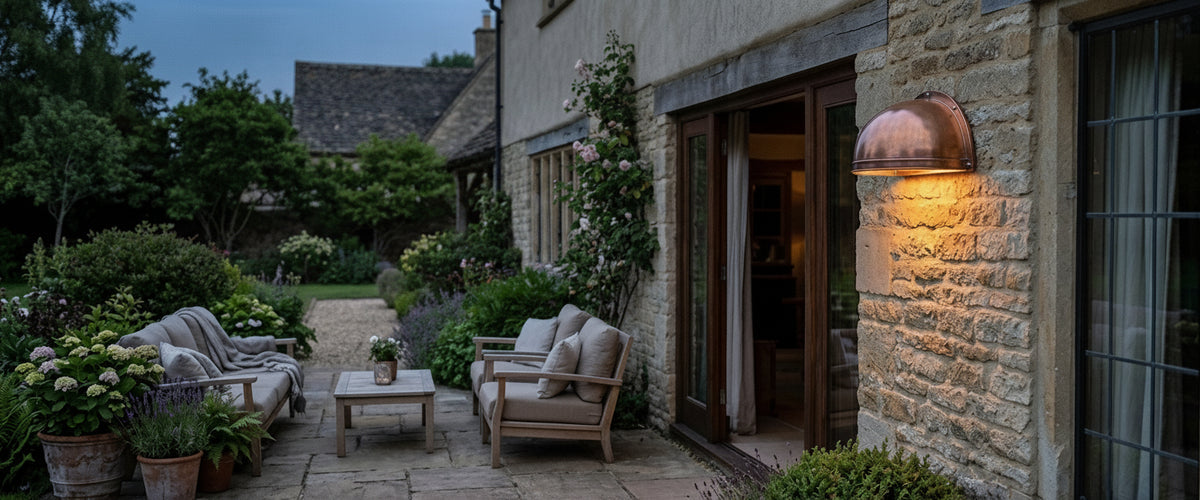

Buy a copper outdoor wall light and you are buying a finish that refuses to sit still. Within weeks the bright penny shine dulls. Within a year it has gone chestnut, then chocolate. Given a coastal address and a decade, it turns that soft mineral green you see on church roofs. Most exterior metals are engineered to stay exactly as they left the factory. Copper treats weather as part of the design.
That is either the best argument for a copper outdoor wall light or the reason to walk away, and the answer depends entirely on what you want your house to look like in five years.

At a Glance
Live copper (unlacquered) darkens and eventually greens. A live copper outdoor wall light never looks tired, because it never looks new for long.
Lacquered copper holds its colour for a while, then fails unevenly. UV and frost are harder on clear coats than most buyers expect.
Facade tone decides everything. Copper sings against grey render, London stock brick and weathered timber. It fights orange-red brick.
After dark, copper reads warm. Pair it with a 2400K to 2700K lamp and the metal glows rather than goes flat.
Specify IP44 as a minimum for a copper outdoor wall light in a sheltered position and IP65 for fully exposed walls, and have a qualified electrician handle the connection.
Fixings matter more than the fitting. Stainless steel screws, the right wall plug for the substrate, and a backplate that suits render, brick or board.

Why Copper Moves While Brass and Aluminium Stand Still
Brass ages too, but towards a flat brown rather than anything structural, and most exterior brass sold today is lacquered or antiqued at the factory to imitate that end state. Powder-coated aluminium does not age at all until the coating chips, at which point it simply looks damaged. Copper is different because its corrosion products are stable, adherent and attractive. The metal forms a brown cuprous oxide layer first, then, over years and only in the right chemistry, converts to the green basic sulphates and chlorides that everyone recognises as verdigris. The Copper Development Association documents this process in architectural applications, and the short version is that the patina protects the metal underneath rather than eating it. A copper outdoor wall light ages; it does not degrade.
Two practical consequences follow. First, a copper outdoor wall light does not need maintaining to stay sound; it needs leaving alone. Second, the green stage is far less inevitable than Pinterest suggests. Inland UK homes in clean air can sit at deep brown for fifteen years and never go green at all. Green arrives fastest near the sea, where airborne chloride accelerates the conversion. If you are in Cornwall or on the Suffolk coast, expect movement. If you are in the Midlands, expect a long, handsome brown.
Live Versus Lacquered: Which Finish Holds Up Across a British Winter
This is the decision that generates the most customer emails, and it is usually the first question anyone specifying a copper outdoor wall light asks. The honest answer is unpopular with anyone hoping copper will stay pink.
A lacquered copper outdoor wall light is a bright copper surface under a clear coat. It looks superb on day one. On a south-facing wall it then faces a full year of UV, driving rain and freeze-thaw cycling, and clear coats are not built for that combination. When the lacquer starts to go it rarely goes evenly. You get cloudy patches, then small windows where the copper underneath begins ageing while the rest stays bright. The result reads as a fault rather than a finish. Stripping and recoating is possible but fiddly, and you are signing up to repeat it.
Live copper, left unlacquered, has no coating to fail. It simply gets on with it. The early months are the awkward ones, because the colour shifts fastest then and often unevenly, particularly where rain runs off a hood or lantern top and where hands touch the fitting. By the end of the first winter a live copper outdoor wall light usually settles into a consistent tone. Broad half-dome fittings of the type of the Paris Outdoor Large Wall Light in Copper Half Dome typically travel from bright metal to a dark tobacco brown inside a year, and the second winter changes them far less than the first.
Our recommendation: choose live copper if the building is rural, coastal, traditional or characterfully weathered. Choose a lacquered or pre-aged copper outdoor wall light only if the property is contemporary and sharply detailed, if the fittings are in a sheltered porch, and if you accept that the coating is a consumable.
Brick, Render and Timber: How Facade Tone Decides Whether Copper Warms or Clashes
Copper is a warm metal with a strong red-orange bias when new and a brown-green bias once aged. Hold a copper outdoor wall light against the wall before you commit.
Where Copper Works Hardest
Grey, white or limewashed render: the best backdrop of the lot for a copper outdoor wall light. Cool neutral behind warm metal, and the patina reads as a deliberate accent at every stage of its life.
London stock and buff brick: the yellow-grey undertone sits comfortably with brown copper without competing.
Weathered oak, larch and charred timber cladding: both materials are ageing on the same schedule, which is why copper on timber barns looks so settled.
Stone, especially limestone and granite: the pairing that flatters both. Warm metal against cool mineral is the same logic that makes alabaster and brass work indoors.
Where to Think Twice
Bright orange-red modern brick: a new copper outdoor wall light disappears into it and an aged one muddies against it. Black or bronze is usually the smarter outdoor wall light choice here.
Warm terracotta render: same problem. Too much of the same family.
Cool blue-grey composite cladding: can work, but only if the copper is already dark. Bright copper against blue-grey looks like a mistake until it ages.
What Happens to Copper's Colour Under Artificial Light After Dark
Daylight and lamplight treat this metal completely differently, which is why an outdoor copper wall light chosen in a showroom can disappoint at night. Copper reflects warm wavelengths and absorbs cool ones. Put a 4000K lamp near it and the metal goes grey and lifeless, because you have starved it of exactly the part of the spectrum it lives on.
Specify 2400K to 2700K for any copper outdoor wall light. At that temperature the reflected bounce off the backplate and hood picks up the metal's own colour and throws a faint amber wash onto the wall, which is most of the reason people fall for copper lanterns in the first place. Look for a CRI of 90 or above so the brickwork and planting behind the fitting keep their real colours. If the fitting takes a clear lamp behind glass, a filament-style LED gives a far kinder sparkle than a frosted bulb; if the fitting throws light up and down onto the wall, frosted is the safer pick.
One more detail that gets missed. Aged copper is darker than new copper, so it reflects less. A pair of live copper outdoor wall lights will look noticeably dimmer at year five than at week one, even with identical lamps. Plan the lighting scheme around the aged state, not the boxed state.
Symmetry, Spacing and Scale: Avoiding the Over-Accessorised Wall
The most common exterior lighting mistake is quantity. Four small fittings scattered across an elevation look like an afterthought; two correctly sized copper outdoor wall lights look designed.
Mount a copper outdoor wall light at around 1.8 to 2 metres (roughly 6 to 6.5 feet) to centre for a front door pair, which puts the source above sightline and stops glare in visitors' eyes. Flanking a door, keep both fittings equidistant from the frame and resist the urge to nudge one across to dodge a downpipe; move the downpipe detail in your head first and find a different fitting if you cannot. Along a garden wall or a run of outbuildings, space wall lanterns at three to four times their mounting height for an even rhythm of pools rather than a strip of continuous light.
Scale is the other trap with copper outdoor wall lighting. A half-dome or lantern that looks generous in a product photo can vanish on a wide render elevation. Measure the door surround and pick a fitting whose overall height is a meaningful fraction of it, typically somewhere between a quarter and a third of the door height. Small fittings on big walls read as timid. On a narrow cottage door or between closely spaced windows, a slim upright form such as the Chelsea 1 Light Outdoor Wall Lantern in Copper holds the proportion better than a wide dome, while a broad elevation usually wants the opposite. Our broader lighting collection is worth browsing side by side when you are trying to judge proportion between a compact wall lantern and a larger half dome.
IP Ratings, Backplates and Fixings: Checks Before Installation
Choosing the copper outdoor wall light is the easy part. What holds it to the wall and keeps water out is where projects go wrong.
Confirm the IP rating against the position. IP44 suits a covered porch or a wall under a generous overhang. IP65 is the sensible specification for anything fully exposed to driving rain. Where the position is sheltered and the light only needs to wash downwards over a threshold, a down-facing form such as the Chelsea Outdoor 1 Light Down Wall Lantern in Copper keeps the glass and gasket out of the worst of the weather. The two-digit system is defined in IEC 60529, and the IEC's own explanation is the clearest reference if you want to check what a rating actually promises.
Check the backplate against the substrate. Flat render takes almost anything. Rough stone, flint or uneven brick needs a small backplate with a bead of low-modulus neutral-cure silicone at the top and sides only, left open at the bottom so trapped moisture can drain.
Use stainless steel fixings. Zinc-plated screws will bleed rust streaks down a pale wall within two winters. A2 stainless is the minimum, A4 near the coast.
Avoid dissimilar metal contact. Copper in direct contact with untreated steel or aluminium in a wet environment invites galvanic corrosion. Nylon washers solve it cheaply.
Protect what is below. Run-off from a copper outdoor wall light can stain pale limestone and light render green over time. On a white rendered wall, choose a fitting with a drip detail that throws water clear, or accept the streak as part of the look.
Sort the cable route before you buy. Surface-mounted conduit, rear entry through the wall and bottom gland entry all need different fittings.
Use a qualified electrician. Exterior circuits in the UK fall under Part P of the Building Regulations. This is not the place for a confident weekend.
Buying Criteria That Actually Change the Outcome
When clients ask us how to choose between two similar copper outdoor wall lights, we ask five questions. Where does rain hit it, and from which direction? Is the wall behind it cool-toned or warm-toned? Do you want the metal to move, or do you want it frozen? What lamp temperature is already used elsewhere on the building? And is the fitting solid copper, copper-plated, or a copper-coloured coating on another metal?
That last one is worth pressing on. Copper-plated and copper-effect finishes do not patina in any meaningful way; they wear through. Solid copper sheet is the material that behaves as described above, and it is what you want in an outdoor wall light copper is meant to carry for decades. Ask before you buy, because the visual difference on day one is close to zero and the difference on year five is enormous.
Budget varies widely with material gauge, whether the body is solid copper or plated, the complexity of the castings, the glass, the IP engineering and the hand finishing involved. Rather than guess at a figure, tell us the wall, the exposure and the number of copper outdoor wall lights you need, and we will quote.
Living With Copper, Long Term
Do almost nothing. A copper outdoor wall light asks for a rinse with clean water and a soft cloth if salt or bird mess builds up, and little else. Avoid abrasive pads, acidic cleaners and proprietary metal polish, all of which strip the patina back to bare copper and restart the clock unevenly. If someone in the household cannot resist polishing, buy lacquered and accept the recoating cycle.
Once a year, check the fixings and the seal around the backplate rather than the finish itself. Loose screws and a cracked silicone bead cause every problem that copper itself will not.
At Niori we spend most of our time working with alabaster, marble and onyx, materials chosen precisely because their internal structure does something light cannot do on its own. Copper belongs in the same conversation. Stone and copper are both honest materials that record time on their surface, and both look better in a house that lets them. If you are pairing a copper outdoor wall light at the entrance with warm diffused stone light inside, the alabaster lighting range is the natural companion; the warmth of an aged copper outdoor wall light outside and backlit alabaster indoors is one of the easiest pairings we know.