
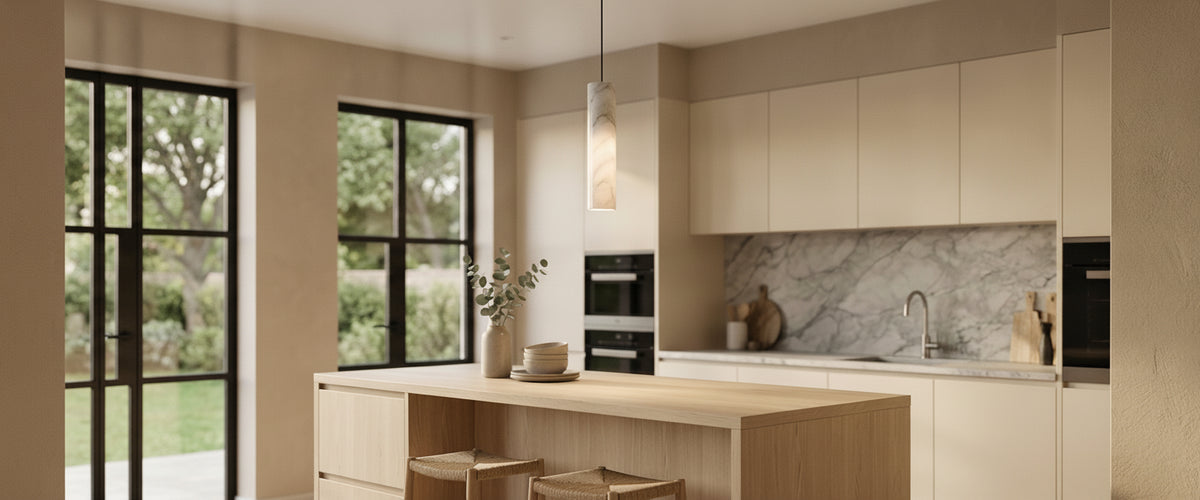

A marble wall can look superb at midday and read like gray drywall by nine at night. Daylight moves across the stone, catches the veining at an angle and gives it depth; a single downlight dropped in the wrong place kills all of that in one go. Deciding how to light up a marble wall is really a choice about angle, color quality and how much light the stone itself is allowed to absorb, and most buyers only discover that after the fitting is already on the wall.
We deal with this weekly at Niori, because alabaster and natural-stone lighting tends to end up in rooms that already have stone in them: a honed Carrara chimney breast, a travertine hallway, a gray marble backsplash in a kitchen extension. Anyone planning to light up marble wall cladding should know that the fitting and the wall are in conversation, and if you pick the fitting purely on looks the conversation goes badly.
When you light up a marble wall, grazing light at a shallow angle reveals the veining; a flat frontal wash erases it.

Quick Answer: What Actually Decides the Glow
Angle beats brightness. To light up a marble wall well, use a shallow grazing beam that picks up texture and veining; light thrown straight at the wall flattens it.
Thickness and vein density act as filters. Thin, lightly veined stone transmits light. Dense dark veining blocks and scatters it.
CRI decides whether gray marble reads silver or dull. Below roughly CRI 90 the cool grays go muddy.
Color temperature sets the mood. 2700K flatters warm creams and alabaster; gray and white marble often prefer 3000K.
Rechargeable marble wall lights solve wiring problems and create new ones around output, dimming and long-term battery life.
Wall color changes everything. The same fitting reads generous on white plaster and mean on dark stone.

Gray Marble, Alabaster and Travertine: Why the Same Bulb Gives Three Different Glows
Put one 2700K lamp behind three stone samples and you get three unrelated results, which is the first thing to understand about how you light up marble wall surfaces. Alabaster, a gypsum or calcite stone, is genuinely translucent: light enters the surface, bounces around inside and leaves as a soft honey-colored glow with almost no hard edge. That internal scattering is the reason alabaster has been carved into window panes and lamp bodies for centuries, and it is why our own shades read as light sources rather than lit objects. The stone seems to hold light rather than reflect it.
Gray marble behaves differently. It is crystalline calcite too, but the crystals are coarser and the mineral impurities that create the veining are opaque. Light penetrates a few millimeters, gets thrown back out, and the surface reads as a luminous skin over a solid mass. Travertine is the outlier: a sedimentary stone full of voids and pits, so it takes light as texture. Every hole casts its own tiny shadow. Graze travertine and it comes alive. Flood it head-on and it looks like a flat beige board.
The practical takeaway when you set out to light up marble walls is simple enough. Decide first whether you are lighting the surface (texture, veining, relief) or trying to make the stone emit light. Surface lighting wants a narrow beam close to the wall. Emission only works with thin, backlit stone, which is a fabrication job rather than a fitting choice.
Vein Density and Thickness Are Doing More Work Than Your Bulb
In the studio we keep offcuts of alabaster and marble by the bench for exactly this reason. Hold a pale alabaster slice up to a work lamp and it glows edge to edge. Hold up a slab of heavily veined gray marble at the same thickness and you get a dim blotch with dark rivers running through it. Nothing changed except the stone, and that is the first lesson for anyone about to light up a marble wall.
Two variables matter most. Thickness is the obvious one: if you plan to light up marble wall panels from behind, transmission drops off quickly as the stone gets deeper, which is why translucent stone panels are specified thin and then backed onto glass or resin for strength. Vein density is the subtler one. A stone with sparse, feathery veining diffuses light attractively, the veins reading as soft shadows inside the glow. A stone with dense, high-contrast veining behaves like a stencil, and you see the pattern rather than the light.
This is why buyers who fall for a dramatic, boldly veined marble are sometimes disappointed when they light up a marble wall made from it, and why quieter stone often photographs and performs better in a fitting. If you want the drama, put the bold stone on the wall and use a calmer alabaster shade to light it. That pairing works far better than trying to make one dramatic stone do both jobs. You can see the difference across the alabaster lighting range, where the shades are chosen for even transmission rather than for pattern.
CRI and Color Temperature Decide Whether Gray Marble Reads Silver or Simply Dull
The same slab under CRI 90 lamps at 3000K, then under a cheaper LED that pushes the grays brown.
Gray marble is the most unforgiving stone in the house when it comes to lamp quality, so plan carefully before you light up marble wall slabs in this color. Its appeal lives in a narrow band of cool neutrals: the silver-blue, the soft dove gray, the faint green in some Italian stone. Those subtleties depend on the lamp rendering colors accurately across the whole spectrum, which is what the color rendering index measures against a reference source. The international framework for that measurement comes from the International Commission on Illumination, and the practical rule for stone is to specify CRI 90 or better. Lower-quality LEDs with weak output in the cyan and red regions turn gray marble flat and slightly brown. Clients describe it as the stone "looking dirty", and no amount of extra brightness fixes it.
Color temperature then sets the character once you light up a marble wall. As a starting point: 2700K for alabaster, cream marble, travertine and honey onyx, where warmth is the whole point. 3000K for white and gray marble, where 2700K can push the stone yellow and undo the cool tones you paid for. Anything above 3500K starts to feel clinical in a home, however crisp it looks in a showroom. Hospitality projects occasionally go to 3500K in an elevator lobby or spa where the stone is pale and the mood should be alert rather than cozy.
One more thing designers often skip: consistency. If you light up marble walls with two fittings from different production batches, small differences in color temperature show up on the stone as visible bands. Buy the lamps together, keep a spare from the same batch, and use dimming that holds color rather than shifting blue as it drops.
Rechargeable Marble Wall Lights: Real Freedoms, Quiet Compromises
A rechargeable marble wall light solves a genuine problem. Marble and stone walls are difficult to chase for cable, and on a fitted slab it is often impossible without wrecking the surface. Battery fittings let you light up a marble wall exactly where the composition needs it, or light a rented apartment without touching the wiring. For a client with a bookmatched marble chimney breast in a Surrey sitting room, two rechargeable sconces mounted on a slim magnetic plate were the only route that did not involve drilling the slab face.
The compromises are real and worth stating plainly. Output is lower than a mains fitting, so a rechargeable marble wall light is an accent, not a room light. Battery life shortens over years of cycling, and some fittings do not allow cell replacement, which makes them a consumable rather than an heirloom. Dimming range is usually coarse. Color quality varies a lot between manufacturers, and the cheap end of the market rarely publishes a CRI figure at all, which tells you something.
Our honest advice: use rechargeable fittings where the wall genuinely cannot be wired, or as a first phase before a renovation. Where you can run a cable to light up marble wall panels, run it. Mains-wired stone wall lights give you better control and better color, and they will still be working long after a sealed battery pack has given up. Have any hard-wired work done by a qualified electrician, and on solid stone walls ask them to assess fixings before the first hole goes in.
Dark Walls Versus White Walls: The Contrast Trap
Here is the effect that catches most buyers out when they light up marble walls: a wall light is judged by contrast, not by lumens. Mount an alabaster sconce on white plaster and the light spreads, bounces and reads as generous ambient glow. Mount the identical fitting on dark gray marble or a charcoal-painted wall and the same output looks weak, because there is nothing behind it to reflect. The shade itself now reads as a bright point against a dark field, which can be handsome, but the room stays dim.
On dark stone, plan to light up the marble wall with more fittings at lower output rather than fewer at high output. A twin-arm fitting such as the Aegean 2 Light Wall Light in Polished Nickel spreads the same modest output across two points, and the cool metal holds its own against gray veining in a way warm brass sometimes cannot. Bring the fittings closer together, accept that they are decorative accents, and add a floor lamp or table lamp to carry the actual illumination. On pale stone, restraint pays: two well-placed sconces can be plenty, and overlighting pale marble strips out the shadow that gives the veining depth.
Positioning follows the same logic when you light up marble wall cladding. For texture on travertine or a fluted marble panel, keep the light source close to the wall, roughly 4 to 6 inches (10 to 15cm), and let the beam graze upward or downward; where the brief is upward grazing rather than a pool of light at head height, an uplighter such as the Alderley 2 Light Art Deco Wall Uplighter throws light along the stone rather than across the room. For an even wash on a flat polished slab, pull the fitting further off the wall and use a wider beam, accepting that the veining will read softer. For flanking a fireplace or a mirror, mount at around eye level when seated, and check for glare reflections in the polished stone before you commit to the fixing points. Polished marble is a mirror; anything bright and bare will show up in it. Where the target is a framed piece hung on the slab rather than the stone itself, a shallow-projection fitting like the Winchfield 2 Light Picture Light keeps the beam on the artwork and off the reflective surround. If the format is still open, compare wall lights, pendants and table lamps side by side in the wider lighting range before you fix a layout.
What to Read in Product Photography Before Trusting a Warmth Claim
Photographs of stone lighting are heavily edited, and warmth is the easiest thing to fake in post-production. A few tells we would look for as buyers before trusting a listing to light up a marble wall the way it promises:
Check the white areas. If a white wall or a white ceiling in the shot is warm-toned too, the whole image has been graded and the fitting's glow tells you nothing.
Look for the shadow color. Genuine warm light from alabaster leaves soft, slightly amber shadows. Cool LEDs graded warm in editing leave gray or blue-gray shadows.
Find an unlit shot. Stone looks completely different off and on. A listing with only a lit hero image is hiding the veining, the joins and the finish.
Look at the edges. Real alabaster shows vein continuity around corners and a glow that varies slightly across the surface. Perfectly even luminance usually means acrylic or resin.
Read the specification, not the caption. "Warm ambient glow" means nothing. Kelvin value, CRI, lumen output and dimming type mean everything.
Checklist Before You Light Up Marble Walls
Identify the stone and the finish: polished, honed or brushed. Finish changes reflectivity more than color does.
Decide whether you are lighting the surface or backlighting a translucent panel. They need different fittings entirely.
Specify CRI 90 or higher, and pick 2700K for warm stone or 3000K for gray and white marble.
Test beam angle with a flashlight at night before you drill anything to light up a marble wall. Ten minutes of this saves regrets.
Check for glare reflections in polished stone from every seated position in the room.
Confirm dimming compatibility, and buy lamps from one batch for color consistency.
On solid stone walls, get the fixing method confirmed by a qualified electrician or fitter before installation.
Choose a rechargeable marble wall light only where cable really cannot be run, and ask whether the cell is replaceable.
Plan cleaning: dust stone shades dry with a soft brush and avoid acidic or general-purpose sprays, which etch calcite surfaces. Guidance from Stone Federation Great Britain is a sensible reference for natural-stone care.
Ask for a tailored quote rather than assuming a budget. Cost depends on stone, scale, complexity, engineering, installation and finishing.
The Short Version
Stone rewards patience. The buyers who light up marble wall surfaces most successfully are the ones who work out what their particular slab does with light before they choose a fitting, then pick lamps for color quality rather than for wattage. Get the angle right and hold CRI high, and a marble wall will hold a room together after dark as convincingly as it does at noon. If you want a second opinion on a specific stone or a tricky wall, send us the details at Niori and we will talk it through.