
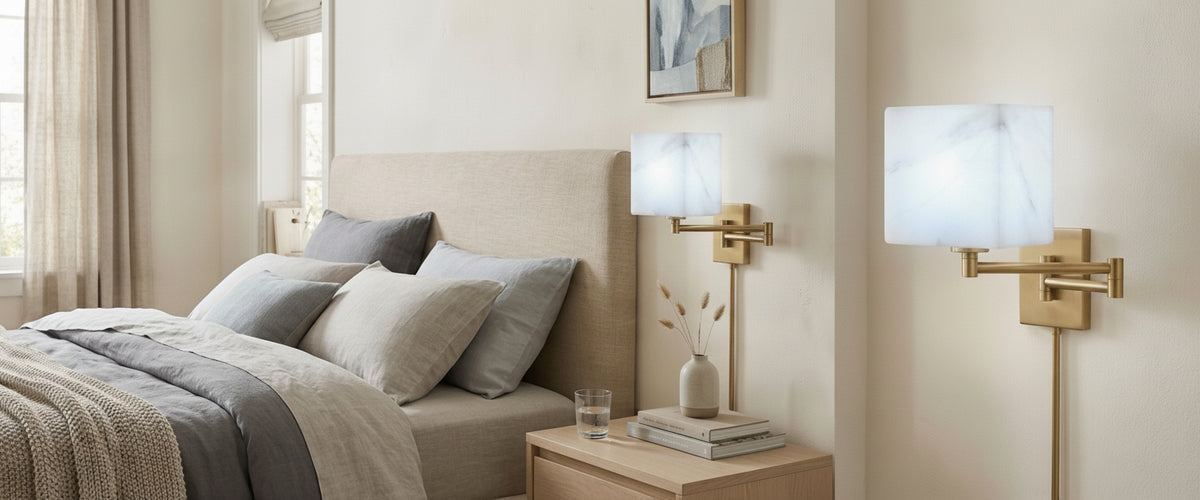

Most brass bedroom wall lights fail for one reason: they were hung at hallway height. The fixture is beautiful, the finish is right, and yet every evening the bulb sits just above eye level when you are propped against the pillows, throwing a hot line across the page you are trying to read. Brass is forgiving about almost everything except position. Get the height and the reach correct and the same pair of lights suddenly looks considered, warm and permanent.

Key Takeaways
- Set bedside wall lights by seated eye level, not by ceiling height or by what looks balanced when the room is empty.
- Swing arm fittings buy you reading light and flexibility; fixed backplates buy you symmetry and a cleaner wall. Decide which matters more before you shortlist.
- Brass shifts tone against its background. A dark stained headboard pulls warmth out of aged brass; a chalky off-white wall makes brushed brass look cooler and more graphic.
- Aim for warm bulbs around 2400K to 2700K on a dimmer with genuine low-end control. A fitting that stops dimming at 30 percent is no use at midnight.
- Shade material decides the quality of the light. Alabaster, frosted glass and ivory linen all diffuse; clear glass and open metal cones do not.
- Always use a qualified electrician for new wall boxes and switching.

Why Brass Bedroom Wall Lights Behave Differently After Dark
In a hallway, brass is decoration you walk past. In a bedroom, it is something you look at from a reclining position for twenty minutes every night, usually at very low light levels. That changes the brief entirely. Highly polished brass becomes a mirror at close range and catches the lamp as a bright pinpoint. Aged, darkened and brushed finishes absorb more of that reflection and read softer, which is why they dominate bedside work.
There is a second shift. Bedrooms run at far lower light levels than circulation spaces, and sound domestic lighting practice follows from that: light for reading should be local and controllable rather than general and bright, which is exactly what a well-placed wall fitting delivers. If you want the underlying design principles, the Society of Light and Lighting is the place to start. At low levels, warm metal becomes a visual cue for comfort. Brass glows slightly in dim conditions in a way that chrome and nickel never do.
This is where brass earns its place next to stone. At Niori we work mostly in alabaster, marble and onyx, and brass is the natural companion metal because both materials do the same job: they warm light instead of cutting it. A brass arm carrying a carved alabaster shade gives you a fitting that is quietly bright when lit and sculptural when off. Browse the alabaster lighting collection if you want to see how the stone handles that low-level glow before you commit to a metal finish.
The Mounting Height Trap
Here is the mistake we see most often on plans that arrive at the studio. The electrician is on site, the bed has not been delivered, and the wall boxes get set at a height that looks sensible standing in an empty room. Then the bed arrives with a deep mattress and a 120 cm (47 in) upholstered headboard, and the light sits either behind the headboard or directly in the sightline.
Work backwards from the body instead. Sit on the mattress against the headboard and note where your shoulder sits. For most beds, the centre of brass bedroom wall lights lands somewhere around 1.4 m to 1.6 m (55 in to 63 in) from finished floor level, but that figure is a symptom, not a rule. What matters is that the bottom of the shade sits slightly above your shoulder and that you cannot see the bulb or the bright inner surface of the shade from a seated reading position. If you can see the source, you will get glare, and no dimmer fully fixes glare.
Three practical notes. Mattress depth varies enormously, so confirm the bed before the wall boxes are chased in. Allow for a bedside table or a shelf so the lower edge of the fitting does not collide with a stack of books. And keep the lateral position honest: roughly 25 cm to 35 cm (10 in to 14 in) clear of the bed edge usually gives an arm room to swing without knuckling the headboard.
Swing Arm or Fixed Backplate
These two configurations commit you to different bedrooms.
Swing Arm
A jointed brass arm lets you pull light onto a book and push it back against the wall in the morning. It is the honest choice for anyone who actually reads in bed. The trade-offs are real: jointed brass bedroom wall lights need a solid wall fixing because the arm applies use every time it moves, the backplate tends to be larger, and two swing arms rarely sit in perfect mirror symmetry once they are in use. Look for smooth friction joints rather than stiff ratchets, and check whether the fitting has an integral pull switch so you are not reaching across the bed for a wall plate. Where that switching detail matters more than a dramatic profile, something like the Clarke 1 Light Wall Light in darkened brass with an ivory linen shade answers both problems at once: the switch is on the fitting and the linen takes the hard edge off the bulb.
Fixed Backplate
A fixed wall light is the architectural option. It holds a line, it repeats cleanly across a pair or a row, and it suits panelled walls and headboard-to-ceiling upholstery where a moving arm would look restless. The cost is flexibility. Fixed fittings need to be right first time, which pushes more weight onto shade choice: a downward-facing alabaster or frosted glass shade will put usable light on a book, while an uplighter will wash the wall beautifully and do almost nothing for reading. Where the room needs a soft diffused glow rather than a hard downlight, a frosted glass fitting such as the Corona Wall Light in dark brown brass is closer to the right design language. In guest rooms and hotel suites, fixed brass wall lights paired with a separate dimmer circuit are usually the safer specification because guests cannot knock them out of alignment.
How Headboard Material and Wall Colour Change the Brass
Brass has no fixed colour. It borrows from whatever sits behind and beside it.
Against dark walnut or a deep inky wall, aged brass reads warm and almost red, and the contrast is strong enough that the fitting becomes a feature. A simple aged brass form like the Rosa Medium 1 Light Wall Light is a useful test case here, because there is nothing between you and the metal: the finish does all the work against the wall behind it. Against pale plaster, linen or a chalky white, the same finish looks more yellow and considerably quieter. Brushed brass on a mid-grey wall can tip slightly green under cool daylight, which surprises people who chose the finish under warm shop lighting.
Headboard texture matters as much as colour. Boucle and heavy linen scatter light and soften the edge of the beam, so brass bedroom wall lights with a tighter downward throw work well. Leather and lacquered timber reflect, and a bare bulb will bounce straight back at you. One client scheme last year had a glossy dark-green panelled wall behind the bed; the first mock-up with clear glass shades was unusable because of reflections, and swapping to a honed alabaster shade solved it in one move. Stone diffuses at the source, which is why it forgives reflective backgrounds.
If the room already has a marble fireplace or an onyx-topped bedside table, match the metal to those pieces rather than to the door furniture. Mixed metals work; mixed warm and cool metals within a metre of each other rarely do.
Dimming Range and Bulb Temperature: The After-Dark Test
Most buyers test brass bedroom wall lights at 8pm with the curtains open. Test them at 11.30pm with everything else off. That is the condition the fitting has to survive.
- Colour temperature: 2700K is the sensible default for bedrooms. 2400K feels closer to candlelight and suits alabaster and onyx especially well, because the stone already adds warmth. Anything at 3000K or above tends to look clinical beside brass.
- Dim-to-warm: worth paying attention to. These lamps drop toward 2200K as they dim, mimicking the behaviour of an incandescent bulb, which is flattering on both skin and stone.
- Low-end performance: ask what the fitting and driver will actually dim to. Ten percent or lower is what you want at the bedside. Dropping out at 30 percent then flickering is the single most common complaint we hear about retrofitted LED wall lights.
- CRI: 90 or above. Low-CRI LEDs make brass look flat and grey out the veining in stone shades.
- Switching: integral pull switches, cord switches or bedside rocker switches all beat a distant wall plate. Two-way switching from door and bed is the detail people notice most.
One more point on dimming: a bedside light and a ceiling fitting should not share a circuit. If bedroom brass wall lights come up on the same dimmer as a central pendant, you lose the ability to run a low reading pool of light with everything else dark, which is the whole reason for fitting them.
Pairing Brass Bedroom Wall Lights Without Catalogue Symmetry
A matched pair either side of the bed is the default, and it works. It can also look showroom-flat if nothing else in the room breaks the mirror. Three ways to loosen it:
- Vary the shade, keep the metal. Identical brass arms with slightly different stone shades, or one linen and one alabaster, look collected rather than bought as a set.
- Break the symmetry with what sits below. A tall chest on one side and a low table on the other makes identical fittings read as intentional rather than default.
- Repeat the metal, not the fixture. Brass wall lights at the bedside, a brass-based alabaster table lamp on a dressing table, a brass stem on a floor lamp in the reading corner. The finish becomes the thread.
For larger rooms, a third fitting matters more than a matched pair. A wall light beside a wardrobe or over a dressing table gives you a second layer, and it means the room still works when the bedside lights are off. If you are building that layered scheme, the wider lighting range is the place to check how pendants, wall lights and table lamps share a finish family.
Buying Checklist
- Confirm the bed and mattress depth before wall boxes are positioned.
- Check bulb visibility from a seated reading position, not standing.
- Decide swing arm or fixed early; it changes backplate size and wall fixing.
- Choose a diffusing shade material: alabaster, onyx, frosted glass or ivory linen.
- Specify 2400K to 2700K, CRI 90+, dimmable to 10 percent or lower.
- Keep brass bedroom wall lights on a separate circuit from the ceiling fitting.
- Check the brass finish under both daylight and warm light before ordering.
- Ask whether the finish is lacquered or living; it changes how it ages.
- Book a qualified electrician for wiring, switching and testing.
- Price varies with material, scale and installation, so ask for a quote against your actual specification.
Living Finishes, Patina and Care
Unlacquered brass will darken. That is the point of it, and in a bedroom the process is slow because there is little moisture and few hands on the metal. Lacquered brass holds its original tone but the coating can wear at touch points such as a pull switch or a swing arm joint. Ask which you are buying; it is the detail most often left off a product description.
Care is undramatic. Dust with a dry microfibre cloth, keep abrasive metal polish away from lacquered surfaces entirely, and never let cleaning products run down onto a stone shade. Conservation guidance on copper alloys from the Canadian Conservation Institute makes the same point: aggressive polishing removes metal, not just tarnish. Alabaster needs even gentler handling, since it is a soft, slightly porous stone that marks with water. A dry cloth and occasional light dusting is genuinely all it wants.
Done properly, brass bedroom wall lights are a twenty-year decision rather than a seasonal one. The metal improves, the stone stays warm, and the only thing you will ever change is the bulb. If you want help matching a finish to an existing scheme, the team at Niori works through these choices with designers and homeowners every week.