
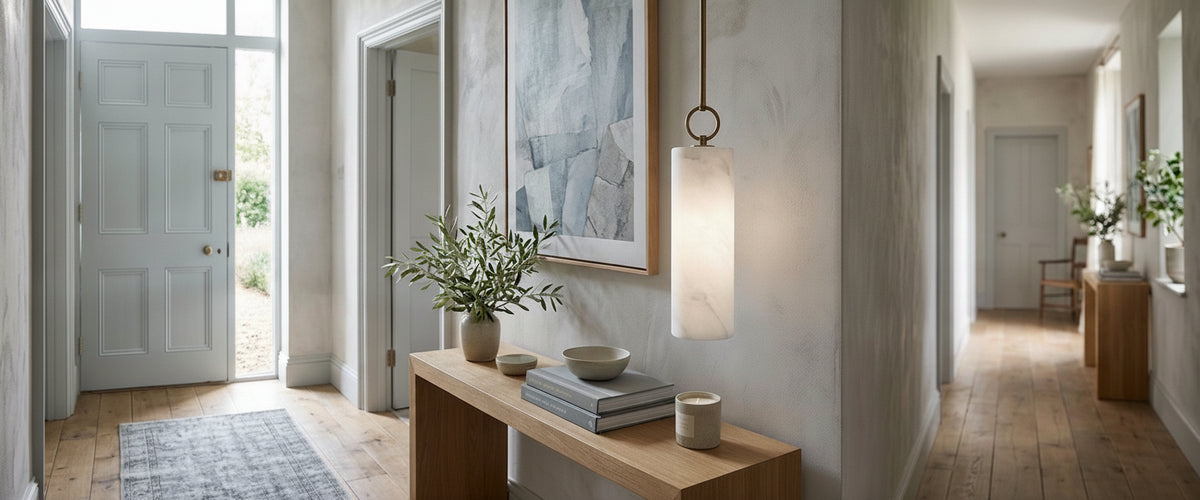

Brass tells small lies in daylight. An antique brass lighting that looks soft and tobacco-brown in a photograph can turn grey-green against cool plaster, or go oddly flat under a 4000K lamp, and then change character again the moment the bulb warms up. The finish behaves less like a fixed colour and more like a surface with opinions: it borrows from the wall behind it, the floor beneath it, and above all from the light it is throwing. Get that relationship right and antique brass reads as quiet, aged confidence. Get it wrong and it reads as a metal that cannot decide what decade it belongs to.

Key Takeaways Before You Buy
- Most antique brass lights fall into one of two broad families: honey-warm (reddish, golden, lively) and olive-dark (smoky, greenish-brown, restrained). They behave very differently in the same room.
- The bulb decides the finish. 2700K flatters warm brass; anything above 3000K drains it and can push aged brass toward grey.
- Alabaster is brass's easiest partner because the stone diffuses light at a warm, low-contrast level that stops the metal looking hard-edged.
- Patina is controlled oxidation; tarnish is neglect. Which one you end up with depends on humidity, handling and whether the piece is lacquered.
- Mixing metals works if you commit to one dominant finish per sightline and let the others appear as accents.

Why an Antique Brass Light Shifts Tone the Moment a Bulb Fires Up
Unlit, an antique brass light is a reflective object reading the room. Lit, it becomes a light source with a metal skin, and the two states can look almost unrelated. Warm filament-style light bounces off the raised areas of the finish and pools in the recesses, which exaggerates the depth of the ageing. That is why a wall light with a hand-worked, slightly uneven brass surface gains dimension when switched on, while a perfectly smooth machine finish can flatten out. Shallow upturned bowls and exposed arms, as on Aegean 2 Light Wall Light, Aged Brass, exaggerate that effect because the light grazes the metal before it ever reaches the wall.
There is a second effect that catches people out. Brass reflects the colour of whatever it is near. Put an aged brass bracket beside a cool grey-blue wall and the metal picks up that cast; set the same bracket against clay plaster or warm oak and it reads noticeably redder. Repaint a hallway from chalky grey to soft ochre and a pair of brass and alabaster sconces will look as though someone swapped them for a different finish overnight. Nothing about the fittings has changed.
Honey-Warm Versus Olive-Dark: The Two Antique Brass Families
Most finishes sold as antique, aged, heritage or old brass fall into one of two camps, and knowing which you are looking at saves a lot of grief.
Honey-Warm Antique Brass
This is brass that has been aged but kept golden: amber, faintly pink in the highlights, with the darkening concentrated in the crevices. It is generous and forgiving in rooms with warm timber, limestone, linen and terracotta. Under a 2700K lamp an antique brass light in this family genuinely glows. Its weakness is cool schemes, where the golden cast can look like it has wandered in from another house.
Olive-Dark Antique Brass
Darker ageing pushes the alloy toward smoky brown with a green undertone. It sits more quietly, recedes against deep colours, and reads as older and more architectural. It is excellent in libraries, panelled dining rooms and low-lit hallways. The risk is that in a bright, north-facing room with white walls it can look muddy or simply grey, losing the metallic quality that made you choose brass in the first place.
A useful test: look at the piece against the actual materials in your scheme, not a showroom backdrop. If you are ordering a brass and stone fitting remotely, ask for images shot both lit and unlit, because the difference between the two states is the real information.
Where Antique Brass Reads Considered, and Where It Argues with Itself
Antique brass is at its best where there is texture to answer it. Period joinery, plaster cornices, unpolished stone, aged oak, wool, leather. In a Georgian entrance hall or a converted barn, an antique brass light looks like it has been there long enough to belong. Where the ceiling is too low for a pendant to hang safely, a close-fitting piece such as Old Park 2 Light Semi-Flush Ceiling Light, Antique Brass keeps the finish in the sightline without forcing anyone to duck beneath it.
It struggles in two situations. The first is a hard, high-gloss modern interior with cool white surfaces and chrome ironmongery, where the aged finish reads as an accident rather than a decision. The second is a room already crowded with competing warm metals: burnished copper handles, a rose gold tap, a bronze mirror frame. Brass needs breathing space to register as brass.
Bathrooms and coastal properties deserve their own note. Salt air and sustained humidity accelerate surface change dramatically. Unlacquered brass in a Cornish seafront bathroom will move faster in a year than the same piece in a dry inland bedroom will move in five. That is fine if you want it. It is a problem if you expected the finish to stay put.
Mixing Antique Brass with Alabaster, Stone and Cooler Metals
Alabaster and brass are an old pairing for a reason. The stone transmits light at low intensity with a warm, faintly honeyed cast, and that glow wraps the metal rather than fighting it. On a pendant or chandelier, the alabaster does the soft work while the brass gives the piece structure and a line for the eye to follow. The same logic holds for onyx, where the banding is stronger and the brass detailing needs to be finer so it does not compete. Across our alabaster lighting range, brass appears most often as stems, canopies, collars and gallery detail, which is exactly where it earns its place: definition without dominance.
Marble is a slightly different conversation. Cooler white marbles with grey veining can pull antique brass toward green, so honey-warm finishes generally read better against them than olive-dark ones. Warmer stones with beige or gold veining are happy with either.
On mixing metals, the rule that actually works is hierarchy rather than balance. Choose one dominant finish per sightline, usually the lighting or the ironmongery, and allow the second and third metals to appear in smaller quantities. An antique brass light above polished nickel taps looks deliberate when the brass is clearly the feature. The same combination in equal proportions looks unresolved. Timber sits between the two and calms everything: mid-brown oak and walnut are natural bridges between warm and cool metals.
Colour Temperature and Dimming Choices That Keep the Finish Alive
This is where most antique brass light schemes are won or lost. Warm brass finishes want 2700K. At 3000K they hold up in kitchens and utility spaces. Push to 3500K or 4000K and the golden reflectance is stripped out, leaving the metal looking chalky and, in darker aged finishes, distinctly green.
Colour rendering matters just as much as colour temperature. A lamp with a CRI of 90 or above will show the depth in an aged finish and the subtle mineral colour in alabaster and onyx; a low-CRI lamp flattens both into something closer to beige. Pay attention to how the lamp behaves at the bottom of the dimming curve too. Good warm-dim LEDs shift slightly amber as they lower, which suits brass and stone; cheaper drivers hold a fixed colour and can flicker or shudder at low output.
Always confirm that your dimmer is compatible with the specific driver in the fitting rather than assuming any trailing-edge unit will do. The Lighting Industry Association publishes useful guidance on LED and control compatibility, and any hard-wired installation should be carried out by a qualified electrician. For multi-light schemes, keep pendants, wall lights and picture lights on the same lamp specification. Picture lights are the usual offender, because a piece like Chawton Medium Picture Light, Aged Brass tends to get specified late and separately, and a cooler lamp over the artwork will make every other brass fitting in the room look tired by comparison. Mismatched colour temperatures across brass fittings in one room are immediately obvious.
Patina Versus Tarnish, and the Habits That Decide Which You Get
Patina is the gradual, even darkening of a metal surface as it oxidises, and on brass it is a genuine asset: it deepens the colour and softens reflectivity. Tarnish is the same chemistry gone unmanaged, producing blotches, fingerprint shadows and dull grey-green patches that read as neglect rather than age.
The deciding factors are lacquer, humidity and hands. Most commercially produced antique brass light fittings carry a protective lacquer that holds the finish at the point it left the workshop. Lacquered pieces need nothing more than dusting with a dry microfibre cloth. Never use brass polish or an abrasive cream on them; it cuts straight through the coating and leaves a bright patch that will never match. Unlacquered or living-finish brass is meant to move, and the sensible approach is to let it, wiping away fingerprints with a dry cloth so oils do not etch uneven marks. Conservation bodies including the Canadian Conservation Institute take the same line on historic metalwork: stable, gentle handling beats aggressive cleaning every time.
Where brass meets stone, be more careful still. Polish residue and metal cleaners can stain alabaster, which is porous and will absorb anything liquid. Clean the metal with the cloth away from the stone, or mask the joint. For the stone itself, a dry soft brush and an occasional wipe with a barely damp cloth is the whole routine.
A Practical Checklist Before You Order an Antique Brass Light
- Identify the family. Honey-warm or olive-dark? Match it to your walls, floor and stone, not to a mood board.
- Check lacquered or living finish. Ask outright. It changes both the look in five years and the care routine.
- Lock the lamp spec. 2700K, CRI 90+, dimmable, and identical across the room.
- Test the dimmer pairing before the ceiling is made good, and use a qualified electrician for any hard wiring.
- Consider the environment. Bathrooms, kitchens and coastal homes age brass faster; specify accordingly.
- Plan drop heights. A pendant over a dining table generally sits around 75 to 90cm (30 to 35in) above the surface, adjusted for ceiling height and the visual weight of the fitting.
- Look at it lit. Request an image or a sample of the finish in its illuminated state, not just a catalogue shot.
- Budget realistically. Cost depends on the stone, the scale, the metalwork complexity and the hand-finishing involved, so ask for a tailored quote rather than working from an assumed figure.
Where Niori Fits
Niori works almost entirely in alabaster and natural stone, with brass used as the structural and decorative counterpoint rather than the headline. That is a deliberate position: stone carries the light, metal carries the form. If you are weighing up an antique brass light for a hallway, dining room or hotel lobby, the honest starting question is what the stone is doing, because the brass will only ever be as convincing as the glow it frames. Browse the full lighting collection to see how the two materials behave across pendants, chandeliers, wall lights, table lamps and floor lamps, and get in touch if you want advice on a specific room or a bespoke piece.