

Most silver chandeliers are chosen at 2pm and regretted at 8pm. In daylight, polished nickel, chrome and brushed nickel all look like the same cool, confident metal. Switch the room over to lamplight and they behave like three different fixtures, one of which usually looks clinical. If you are shopping for a modern silver chandeliers, the finish decision matters less than what happens to that finish once it is the only light source in the room.
Showroom photography never shows you that. Here is how we talk clients through a modern silver chandelier at Niori, where most of our work pairs cool metals with alabaster, marble and onyx to keep the light warm.

Key Takeaways Before You Shop
Almost nothing sold as "silver" is silver. You are choosing between polished nickel, chrome, brushed or satin nickel, and occasionally silver leaf over metal.
Cool metal plus cool bulbs equals a cold room. Under a modern silver chandelier, aim for 2700K, and 2200K to 2400K on dimmed circuits.
Scale beats detail. An undersized silver chandelier floats; the right diameter and drop makes it read as architecture.
The diffuser does the real work. Crystal scatters, open metal throws hard shadows, frosted glass softens, alabaster glows from within.
Never sign off a finish in daylight. Look at samples at night, under the exact bulb you intend to install.

Three Finishes That All Read as Silver by Day
Start by naming what you are actually buying. Polished nickel has a faint warm, almost buttery undertone and a deep reflective surface. It holds candlelight beautifully and sits comfortably next to brass, oak and stone. Chrome is bluer, harder and more mirror-like; it reads graphic and slightly technical, which suits minimal apartments and bathrooms but can feel severe in a room full of linen and wool. Brushed or satin nickel scatters reflections rather than returning them, so it stays quiet and hides fingerprints, at the cost of sparkle.
Silver leaf over metal behaves differently again, with a slightly broken, hand-applied surface that catches light unevenly. Like real silver, it is sensitive to handling and harsh cleaners; the Canadian Conservation Institute is clear about how quickly abrasives and ammonia damage plated and silvered surfaces.
The practical takeaway: if your room has warm materials in it, polished nickel is usually the safer silver. Where the metalwork is slim and the finish is doing all the reflective work, something like the Kula 5 Light Chandelier in Polished Nickel shows why that undertone matters more than the arm count. If the scheme is deliberately cool and architectural, chrome earns its place. Brushed nickel is the choice for high-traffic family spaces where nobody wants to polish a chandelier.
Polished nickel keeps a faint warm undertone that chrome does not.
Why Warm Rooms Need a Warmer Bulb Under a Modern Silver Chandelier
Cool metal amplifies whatever colour temperature you feed it. We delivered a polished nickel and alabaster fixture to a dining room in Hampshire last year, and the owner emailed a week later to say the metal looked "surgical". The contractor had fitted 4000K lamps left over from the kitchen job. Swapping to 2700K, 90+ CRI lamps fixed it completely, with no changes to the fixture at all.
Rules we hold to under any modern silver chandelier:
2700K as the default for living and dining spaces. 3000K only where the scheme is genuinely cool and stone-heavy.
Dim-to-warm lamps where the chandelier is the evening light source. Dropping to 2200K to 2400K at low output mimics candlelight and takes the blue edge off chrome.
CRI 90 or above. Cheap lamps flatten the veining in alabaster and marble and make nickel look grey rather than luminous.
Match every lamp in the fixture. Mixed batches in a multi-arm chandelier are obvious once dimmed, and the eye reads the inconsistency before it reads the design.
Confirm the driver and dimmer pairing with a qualified electrician before installation. Flicker and dropout at the bottom of the dimming curve are almost always a compatibility issue, not a fixture fault.
Scale: The Drop and Diameter a Modern Silver Chandelier Needs
A modern silver chandelier that is slightly too small does not read as restrained. It reads as a mistake. Reflective metal draws the eye upward, so any shortfall in scale is exposed.
Working rules of thumb we use on planning calls:
Diameter: add the room's length and width in feet and use that total in inches as a starting diameter. A 4.3 by 4.9 m room (14 by 16 feet) suggests roughly 76 cm (30 inches) across.
Over a dining table: hang the lowest point 76 to 91 cm (30 to 36 inches) above the tabletop, and keep the fixture narrower than the table by around 30 cm (12 inches) on each side.
In walkways and entrances: keep at least 2.1 m (7 feet) of clearance beneath the fixture.
Tall ceilings: add roughly 6 to 8 cm (2.5 to 3 inches) of overall drop for every additional 30 cm of ceiling height above 2.4 m.
Diameter, drop and clearance measured rather than estimated.
Shape follows the table as much as the room. Over a long rectangular table, a round fixture large enough to feel proportionate often ends up too wide for the tabletop, which is where a linear form such as the Zuma 6 Light Linear Chandelier in satin black with a silver chain resolves the problem, spreading light along the length rather than pooling it in the middle.
Double-height spaces are where big modern silver chandeliers genuinely pay off. A galleried stairwell or a double-height entrance hall can carry a tiered or cascading fixture that would overwhelm a standard ceiling, and the vertical reflections do half the decorative work. Just check the sightline from the floor above; a design meant to be read from below looks skeletal when you are staring into its top plate from a landing.
Crystal, Open Metal, Frosted Glass or Alabaster
Silver is the frame. The diffuser decides the mood.
Crystal and Faceted Glass
Crystal refracts, so it throws small bright points across ceilings and walls. Paired with polished nickel it gives sparkle and movement, which suits formal dining and hospitality. The trade-off is glare; crystal needs low-output, well-shielded lamps and a dimmer, or it becomes uncomfortable at eye level. Scale is the other control: in a cloakroom or a modest entrance hall, the Aries 4 Light Small Crystal Chandelier in Polished Nickel carries the same refraction without the mass that makes crystal feel formal in a small volume.
Open Metal Frames
An exposed armature with visible lamps gives crisp, directional light and hard shadow edges. Graphic and architectural, but unforgiving. On a long dining table it will light faces from a single angle, so plan wall lights or table lamps to fill in.
Frosted and Opal Glass
Even, predictable and quiet. Frosted glass softens output without much character of its own, which makes it a sensible neutral when the joinery and textiles are doing the talking.
Alabaster and Natural Stone
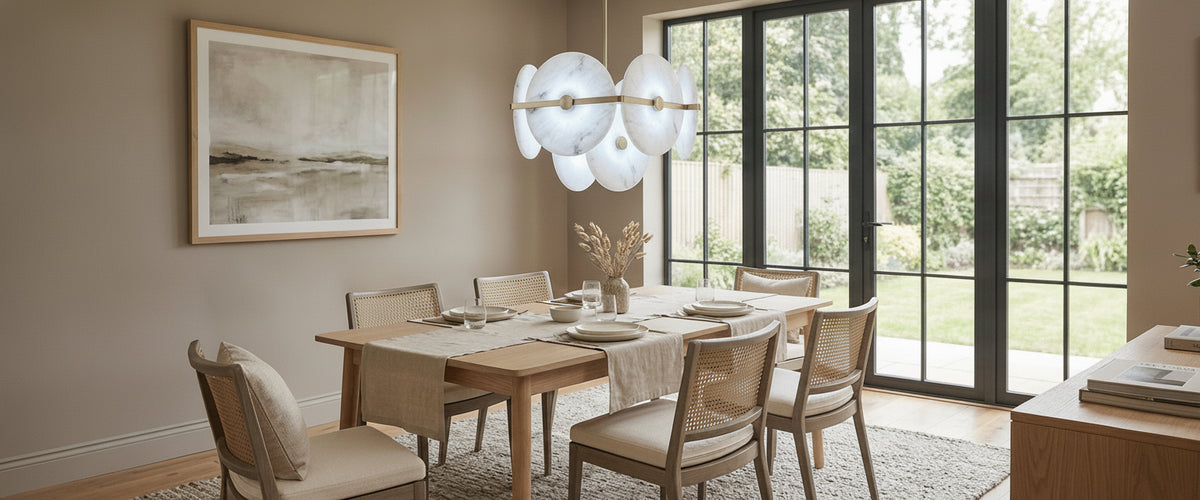
This is where a cool metal frame becomes genuinely warm. Alabaster is a gypsum stone, soft enough to be carved thin and translucent, and it transmits light with a honeyed, cloudy glow rather than a flat wash. Slice it thinner and the veining reads more strongly; keep it thicker and the light stays deep and even. Marble discs and onyx panels behave similarly, with onyx pushing amber and gold. Set inside polished nickel, alabaster cancels out almost everything people dislike about a modern silver chandelier at night. Our alabaster lighting collection is the clearest place to see how that pairing behaves across pendants, chandeliers and wall lights.
Stone diffusers warm the light before the metal can cool it.
Room Pairings That Hold
Silver sits best against materials with texture and depth. Limewash walls are the strongest partner we see: the chalky, mottled surface absorbs light and gives the metal something to reflect other than flat paint. Add a plaster or stone fireplace and a modern silver chandelier stops reading as a decorative object and starts reading as part of the shell.
Velvet is the other reliable pairing. Deep green, ink blue or oxblood upholstery drinks light, and reflective metal above it creates the contrast the room needs. In stone-heavy kitchens, a chrome or brushed nickel fixture over a marble island is almost too easy; the risk there is a scheme that reads grey rather than calm, which is exactly when an alabaster diffuser earns its keep.
Where silver struggles: rooms built on honey oak, terracotta and rattan. Those schemes want brass or bronze. If the client insists on a modern silver chandelier in a warm room, we push toward polished nickel with a stone diffuser and a dim-to-warm circuit, and it holds. Chrome in the same room will fight everything around it. If you are weighing finishes across a whole project, browse the wider lighting range as a set rather than picking each room in isolation.
The Daylight Finish Mistake, and How to Avoid It
Here is the sequence that catches people out. Finish is approved on a bright morning, against a white wall, with no bulb in the socket. The fixture arrives, gets wired to a contractor's leftover lamps, and the first proper viewing happens at nine at night. Nickel that looked warm at noon now looks grey; chrome that looked crisp now looks like a bathroom fitting.
Avoid it with four steps. Request physical samples. View them vertically, since reflective metal changes completely with angle. Hold them against your actual wall colour and fabric. Then look again after dark, under the lamp you plan to install.
Pre-Order Checklist
Finish confirmed from a physical sample, viewed at night
Diameter and total drop checked against room dimensions and ceiling height
Clearance over table or walkway measured, not estimated
Ceiling construction and fixing point assessed for weight, with an electrician engaged early
Lamp type, colour temperature and CRI specified, with spares ordered in the same batch
Dimmer and driver compatibility confirmed
For stone diffusers, accept that veining varies panel to panel; that is the material, not a flaw
Access plan for future cleaning and lamp changes agreed before install
Living With the Finish
Polished nickel shows fingerprints during installation and almost never after, since nobody touches a chandelier. Dust with a dry microfibre cloth and skip anything abrasive or ammonia-based. Alabaster and marble components want the same restraint: dry dusting, no water sitting on the surface, no household spray. Gypsum alabaster is soft and porous, and as the Natural Stone Institute and any stone conservator will confirm, moisture is the real enemy, not dust. Let a specialist handle deeper cleaning on carved stone elements.
On budget, be wary of headline figures. Cost tracks material, scale, the complexity of the metalwork, whether stone is hand-selected and hand-carved, engineering for weight, and on-site installation. A large tiered fixture with carved alabaster is a different proposition from a small frosted-glass piece with the same arm count. Send us the room dimensions, ceiling height and finish direction and we will quote your modern silver chandelier properly.