
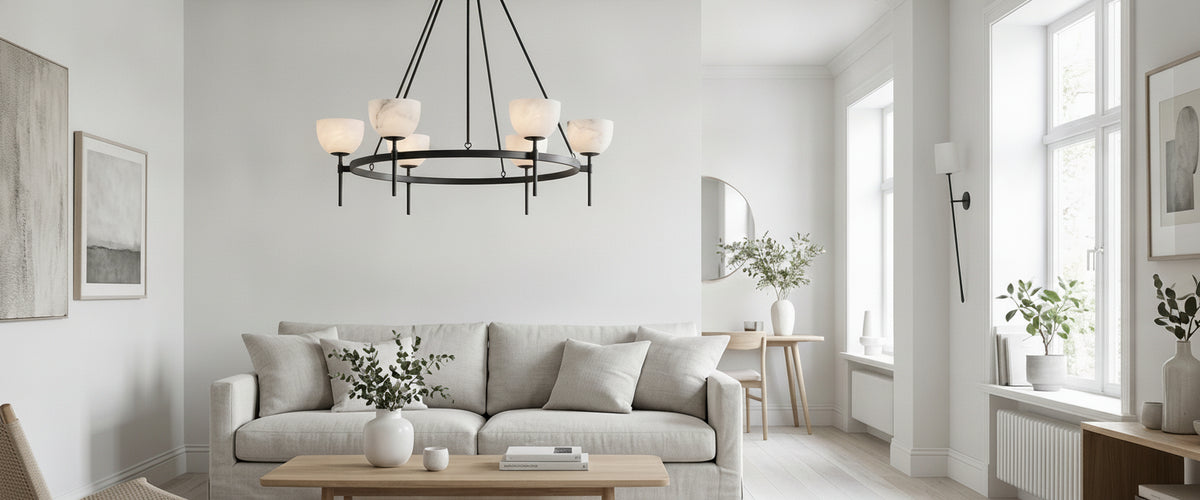

Black fittings photograph beautifully. They can also drain a sitting room into something that reads like a hotel corridor at six o'clock in November. The difference has very little to do with taste and everything to do with finish, drop height and how much light the fitting actually releases into the room. Specifying a living room chandelier black rather than brass or nickel commits the whole scheme to contrast, so it needs to be a decision rather than a default. A black living room chandelier is a deliberate, confident choice, and it rewards planning rather than impulse.

Key Takeaways Before You Shortlist
Finish decides the mood. Matt black goes silent and heavy when the lights dim; gloss and powder-coated finishes keep a highlight along every edge.
Dark metal absorbs light. Plan for more total output across the room than a pale fitting would need, spread over lamps and wall lights rather than piled into the black living room chandelier itself.
Clearance is non-negotiable. Keep at least 2.1m (about 7ft) under the fitting where people walk, and give a low ceiling a compact form rather than a long drop.
A second material rescues black. Alabaster, onyx, glass or brass detailing stops a black living room chandelier from reading as a flat silhouette.
Dimming needs planning. A trailing-edge dimmer and dim-to-warm lamps give you the low end where a dark fitting looks its best.

Matt, Gloss and Powder Coat: How Black Reads Once the Room Goes Dim
Three fittings can all be described as black in a product listing and behave like three different objects at nine in the evening. Matt black, especially a deep textured coating, kills any specular highlight. The frame disappears into shadow and you are left with floating light sources and a vague dark mass. That can be exactly what you want in a room with pale walls, where a black living room chandelier should read as graphic outline. In a dark or wood-paneled sitting room it can look like a hole in the ceiling.
Gloss black does the opposite. Every curve of a gloss black living room chandelier picks up a thin line of reflected light from lamps, windows and the fire, so the form stays legible after dark. It also shows dust and fingerprints, which matters if the arms hang low enough to be touched. Powder-coated satin black sits between the two and is the most forgiving choice for a family room: enough sheen to hold an edge, enough texture to hide the odd smear. Blackened or bronzed brass is a separate category again, with a warm undertone that flatters oak, leather and stone in a way that flat black never quite manages.
One studio habit worth borrowing. Shortlist from a search for chandelier black living room by all means, but judge the shortlisted finishes at night, under the lamps you actually own, rather than in daylight next to a window. We have had clients reverse the finish on a black living room chandelier entirely after ten minutes with a swatch and a table lamp.
Why a Black Chandelier Eats Ambient Light in a Living Room
Pale fittings work as secondary reflectors. Light hits the arms, the canopy and the inside of the shades, and bounces back into the room. Dark powder coat absorbs most of that. The lamp output has not changed, but the useful light in the room drops, and it drops most in the corners furthest from the fitting.
The practical consequence is a layering decision, not a wattage decision. A black chandelier living room scheme has to be built up from several sources rather than forced through one fixture. Overloading a black living room chandelier with high-output lamps produces glare from the source while the room around it stays gloomy. Better to hold the chandelier at a comfortable level and add two or three secondary layers: a pair of wall sconces washing the chimney breast, a table lamp on a console, a floor lamp behind the reading chair. Warm light bouncing off a pale ceiling does more for a room than one very bright point overhead ever will. If the shades themselves are opaque, check whether the interiors are finished pale; a white or champagne-lacquered inner surface makes a substantial difference to how much light reaches the floor.
This is where translucent stone earns its place. An alabaster disc or a marble shade set into a black frame converts a hard source into a broad warm glow, so the black living room chandelier contributes real ambient light instead of only silhouette. You can see how that pairing behaves across the alabaster lighting collection, where dark metalwork and backlit stone are frequently used together.
Drop Height and Diameter: The Numbers That Decide It
Most black living room chandelier mistakes are dimensional rather than aesthetic. Two rules of thumb get you close.
Diameter
Add the length and width of the room in meters, then multiply by roughly 10 to get a sensible fitting diameter in centimeters. A 4m by 5m sitting room (about 13ft by 16ft) suggests something in the region of 90cm across. Go smaller and the fitting looks apologetic; go larger and it starts to compete with the seating rather than crown it. If the fitting sits over a coffee table rather than centrally, size it to the table instead and keep it narrower than the table top.
Drop
Over a walkway or open floor, keep the lowest point at least 2.1m (7ft) above the finished floor. Over a coffee table where nobody stands, you can drop lower for intimacy, but check sightlines from the sofa first. A common British constraint is the 2.4m ceiling; with that height, a wide low-profile fitting or a compact multi-arm form beats a long stem every time. Where the ceiling is low but the room still wants a chandelier rather than a flush plate, something on the scale of the Global 4 Light Bubble Chandelier, 50cm sits closer to the right proportion than a tiered drop. Rooms with a 3m ceiling or a double-height void can take a tiered or cascading form, and those are the rooms where a dark frame looks most convincing, because it holds its own against the volume; at that scale a piece like the Global 16 Light Bubble Chandelier, 150cm reads as architecture rather than decoration.
Two extra checks people forget. First, whether the ceiling rose sits centrally to the room or centrally to the seating; they are rarely the same point, and moving a supply is an electrician's job. Second, the swing of the door and any full-height curtains, which have a habit of meeting a wide black living room chandelier at exactly the wrong moment.
Palettes a Black Living Room Chandelier Strengthens, and the Ones It Suffocates
Black is at its best when it has something to contrast against. Chalk-white plaster walls, pale limewash, warm greige, natural oak and linen all gain structure from a dark fitting overhead. So do rooms with an existing black note already in play: a cast-iron fireplace, steel Crittall-style glazing, a dark stone hearth. The chandelier then reads as part of a deliberate scheme rather than a stray dark object. Industrial, Scandinavian and mid-century rooms take flat black metalwork easily; an art deco or Regency-influenced scheme is usually happier with blackened brass or antique bronze, where the undertone keeps some warmth in the frame.
Where it struggles is in a room already committed to depth. Deep green or oxblood walls, walnut joinery, heavy velvet and a dark rug will swallow a matt black frame whole. You lose the outline that made the fitting attractive in the first place. If the scheme is dark and you still want a black chandelier in the living room, insist on contrast within the fitting itself: pale alabaster shades, clear glass globes, polished brass collars or crystal. Against walnut joinery or a deep green wall, a form such as the Libra 3 Light Glass Bubble Chandelier, 100cm keeps the light-carrying elements legible while the frame recedes into the scheme.
Gray and cool blue schemes are the third case. A black living room chandelier works here, but the room can tip clinical, so bring warmth back through the light source rather than the finish. A 2700K lamp and a stone or opal diffuser will keep the room habitable on a wet Tuesday in Manchester.
Crystal, Glass and Stone: The Second Material That Saves a Black Fitting
Chandeliers have always relied on the interplay between structure and something that catches light; the great eighteenth-century cut-glass pieces held in collections such as the Victoria and Albert Museum are essentially frames engineered to make glass sparkle. The same logic applies to a modern black living room chandelier. Bare metalwork alone can look flat, particularly in photographs where it collapses into a black shape.
Crystal against black gives the sharpest contrast and the most traditional read. Clear, smoked, ribbed, seeded or opal glass globes give a lighter, more contemporary result and let you see the lamp, which means lamp choice matters visually as well as technically. Alabaster and onyx give the softest result: the stone glows from within, the veining shows only when lit, and the black frame becomes a drawing around a warm center. Marble collars and brass detailing add weight without adding brightness.
One combination solves the problem repeatedly: a blackened metal frame carrying alabaster discs, specified for period rooms where anything shinier looks brash and anything paler looks weak. On a dimmer at about a quarter output it reads as a handful of small moons on a thin black armature. That split, dark structure and warm stone, is the single most reliable way to keep a black living room chandelier from feeling cold, and it is worth browsing the wider lighting range with that pairing in mind before you commit to bare metalwork.
Costs vary considerably with material, scale, the complexity of the metalwork, how much hand-finishing the stone requires and the installation itself. Stone-shaded fittings are cut and matched by hand, so scale and veining both move the figure. Ask for a tailored quote against your actual room rather than assuming a wide fitting costs proportionally more than a narrow one.
Dimming a Dark Fitting Properly
A black living room chandelier looks best at the bottom of its range, which is exactly where cheap dimming falls apart. Three things to specify:
Trailing-edge (leading-edge is for old-style loads). Most LED lamps and integrated drivers want a trailing-edge dimmer for smooth low-end control. Check the minimum and maximum load of the dimmer against the total fitting load; a low-wattage LED chandelier can sit below a dimmer's minimum and flicker.
Warm color temperature and honest color rendering. 2700K is the sensible default for a living room, and anything at 3000K or above starts to feel like a kitchen. Look for CRI 90 or above so skin tones, timber and stone veining hold their color. Dim-to-warm lamps, which drop towards 2200K as they dim, mimic the behavior of the incandescent lamps most of us still judge "cozy" by.
Matched lamps throughout. Mixing brands or batches across eight lamp holders in one fitting is the fastest route to a chandelier where two arms are visibly cooler than the rest. Buy spares at the same time.
General guidance on LED lamp choice and dimmer compatibility is available from the Energy Saving Trust. Whatever you specify, the installation itself should be carried out by a qualified electrician registered with a competent person scheme such as NICEIC or NAPIT, particularly where you are moving a ceiling point, adding a new dimmer circuit or hanging a heavy fitting that needs a proper ceiling fixing.
When a Black Chandelier Is the Wrong Call
Sometimes the room answers the question for you. Under a 2.3m ceiling in a walkway, or in a rented flat where the ceiling point cannot move, a semi-flush fitting or a flush plate in the same finish gives you the dark note without the collision risk. Over a long sofa or an off-center seating plan, a run of two or three black pendants often balances better than one central chandelier, because you can place them where the furniture actually sits. And in a small north-facing room already short of daylight, wall sconces plus a pair of table lamps will do more for the atmosphere than any ceiling fitting, dark or pale. If you get to the end of the measuring and the numbers keep fighting you, that is useful information rather than a failure.
The Pre-Order Checklist
Measure ceiling height and confirm at least 2.1m (7ft) clearance under the fitting in any walking zone.
Calculate diameter from room dimensions, then check it against the coffee table or rug beneath it.
Confirm where the ceiling point actually sits relative to the seating plan.
Ask about weight and fixing requirements before ordering, and tell your electrician early.
Choose the finish at night, under lamplight, not in a showroom or on a bright screen.
Decide on the second material: crystal, glass, alabaster, onyx or brass.
Specify dimmer type, lamp color temperature in Kelvin and CRI at the same time as the fitting.
Plan two or three secondary light layers to compensate for the light a black living room chandelier absorbs.
Check how the fitting is cleaned; matt coatings dislike solvents, and stone shades want a dry soft brush and a barely damp cloth, never a spray cleaner.
Living With It
Dark fittings need less frequent cleaning than pale ones but show dust differently, gathering it along the horizontal arms where it catches the light. Twice a year with a soft dry brush is usually enough, with the power isolated first. Alabaster and marble elements should never meet household sprays; the surfaces are porous and mildly acidic cleaners will dull them permanently. Handle stone shades by their edges rather than their faces, and refit them gently so nothing loads on one point.
Done well, a black living room chandelier gives a room the anchor it has been missing: a definite point of gravity above the seating that pulls the scheme together. Done badly, it is a dark shape absorbing everything around it. The deciding factors are unglamorous ones, which is precisely why they are worth spending time on. If you want a starting point for how black metalwork and warm translucent stone can work together, the fittings on the Niori homepage are a reasonable place to begin, and our team can advise on scale and drop for your specific ceiling.