
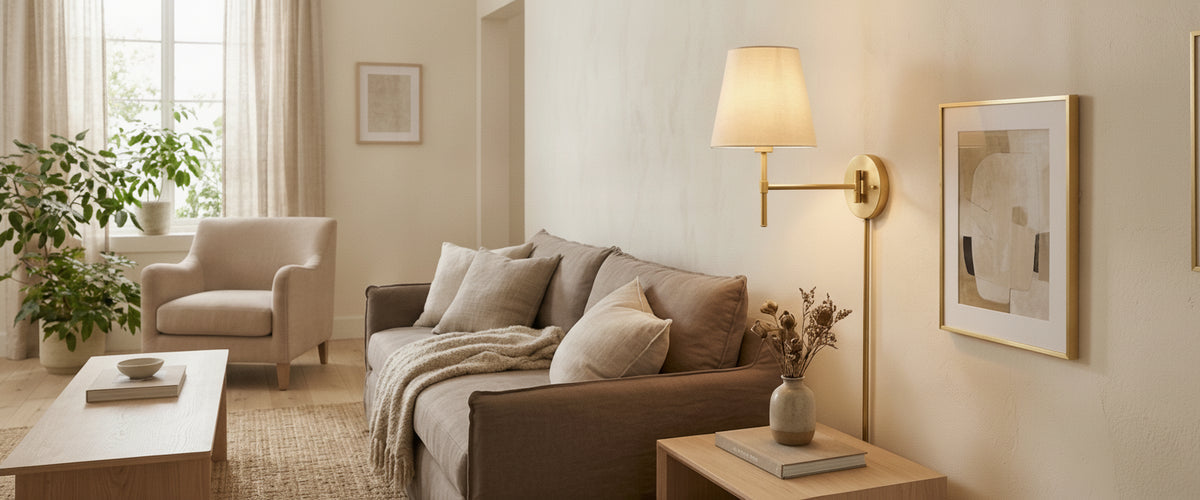

Gold reflects almost everything you throw at it, which means the lighting in a gold living room is doing half the decorating whether you planned for it or not. Get the light right and the metal reads deep, buttery and expensive. Get it wrong and the same room turns brassy, greenish, or oddly cold by nine in the evening. Gold is a finish with opinions, and it will argue with a cheap lamp.

Key Takeaways
Warm, not hot: aim for 2700K as your baseline, dropping to 2400K on decorative lamps for evening depth.
CRI matters more here than in a neutral room: look for 90+ with a strong R9 value, or your gold loses its red undertone.
Finish sympathy beats finish matching: antique brass, unlacquered brass and alabaster flatter gold; chrome and cool nickel undercut it.
One ceiling light is not a scheme. A single overhead source flattens contrast and kills the shimmer that makes gold worth having.
Dim to roughly 20 to 30 per cent on the main sources in the evening and let table lamps carry the room.
Budget follows material, scale and engineering, so ask for a tailored quote rather than guessing from a photograph.

Why a Gold Living Room Is More Demanding Than a Neutral One
Neutral rooms are forgiving. Plaster walls, oatmeal linen and pale oak absorb light diffusely, so a mediocre bulb still produces a pleasant result. Gold behaves differently. It is a specular surface, meaning it bounces light back at an angle rather than scattering it softly, and it carries a strong colour bias of its own. Every fitting you add is effectively tinting the room.
That specularity is also why a gold living room can look magnificent at 4pm in October and hollow at 8pm. Daylight arrives from a huge, diffuse source and lifts the whole surface evenly. A few downlights arriving from directly above hit only the horizontal planes, leaving the vertical gold details, picture frames, gilded mirror edges, brass table legs, in shadow. The shimmer disappears and you are left with the colour but none of the movement.
There is a second problem. Gold pairs naturally with deep, saturated companions: inky blues, oxblood, forest green, charcoal. Those colours eat light. A pale grey room lit to a given level and a deep green room lit identically will read very differently, because reflectance values across the surfaces can differ by a factor of five or more. A gold living room needs more light sources at lower individual outputs, not two bright ones working overtime.
Stone shades soften the output so gilded surfaces catch a raking wash rather than a hotspot.
Colour Temperature and CRI: The Numbers That Keep Gold Looking Like Gold
Gold sits in the red-yellow end of the spectrum, so it needs light that carries genuine red content. This is where colour rendering index matters. A lamp rated CRI 80 can still look acceptable on white walls while rendering deep reds poorly, and the specific measure to ask about is R9, the saturated red value that most budget LEDs quietly fail. Specify CRI 90 or above with a published R9 figure and the difference on a gilded frame is immediately visible: warmth instead of a dull yellow-brown.
On colour temperature, 2700K is the sensible default for a living room. Go to 3000K only if the scheme leans toward pale gold and cool stone; anything at 3500K or above will push warm metal toward a greenish cast. For table lamps and wall lights used late in the evening, 2400K adds depth after dark and suits gold particularly well. If your dimming system supports warm dim, where the colour temperature drops as output falls, use it. The Energy Saving Trust's lighting guidance is a useful starting point for understanding how LED specifications are labelled before you commit to a whole-room order.
Keep the specification consistent. Mixing a 2700K bulb in a pendant with a 3000K downlight and a 4000K floor lamp is the single most common reason a gold living room looks disorganised after dark. One colour temperature per room, with a deliberate warmer exception for decorative lamps, is the professional standard.
Which Fixture Finishes Amplify a Gold Palette, and Which Fight It
The instinct is to match gold with gold. Resist it. Matching a polished gold fitting to a polished gold coffee table usually produces a flat, showroom look because the two surfaces reflect at identical intensities and neither becomes the focal point.
Finishes that work with gold:
Antique and aged brass. Slightly darker and less reflective than the gold in your furnishings, so it recedes and lets the room's gold do the talking.
Unlacquered brass. It patinates over years, gaining depth that sits naturally alongside gilding. Expect the change; it is the point.
Alabaster. The strongest partner of all. Alabaster is a fine-grained gypsum stone that transmits light rather than reflecting it, so it softens and warms output while contributing a creamy, faintly veined counterpoint to hard metal.
Honey onyx and warm marble. Natural stone with amber banding shares gold's undertone without competing for shine.
Where you want the metalwork to read as patina rather than polish, a fitting such as the Christina 2 Light Wall Light in silver/gold patina sits half a step back from bright gilding, which is usually the right relationship on a chimney breast or either side of a gilt mirror.
Finishes that quietly work against gold: polished chrome and cool nickel, which introduce a blue bias; bright white opal acrylic, which reads clinical next to warm metal; and matte black used in large quantities, which can flatten the reflections that give gold its life. Small black accents are fine and often useful as punctuation.
Stone earns its premium here for one reason: light passing through alabaster arrives glowing rather than glaring, so a gold surface nearby catches a gentle wash instead of a hard hotspot. Our alabaster lighting collection is built around exactly that behaviour, with brass detailing that sits sympathetically alongside gilded joinery and metallic upholstery.
Why a Single Ceiling Source Collapses the Scheme
A high-contrast room lit from one point above becomes theatre in the worst sense: a bright ceiling, shadowed corners, and unflattering light on faces at the sofa. Gold suffers most because its appeal depends on the angle between the light, the surface and your eye. Move the source and the metal changes character. With one source, it never changes at all.
A more useful approach is four to six light sources at modest output, placed at different heights. A central pendant or chandelier sets the room's architecture and should be the piece you notice first; wall lights at roughly 1.5 to 1.6 metres (about 5ft to 5ft 3in) above finished floor lift the vertical planes; table lamps at 600 to 700mm (24 to 28in) overall height create the sitting-level glow; a floor lamp fills the awkward corner every living room has.
We shipped a pair of alabaster wall lights to a Bath townhouse last year where the client had a beautiful gilt overmantel mirror lit by nothing but two recessed spots. The mirror looked dead. Moving the light to either side at head height, behind stone shades, meant the gilding caught a soft raking wash from two directions. Same mirror, same room, entirely different evening.
Zoning With Wall Lights and Table Lamps
Pools of light give a gold living room its structure. Think of the room as three or four zones and light each on its own terms.
Four zones, four heights: ceiling piece, wall lights, table lamps and a corner floor lamp.
The Conversation Zone
Two table lamps at either end of the seating group, ideally with shades in ivory linen, parchment or translucent alabaster. Shade height should place the bottom edge near seated eye level so nobody looks directly at the lamp. This is where a warm 2400K bulb pays off. A lamp like the Arabella Table Lamp with its gold quatrefoil base and ivory linen shade suits the job because the gold is carried in an openwork form rather than a solid polished body, so it catches light without adding another mirror-bright surface at sofa height.
The Vertical Zone
Wall lights along the long wall, on chimney breasts, or flanking artwork. In a gold scheme these do the heaviest lifting because they light the surfaces that hold most of the metal. Hard-wired wall lights need a qualified electrician; if you are retrofitting into finished plaster, plan the chases before decorating rather than after.
The Anchor Zone
The ceiling piece. A chandelier or pendant in alabaster or marble acts as an object in daylight and a soft glow at night, which is a genuinely different job from a recessed downlight. Hang the lowest point around 2.1 metres (about 7ft) above the floor in a standard room, higher if it sits over a coffee table with clear sightlines beneath.
The Edge Zone
Corners, bookcases, plant groupings. A floor lamp or a small uplight stops the room's perimeter falling into black, which matters enormously in a dark, gold-accented scheme. Where the corner needs height without visual bulk, a slim form such as the Remyck Floor Lamp in brushed gold reads as a line rather than an object, and the brushed finish keeps the reflection soft instead of mirror-hard. Browse the wider natural stone lighting range if you are trying to keep one material language running across all four zones.
The Dimming Threshold That Decides Whether the Room Glows or Overwhelms
Gold has a tipping point. Above roughly 60 per cent output on general lighting, the reflections become hard and the room starts to feel like a hotel lobby at check-in. Below about 15 per cent, cheap LED drivers flicker, buzz or drop out entirely, and the metal goes muddy. The useful band for a gold living room in the evening is around 20 to 30 per cent on ceiling and architectural sources, with table lamps running higher because their light is contained by shades.
To get that band reliably, match the dimmer to the driver. Trailing-edge dimmers suit most modern LED drivers; leading-edge units designed for old incandescent loads are the usual culprit behind buzzing and poor low-end control. Ask your supplier for the minimum dim level of the specific driver before ordering, and have your electrician confirm the total load sits comfortably within the dimmer's rating.
One practical habit: set a scene. If you have a control system, programme an evening preset rather than relying on someone finding the right level by hand each night. Gold rewards consistency.
A Buyer's Checklist for a Gold Living Room Scheme
Confirm every lamp is 2700K unless deliberately specified warmer, and record it somewhere you will find it in three years.
Specify CRI 90+ with a stated R9 value on any fitting that lights metal, artwork or skin tones.
Choose one hero fixture, usually the pendant or chandelier, and keep the rest quieter.
Pair polished gold furnishings with aged brass or stone fittings rather than more polished gold.
Count your light sources. Fewer than four in a main living room almost always reads flat.
Check ceiling height and joist positions before committing to a heavy stone pendant; natural stone weighs considerably more than glass of the same size.
Confirm dimmer type and minimum dim level with your electrician before installation day.
Ask for a tailored quote rather than assuming a figure. Cost depends on stone selection, scale, metalwork complexity, engineering and finishing, and two visually similar pieces can differ substantially.
Keeping Alabaster and Brass Looking Right
Alabaster is softer than marble and sensitive to moisture, which is why it belongs in living rooms rather than bathrooms. Dust with a dry, soft cloth or a clean natural-bristle brush. Skip household sprays, vinegar and anything acidic, because gypsum stone reacts badly to them. Conservation practice for stone objects favours dry cleaning and stable humidity over wet methods, and the Getty Conservation Institute publishes useful background if you want the detail. If a shade picks up a mark, a barely damp cloth followed immediately by a dry one is the limit.
Unlacquered brass will darken. In a gilded scheme this is usually a benefit, since the fitting gradually pulls back from the brighter metal around it. If you want to hold the original tone, a light wax once or twice a year slows the process. Lacquered finishes need nothing beyond dusting; never polish them, as abrasive compounds cut straight through the coating.
Niori works almost entirely in alabaster and natural stone for this reason: stone ages into a scheme rather than dating out of it. A gold living room built around warm stone diffusion and restrained metalwork will still look considered long after the trend-led finishes have been replaced. Start with the light quality, then choose the pieces, and the gold will take care of itself.