
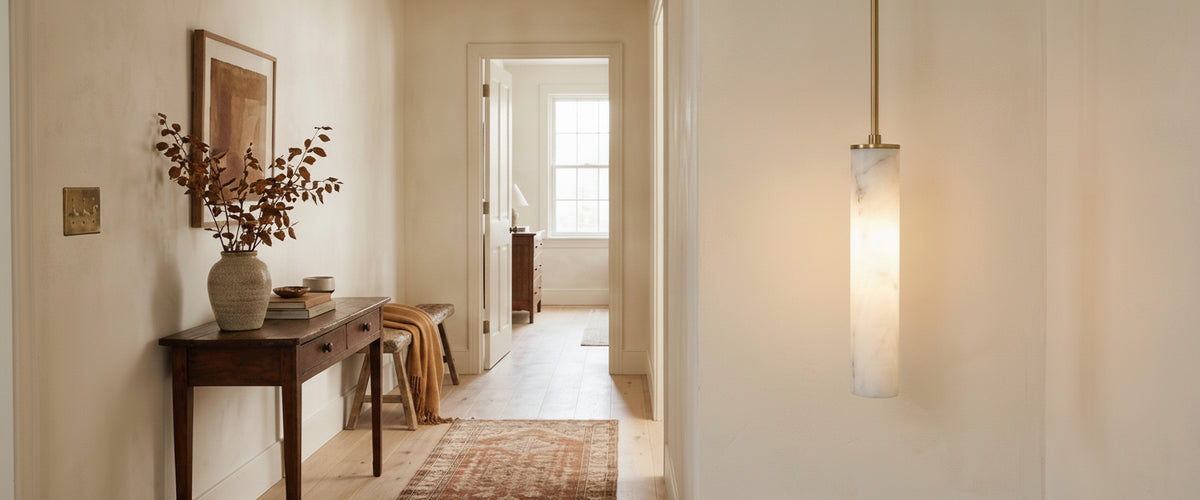

Walk into a finished room and your eye finds the switch plate before it finds the art. That is the awkward truth about antique brass sockets: they sit at hand height, they catch raking light from a window, and they tell you within a second whether the finishes were specified together or bought in three separate panics. A beautiful alabaster pendant with a warm brass collar can be undone by a white plastic plate four feet below it.

Key Takeaways
Antique brass sockets are a finish decision first. The wiring is your electrician's job; the tone, plate profile and screw detail are yours.
Match warmth, not brand names. Antique brass, aged brass and antiqued bronze all read differently under 2700K light.
Order your antique brass sockets in one batch. Antiqued finishes are applied by hand and vary between production runs.
Decide flush or raised early. The wall build-up and back box depth control the choice more than taste does.
Two metals per room is plenty. Three starts to look accidental unless one is clearly structural.

Why Electrical Accessories Give Away a Half-Planned Scheme
Lighting, joinery and hardware usually get a specification sheet. Sockets and switches get ordered late, often by whoever is on site that week. The result is a room where the pendant, the cabinet pulls and the faucet all agree, then a bank of gray plastic rockers appears beside the doorway and the whole thing loosens. A matching run of antique brass sockets would have held it together.
There is a practical reason antique brass sockets work so well in rooms lit by stone. Alabaster and onyx throw a soft, honeyed light with very little glare, and warm metals sit inside that light rather than punching out of it. Polished chrome under a translucent alabaster shade picks up a cold blue cast at the edges. Aged brass absorbs the warmth and looks like it belongs to the same family as the fixture above it.
Warm metalwork at switch height reads as part of the same family as the fixture above it.
We saw this clearly on a ranch remodel we shipped alabaster wall lights to in Napa. The client had already specified unlacquered antique brass sockets and switch plates throughout the hallway. Six months of hands on the switches had darkened them slightly, and the brass collars on the wall lights had done the same at a similar rate. Nobody planned that. It simply happened because the metals were related.
How Antique Brass Sockets Read Against Screwless, Brushed and Standard White
Finish names are marketing terms with no fixed standard, so compare samples in the actual room before committing. Broadly:
Antique brass has a darker, slightly mottled surface with visible depth in the recesses. It reads warm and settled, and it hides fingerprints better than any other brass finish.
Aged or antiqued brass is usually a touch lighter and more even. It pairs well with alabaster because it does not go muddy under low light levels.
Brushed or satin brass is cooler and more uniform, with a directional grain. It suits contemporary rooms but can look flat beside a hand-finished fixture.
Polished brass is mirror-bright and demands discipline. In a room with several windows it will flash at you from odd angles.
Standard white plastic is not a crime. In a utility room or a child's bedroom it is sensible. In a formal dining room lit by a stone chandelier, it is the detail guests notice and never mention.
Screwless or screwed? Screwless antique brass sockets clip over a mounting frame and give you an unbroken face, which suits minimal rooms and wide multi-gang banks. Screwed plates show two fixings, and in a period-style hallway that honesty looks right, especially with slotted screws aligned in the same direction. One rule matters more than the choice: pick one system and use it everywhere. Mixed screwless and screwed plates in the same sightline is the fastest way to make a run look assembled rather than specified.
Wall Colors and Surface Textures That Make Antique Brass Land
Antique brass sockets need contrast or they disappear. Against a mid-tone caramel or a warm beige, the plate vanishes into the wall and you lose the detail you paid for. The finish comes alive against:
Deep greens, inky blues and near-black, where the metal glints without shouting. This is why antique brass sockets look so good in NYC apartment libraries and Texas dining rooms with dark paneling.
Chalky off-whites and soft grays, which give the warmth something cool to push against.
Textured plaster and limewash, where the slight irregularity of an antiqued finish echoes the irregularity of the wall.
Dark paint gives a hand-patinated plate the contrast it needs to register as a detail.
Be careful with heavy wallpaper and wide-grain timber paneling. A raised antique brass socket on a busy pattern creates two competing edges. If the wall is doing a lot of work, use a flush plate and let the metal read as a quiet punctuation mark.
On a dark wall where the plate and the fixture are read against the same paint within a few feet of each other, the fixture needs a genuinely aged surface rather than a bright one; something like Curtis Large Wall Light, Aged Brass holds its warmth against inky paint in a way a polished fitting beside the same switch bank will not.
Stone floors and stone lighting change the calculation again. In a Hamptons entry hall with a marble floor and an alabaster ceiling light, the antique brass socket plates act as the warm thread connecting cool stone underfoot to glowing stone overhead. Where the ceiling is too low for a pendant to hang honestly, a semi-flush fitting such as Old Park 2 Light Semi-Flush Ceiling Light, Antique Brass keeps the brass at ceiling level without crowding the head height above the switches. That is worth planning deliberately rather than discovering by luck.
Flush Versus Raised Profiles, and the Batch Question
Flush antique brass sockets sit close to the wall and suit smooth plaster, particularly in contemporary schemes where you want the wall to look uninterrupted. Raised plates have a defined edge and a small shadow line, which reads more traditional and forgives slightly uneven plasterwork around the back box.
The decision is rarely purely aesthetic. Back box depth, plate thickness and the space behind the accessory all matter, and a licensed electrician should confirm what fits before you order a house full of anything. Ask about depth early; it is a miserable conversation to have when the plates are already on site.
Batch consistency is the issue buyers underestimate. Antique brass sockets get their color from chemical patination and hand work, so two orders placed weeks apart can differ in tone, sometimes noticeably. A designer we work with in Aspen ordered the ground floor in one go and topped up eight single-gang plates later for a guest suite; the second batch ran a shade cooler, and those eight plates had to be relegated to a laundry corridor. Order everything you need at once, plus spares, and keep the spares boxed and labeled.
Running Antique Brass Alongside Other Metals Without Visual Conflict
Mixing metals works when there is a hierarchy. Choose one dominant metal for the elements at eye level and above, then allow a second for a specific job: door hardware, a faucet, a curtain pole.
Antique brass with blackened steel is the safest pairing. The dark metal reads almost as a shadow, so the brass stays the story.
Antique brass with nickel or chrome needs separation. Keep the cool metal in wet zones and the brass in dry zones, and avoid putting them within the same 3 feet (about 1 m) of wall.
Antique brass with polished brass is the trap. Two brasses at different brightness levels in one sightline look like a mistake rather than a layered scheme.
Where a room needs directional light over a worktop or a run of shelving, keeping that fitting in the same brass family avoids introducing a third metal by accident; a restrained head such as Daneford Single Spotlight, Brass does the task job without setting up a second, brighter metal above the switch line.
The same logic governs how your accessories sit beside your fixtures. Brass detailing on alabaster and marble pieces tends to be warm and lightly aged rather than bright, which is why antique brass sockets pair so comfortably with them. If you are still choosing fixtures, it is worth browsing the alabaster lighting collection with a sample plate in hand so you can see the two warmths together rather than guessing from a screen.
Buyer's Checklist Before You Order at Scale
Count every position, room by room, including multi-gang banks, dimmer positions, floor outlets, USB modules and TV plates. Add spares.
Confirm gang counts so you are not left with a lone single next to a triple where a quad would have looked intentional.
Choose one plate system (screwless or screwed) and one profile (flush or raised) for the whole project.
Check finish under your actual light source. Antique brass sockets at 2700K look warmer and softer than the same plates under a showroom's cool downlights.
Ask whether the finish is lacquered or living. Lacquered stays put; living brass darkens with handling, which is charming in a hallway and inconsistent in a room where only one switch gets used.
Specify dimmer modules to match your lamps. Trailing-edge dimmers generally handle warm-dim LEDs better; give your electrician the driver details for every fixture.
Book the electrician before the plates arrive. Never treat socket or switch replacement as a weekend DIY task; have a qualified electrician carry out and certify the work.
Photograph the batch labels so a future top-up order has a reference.
The Mistakes That Show Up After Install
Mismatched tone across a run of antique brass sockets is the big one, and it usually comes from ordering in stages or from mixing two suppliers whose plates are patinated differently. Compare physical samples side by side; product photography will mislead you.
Orphaned single-gangs are the second. A kitchen with a run of doubles and one stray single at the end of the counter looks unresolved. Plan the layout as a composition: equal heights, aligned centers, consistent gang widths where possible.
Then there is the cleaning problem. Brass tarnishes because copper alloys react with sulfur compounds and moisture in the air, and abrasive polishes strip both lacquer and patina; conservation guidance on cleaning brass and copper is blunt about how much damage well-meant polishing does. For lacquered antique brass sockets, a dry microfiber cloth is almost always enough. For living finishes, leave them alone and let the handling do its work.
One final mistake: buying accessories before the lighting. Fixtures set the temperature of a room's metalwork, so specify pendants, wall lights and lamps first, then choose antique brass sockets and switches to agree with them. If the scheme is still open, working through the wider lighting range at Niori first will tell you which brass you are actually matching. As a studio working in alabaster, marble and onyx with brass detailing, we build most projects in exactly that order.
Budget for accessories depends on plate material, finish process, gang counts and how much the electrician has to alter existing boxes, so get a tailored quote once your schedule of positions is settled rather than guessing from a single unit cost.