
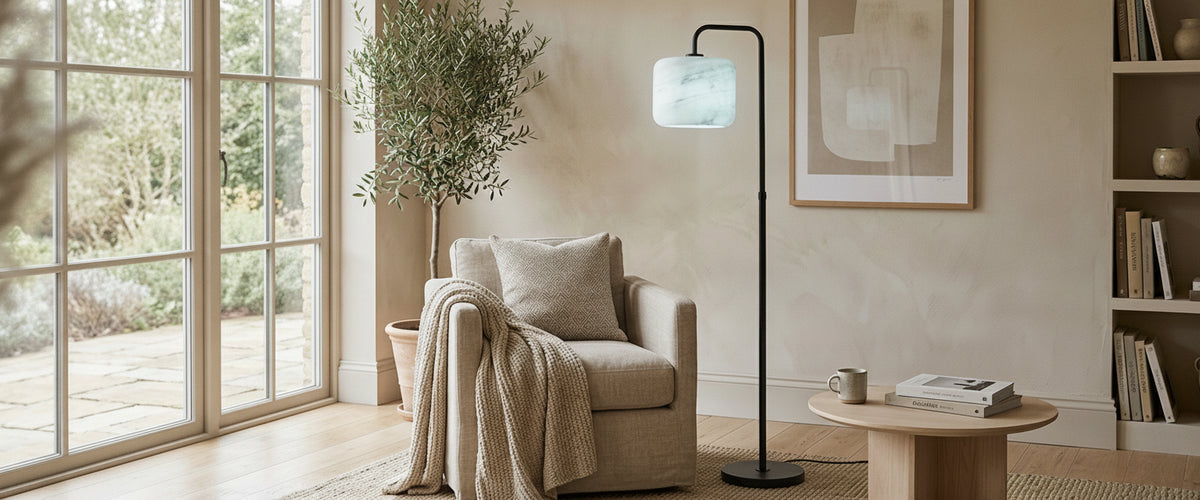

Most industrial style floor lamps give themselves away at ten in the morning, switched off. That is when you see the thin rolled tube pretending to be scaffold pipe, the sprayed-on "aged" finish that has gone slightly chalky, the shade that rings like a biscuit tin when you tap it. An industrial style floor lamps is one of the few pieces in a room that has to survive close inspection, because the whole aesthetic is built on exposed structure. Nothing is hidden. If the joints are cheap, the joints are the design.

Key Takeaways
- Weight tells the truth. Cast iron and solid steel bases feel planted; hollow spun bases wobble when someone walks past.
- The shade decides the mood. Bare metal throws hard, directional light. A stone or alabaster diffuser keeps the structural look and softens the glare.
- Finish matters more than form. Matte black, blackened steel and aged brass each read differently at night under warm light.
- Height beats styling. For reading, the bottom of the shade should sit roughly at seated eye level, around 1.2 to 1.5 m (4 to 5 ft) off the floor.
- Dimming is not optional. An industrial style floor lamp at full output is a workshop light. On a dimmer it becomes furniture.

Pastiche Versus the Real Thing
Genuine industrial lighting was engineered for function, and function left fingerprints: threaded conduit joints that could be unscrewed and reconfigured, counterweights sized to balance an arm, guards over bulbs because bulbs got broken. The good reproductions keep that logic. The weak ones keep only the look, which is why a decorative cage welded shut over a bulb that cannot be reached always feels slightly silly.
Three details separate a considered industrial style floor lamp from costume. First, fasteners: real hardware is visible, symmetrical and does a job, while decorative rivets pressed into sheet metal are stage dressing. Second, articulation: if a lamp has a boom, a knuckle or a swing arm, it should actually move and hold position under its own friction. Third, finish depth. Powder coat over steel has body and a faint texture; sprayed lacquer over zinc alloy looks flat and picks up scratches that show silver underneath. Tap the shade. A solid component answers with a dull note rather than a rattle.
The style has a real lineage worth knowing. Early twentieth-century task lighting, and the Bauhaus reworking of it into domestic objects, established the visual language that retro industrial floor lamps still borrow from today, and the Design Museum collection is a useful reference point for how quickly workshop hardware became a design idiom.
Base Material for an Industrial Style Floor Lamp: Steel, Cast Iron or Aged Brass
The base is the part your eye reads first and your shins meet eventually, so material choice changes how the room feels.
Raw and Blackened Steel
Steel is the purist's choice, and the slimmest industrial style floor lamp silhouettes are all built from it: high strength, narrow profile, and a matte black or gunmetal finish that disappears into a dark corner and reappears as an outline when the lamp is on. A black industrial floor lamp in blackened steel works hardest in rooms with pale plaster walls or light oak floors, where the contrast does the styling for you. Where you want that silhouette without a heavy tripod footprint, something like the Remyck Industrial Floor Lamp in matte black reads as a drawn line against the wall rather than a mass in the corner. The trade-off with steel is stability: it is strong but not heavy, so look for a weighted foot or a wide tripod stance.
Cast Iron
Cast iron is the honest option for vintage industrial floor lamps forms, especially anything with a boom arm or an adjustable upright. The mass is the point; it counterbalances a long reach without anchoring. We flag two-person handling on an iron-based industrial style floor lamp for a reason, and it is worth telling your courier or fitter in advance. Cast surfaces also carry a slight granularity that catches light beautifully at low output.
Aged Brass
Aged brass is where industrial stops being austere. It warms the whole fixture, sits comfortably next to walnut and leather, and keeps changing with handling as the patina develops. Solid brass will darken over years; lacquered brass holds its tone but can eventually show wear at contact points. In a room where blackened steel would feel too severe next to timber, a brass industrial style floor lamp such as the Provence Industrial Floor Lamp keeps the workshop geometry while warming the whole corner. Brass detailing against a stone or alabaster element is the most forgiving combination we sell. You can compare finishes across the uprights in our lighting collection to see how differently each metal behaves in the same form.
Why the Shade Is Where Most Industrial Style Floor Lamps Lose the Plot
Here is the practical problem. A metal dome or cone was designed to push light down onto a bench, and it does that ruthlessly. Put the same shade beside a sofa at 1.5 m (5 ft) and you get a hot pool of light on the rug, a bright bulb edge in your peripheral vision, and a ceiling left completely dark. The room reads gloomy even though the lamp is bright, and it is the most common failure in the whole category.
The fixes, in order of how well they work. A deep shade with a genuine internal reflector, ideally white or brushed pale metal inside, softens the cut-off. A wire guard with a frosted bulb reduces the point source. Best of all, a translucent stone diffuser: alabaster or thin marble carries light through the material itself, so you keep the structural metal armature and lose the glare entirely. This is the combination that has quietly taken over the industrial category, and it is the heart of what Niori does as an alabaster and natural-stone lighting brand. An alabaster drum on a blackened steel upright behaves like a lantern rather than a spotlight, and the veining glows differently on every piece. Our alabaster lighting collection shows how stone changes the character of otherwise hard-edged metalwork.
One caution: stone components are heavier and more brittle than glass or metal, so check the fixing detail. A stone shade should be cradled or seated on a machined collar, not clamped onto a thin threaded rod.
Rooms Where an Industrial Style Floor Lamp Pulls Its Weight
Some rooms take this style easily. Others put up a fight.
- Converted spaces. Mill and warehouse conversions with exposed brick, steel windows and high ceilings are the natural habitat. We shipped a pair of tall booms into a Yorkshire mill apartment last winter where the ceiling was well over 4 m (13 ft); the arms reached over the seating without a single ceiling penetration, which the leaseholder could not have made anyway.
- Home offices and studies. An adjustable upright behind a desk gives directional task light that a table lamp cannot match, and it frees the desktop.
- Reading corners. A swing-arm or boom lamp beside a wing chair is the single best use of the form. Task light where you need it, nothing spilling onto a television.
- Hospitality and hotel lounges. Industrial look floor lamps survive contract use better than delicate decorative pieces, and a stone diffuser keeps guest-facing glare under control.
- Where they struggle. Small period sitting rooms with low ceilings and busy pattern. Industrial forms need visual air. Also avoid tight circulation routes: a tripod foot or a projecting boom in a narrow hallway is an ankle hazard and will be kicked.
Filament, Frosted or Matte: What the Bulb Does to Metal at Night
The bulb is half the finish of any industrial style floor lamp. Same fixture, three bulbs, three different rooms.
A visible filament LED around 2200K to 2400K gives that amber, slightly theatrical light that flatters aged brass and warm patina. It is gorgeous and it glares, so only use it behind a guard, deep in a shade, or well above or below sightlines. A frosted or opal bulb at 2700K is the sensible default: it evens out the light on the inside of a metal shade and stops hotspots reflecting as bright arcs. A matte or fully diffused bulb is what you want behind alabaster or marble, because any point source will otherwise show as a bright spot through the stone.
Stay warm. Cool white above 3500K turns blackened steel a dead grey and makes brass look brassy in the worst sense. Check the CRI too; above 90 keeps leather, timber and stone veining looking like themselves. And buy dimmable, with a trailing-edge dimmer matched to the driver, or you will get flicker and buzz at low settings.
Getting the Light to Actually Work: Height, Beam Angle and Task Versus Ambient
Decide what the industrial style floor lamp is for before you decide how it should look. For reading, the shade opening wants to sit just above shoulder height when seated, so light falls on the page and the bulb stays hidden; roughly 1.2 to 1.5 m (4 to 5 ft) is the workable band for most seating. For ambient fill, go taller, 1.6 m (5 ft 3 in) and up, with an uplight component or a translucent shade that pushes light onto the ceiling as well as the floor. For that ambient job a tall column with a pale fabric drum, such as the Ascent Column Floor Lamp in black with a white shade, lifts light towards the ceiling in a way a bare metal cone never will.
Beam angle follows the shade. Narrow metal cones give 30 to 45 degrees, dramatic but patchy; you will need a second light source in the room. Wide domes and stone cylinders spread past 90 degrees and can carry a corner on their own. Boom lamps are the exception worth planning for: measure the reach so the shade lands over the arm of the seat rather than over your head, and check the counterweight actually holds when the arm is extended.
Wiring, finally. Floor lamps are plug-in, which makes them the easy win in listed or leasehold properties, but cable routing under rugs and across walkways causes more accidents than anything else in this category. Any hard-wiring, socket relocation or dimmer replacement should go to a qualified electrician; Electrical Safety First publishes clear UK guidance on what is and is not a competent-person job.
A Quick Checklist Before You Buy an Industrial Style Floor Lamp
- Measure the corner or the space beside the chair, including the footprint of the base and any boom reach.
- Check total height against your seating, not against the room.
- Lift it, or ask for the shipping weight. Reassuring mass usually means real material.
- Confirm the shade interior colour and whether the bulb is visible from seated eye level.
- Confirm dimmability, driver type and which bulb cap fits.
- Ask whether metal parts are lacquered or left to patina, so you know what to expect in five years.
- For stone or alabaster components, ask how the shade is seated and whether it can be removed for cleaning.
- Check cable length against the nearest socket. Extension leads across a room are a compromise you will regret.
Care: Keeping Metal and Stone Looking Intentional
Blackened and powder-coated steel needs almost nothing: a dry microfibre cloth, and a barely damp one for fingerprints. Skip anything abrasive, because scuffing the coating exposes steel that will spot in humid rooms. Unlacquered brass is a choice, not a problem. Leave it and it deepens; polish it lightly with a brass cream once or twice a year and it stays brighter. Do not mix the two approaches halfway through, because uneven patina looks like neglect rather than age.
Alabaster and marble want different handling. Stone is porous and reacts badly to acids, so no vinegar, no citrus cleaners, no general-purpose spray. Dust dry, and if a mark needs lifting, use a slightly damp cloth with distilled water and dry immediately. Conservation guidance from institutions such as the Smithsonian's Museum Conservation Institute is consistent on this point for calcite-based stone. Let a warm shade cool before touching it, and never clean around a live fitting.
Building Your Own, or Buying Properly
Plenty of people search for how to build an industrial pipe floor lamp, and the appeal is obvious: galvanised fittings are modular and the geometry is forgiving. Done well, a self-built lamp can look excellent. Done badly, it is a top-heavy tube with exposed flex and no strain relief. If you go that route, get the electrical assembly, earthing and plug termination signed off by a qualified electrician, and be honest about the base weight needed for anything with an arm. What a workshop build almost never achieves is the part that matters most in a finished room: a diffuser that turns hard light into something you want to sit under. That is where a bought industrial style floor lamp earns its money, and it is the reason we pair industrial armatures with hand-finished stone. Start at the Niori homepage if you want to see how the metal and stone pieces sit together across the range.