
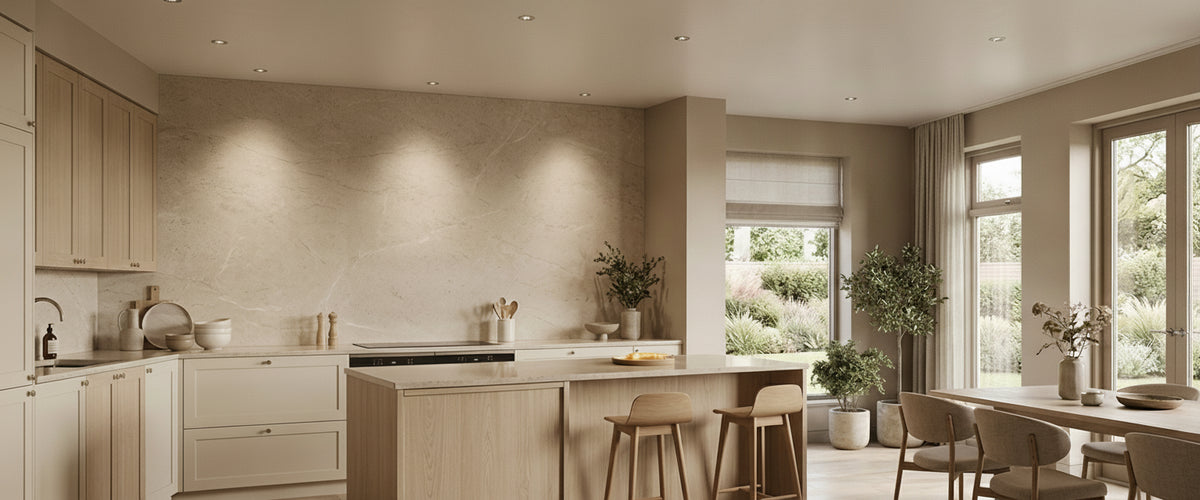

Walk into most newly renovated kitchens and count the holes in the ceiling. Twelve, sometimes sixteen, each one a wide trim ring casting a hard little pool on the counter below. The lighting works, technically. The ceiling looks like a colander. This is the exact problem that led mini recessed spotlights were designed to solve, and the reason specifiers keep moving toward smaller apertures even when the lumen math says they do not have to.

Quick Answer: What Matters Most
- Aperture beats output. A smaller trim reads as a point of light rather than a fitting, which keeps the ceiling plane quiet.
- RA90 or better is the floor for any scheme lighting joinery, stone, textiles or food. Below that, warm materials go flat and gray.
- Match driver to dimmer before you buy. Most flicker complaints are a compatibility problem, not a fixture fault.
- Check plenum depth early. Joist depth, insulation and ductwork derail more tight specs than budget does.
- LED mini recessed spotlights support decorative lighting. They should never be the whole scheme, especially in rooms with alabaster pendants or stone surfaces doing the emotional work.

A Smaller Aperture Changes How a Ceiling Reads
Human eyes register the ceiling as a surface, and anything interrupting that surface registers as clutter. A standard downlight trim announces itself. Most LED mini recessed spotlights sit somewhere in the one to two inch (roughly 25 to 50 mm) aperture range, depending on the range you specify, and disappear into the plane, leaving only the light behind.
The practical result is that you can use more of them without the ceiling looking busier. In a Napa dining room we supplied an alabaster chandelier for last year, the architect had drawn six large downlights around the table. The revised scheme used more tiny apertures, placed off the table axis and aimed at the walls and the stone fireplace. The room got brighter and looked emptier at the same time.
Deep-set optics help further. A recessed source with a dark baffle cuts the glare you see when seated, which matters in dining rooms, hotel lounges and any space where people spend time looking slightly upward. Shallow, bright-trimmed fittings pull the eye to the ceiling and away from whatever you actually wanted lit.
Where LED Mini Recessed Spotlights Win, and Where They Struggle
They win at accent work. Grazing a limestone wall, picking out artwork, lighting a glass-fronted cabinet, washing a run of oak joinery, marking a corridor without turning it into an airport pier. Narrow beams from a compact housing give you precision that larger fittings blur. They also win in low-ceiling rooms and in properties where you are threading fittings through existing structure, because smaller cut-outs mean fewer collisions with joists.
They struggle when asked to carry general illumination alone. A grid of narrow-beam spots in a large living room produces scallops, hot spots and dark middles, and it flattens faces badly because all the light arrives from directly overhead. They also struggle under very high ceilings, where output falls off fast and you end up over-specifying quantity, which reintroduces the colander problem.
Circulation routes show it clearest. Where a corridor or stair needs orientation rather than a line of downlights overhead, a fitting set low in the wall such as the Grimstad LED Recessed Wall Light puts the light where feet actually are and leaves the ceiling untouched.
The honest rule: use small spots for what they do well and let decorative fixtures handle ambient warmth. Browse the range of alabaster lighting and you will see why we treat recessed fittings as the supporting cast rather than the lead.
RA90 Color Rendering in Miniature Housings
Squeezing a decent LED, its optic and its thermal path into the tiny housings used by LED mini recessed spotlights tempts manufacturers to cut corners, and color rendering is usually the first casualty. An RA80 chip is cheaper and runs cooler. It also renders warm stone, terracotta, walnut and human skin noticeably worse, because the deep red end of the spectrum is where the savings come from.
Specify RA90 minimum and ask about R9, the saturated red value, separately. Two fittings can both claim RA90 while behaving very differently on a marble slab with rust-colored veining. The measurement conventions are set out by the International Commission on Illumination, and reputable manufacturers publish the full data rather than a headline number.
Color temperature deserves the same discipline. For residential interiors, 2700K reads warm and domestic; 3000K suits kitchens and hospitality back-of-house. Mixing the two across one ceiling is a mistake you will notice every evening. Alabaster warms transmitted light, so cooler recessed sources beside it can look clinical. Binning tolerance matters too: twenty mini recessed led spotlights units with loose binning will show visible color drift across a room.
Grouping, Dimming Curves and Driver Matching
Flicker, buzz, pop-on at 30 percent, and a row of fittings that dim at slightly different rates: nearly all of it traces back to a mismatch between driver and control gear rather than a defective light.
Decide early whether you are running mains dimming (leading or trailing edge), 0-10V, DALI or a proprietary smart protocol. Commercial and hospitality projects usually benefit from DALI because it addresses fittings individually and holds calibration across a large grid. Residential schemes do beautifully on trailing-edge dimming provided the driver is rated for it and the load sits inside the dimmer's range. Undersized loads are a common failure; a handful of low-wattage LED mini recessed spotlights on a dimmer built for a 400W incandescent load will misbehave.
Ask about the dimming curve as well as the range. Perception of brightness is not linear, so a logarithmic curve tracks human vision better and makes the bottom end usable. Anything that claims 1 percent but stalls at 15 will not give you the candle-adjacent setting that makes a dining room work.
Group by task, never by convenience: perimeter grazers on one circuit, task pools on another, decorative pieces on a third. Always have a qualified electrician carry out installation and commissioning.
Installation Depth and Joist Clearance
This is where otherwise elegant specifications for LED mini recessed spotlights collapse. Everyone checks the cut-out diameter; the recess depth and the clearance required above the fitting are the numbers that catch people out. Before ordering, confirm the following with your contractor:
- Available plenum depth between ceiling finish and structure, at the tightest point rather than the average.
- Joist direction and centers, so your grid does not need redrawing on site.
- Whether the driver is integral or remote. Remote drivers save depth but need accessible housing for future replacement.
- Insulation contact rating, if the ceiling sits beneath a cold roof or insulated floor void.
- Fire rating requirements, confirmed by your electrician against local regulation.
- Any ductwork, pipework or steel that will not move for aesthetic reasons.
When the void simply is not there, a shallow surface-mounted fitting is the honest answer rather than a compromised recess. Something like the Welland LED Mini Flush Ceiling Light sits close enough to the plane to keep the ceiling quiet, and the aged brass reads as a considered detail rather than a fallback.
One more thing from the studio: tape your positions to the ceiling and live with them for a day before the holes are cut. A Texas client did exactly that and moved every fitting four inches closer to the wall, turning a line of floor spots into a proper wall wash. Free to do, impossible to undo.
Longevity Where Re-Lamping Is Not an Option
In a restaurant with a nine-meter atrium or a hotel corridor running eighteen hours a day, replacing fittings means scaffolding, closures and lost revenue. Integrated units are sealed, so you are buying the light engine, the driver and the thermal design as a single commitment.
Where access is easy and the client wants to change output or color temperature later, a lamped housing taking a standard GU10 LED spotlight bulb keeps that decision reversible, which matters more in a utility space than in a dining room.
Look for published L70 and L90 figures at a stated ambient temperature rather than a bare hour count. The U.S. Department of Energy's work on solid-state lighting explains how lumen maintenance is measured and why heat management drives it. Small housings have less mass to dissipate heat, so thermal design separates the good miniature fittings from the disposable ones. Ask about spares policy and continuity of the range too; mismatched color temperature in year six is worse than the original fault.
Buyer's Checklist Before You Specify
- RA90 minimum, with R9 data supplied and tight color binning across the batch.
- One color temperature per space, chosen against the warmth of your stone and timber.
- Beam angle selected per task: narrow for accent and grazing, wider for general fill.
- Deep-set optic with a dark baffle in any seated space.
- Driver and dimmer confirmed compatible, with a logarithmic curve and a genuine low end.
- Circuits grouped by layer, not by room.
- Recess depth, insulation contact and fire rating verified on site by a qualified electrician.
- Lumen maintenance data and spares availability confirmed for commercial installs.
- Decorative layer specified first, recessed layer designed around it.
Letting the Stone Do the Talking
Alabaster earns its place because it transmits light rather than reflecting it, giving a glow with no visible source and no glare. Recessed fittings do the opposite, and that contrast is the whole point. Use LED mini recessed spotlights to build structure, definition and task light; use alabaster pendants, wall lights and table lamps to give the room its temperature and its character. The two layers should never compete.
A useful test: switch off the recessed circuit entirely and see whether the room still works. If it goes dead, the decorative layer is underspecified. If it settles into something softer, you have the balance right. That principle runs through the Niori lighting collection, where the stone pieces carry a room on their own and the technical layer supports them.
Get the spec right at drawing stage and the ceiling becomes invisible, which is exactly what you want. Get it wrong and no amount of beautiful stonework downstairs will rescue it. If you want the decorative layer settled before the holes are cut, the team at Niori is happy to talk through fixture selection, materials and lead times, and to quote against your actual drawings rather than a guess.