
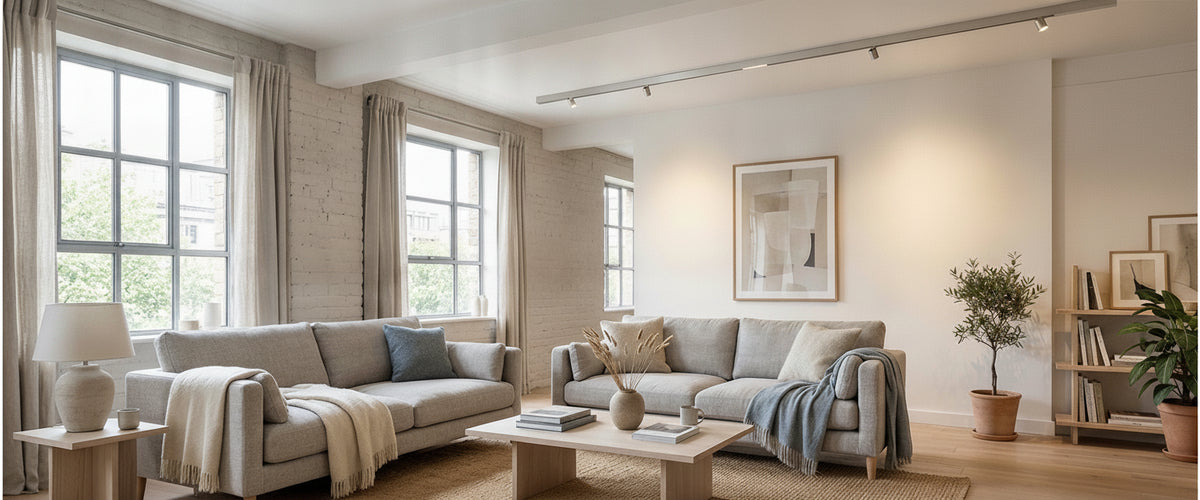

Most disappointing led track lighting installations are not the fault of the fittings. They fail because someone drew a straight line across a plan, spaced the heads evenly, and never stood in the room to check what those beams actually hit. An LED track light run is the most adjustable ceiling system you can buy, which is exactly why it punishes lazy planning. Get the height, span and aim right and it does work no pendant can do. Get them wrong and you have a row of glare sources pointing at your guests.

At a Glance
- An LED track light is an accent tool first. It lights objects, surfaces and walls. It is a poor substitute for soft ambient light.
- Mounting distance matters more than spacing. For wall washing, the track usually sits around 0.6 to 0.9m (2 to 3ft) off the wall, not tight against it.
- GU10 track spotlight heads keep you flexible. You can swap output, colour temperature and beam angle on an LED track light later. Integrated LED modules give cleaner optics but fix your choices.
- Beam angle does the design work. Roughly 15 to 24 degrees for accent, 36 to 60 degrees for wash.
- Layer it. Track handles precision; alabaster pendants, wall lights and table lamps handle atmosphere.
- Dimming compatibility is a specification, not an afterthought. Confirm driver type and dimmer before installation, and use a qualified electrician.

Why Track Suits Some Ceiling Planes and Actively Fights Others
An LED track light run loves a flat, uninterrupted ceiling with a clear relationship to the walls below. Galleries, open-plan kitchens, converted mills, retail floors and long hallways all give the system what it needs: a straight run, a decent drop, and something worth pointing at.
It fights coffered ceilings, heavily beamed barn conversions, vaulted roofs with changing pitch, and low Victorian bedrooms where the heads end up in your eyeline the moment you sit up in bed. It also fights rooms with no visual anchor. A track over a bare wall in a lounge with nothing on it simply lights blank plaster and tells everyone the scheme is unfinished.
Ceiling height sets the boundary. Below roughly 2.3m (7ft 6in), a surface-mounted LED track light starts intruding on head height and sightlines, and the beams flatten out too quickly to model anything. Where you do have to work at that height, drop the output per head rather than the head count: a lower-lumen lamp such as the GU10 LED Bulb 3.1W 230lm Warm White keeps the beam from scorching a surface that is only a metre and a half below it. Between 2.4m and 3m (8 to 10ft) is the sweet spot for domestic work. Above that, track becomes genuinely useful for reaching down into a room that a single ceiling fitting cannot cover, though at real height you want narrower optics and better shielding.
The Numbers Buyers Skip: Mounting Height, Track Span and Sightline Angles
Three measurements decide whether an LED track light scheme looks deliberate or improvised.
Offset from the wall. For washing art or a stone feature wall, keep the track roughly a quarter to a third of the ceiling height away from that wall. On a 2.7m (9ft) ceiling that lands near 0.7 to 0.9m (28 to 36in). Too close and you get a harsh scallop at the top of the wall with the lower half in shadow.
Aim angle. The standard gallery rule is a 30-degree tilt from vertical. It puts light on the object and keeps the reflected beam out of the viewer's eyes. Push past 45 degrees and you create veiling reflections on glass, gloss paint and polished marble; stay under 20 degrees and you get top-heavy shadow and long drop shadows from frames.
Span and head count. A run of track wants breathing room at both ends. Stopping 300 to 450mm (12 to 18in) short of the return wall reads far better than running the track wall to wall. As a working rule, allow one head per object you actually want lit, plus one or two for general fill, rather than distributing heads at fixed centres and hoping.
We shipped a set of alabaster wall lights to a converted warehouse flat in Manchester where the electrician had already installed a 3m track dead centre across the ceiling. Centre lines rarely coincide with anything worth lighting. The track ended up relocated by around 800mm so the heads could graze the exposed brick, and the alabaster fittings took over the job of filling the room with soft light. That split of duties is the whole argument of this article.
GU10 Track Spotlight Heads Versus Integrated LED Modules
Every LED track light head falls into one of two camps. A gu10 track spotlights takes a replaceable lamp. An integrated head has the LED bonded to its own heatsink and optic, so the whole unit is the light source.
Choose GU10 heads when: the use of the room may change, you want to tune colour temperature and beam angle after seeing the space at night, the client wants to handle replacements themselves, or you need to match output across fittings bought at different times. GU10 also makes it easy to trial a 36-degree lamp against a 24-degree one on the same night.
Matching output across a run is easier if you lamp the whole track from one batch; something like the GU10 LED Bulb 4.7W 345lm Warm White, 6 Pack covers a typical four to six head domestic run with a spare, and avoids the patchwork of slightly different whites that appears when lamps are bought one at a time.
Choose integrated modules when: you need tighter optics, better glare control, higher colour rendering consistency, or a very slim head profile. Precision retail and gallery work usually goes integrated for a reason.
The swap has real consequences for dimming. A GU10 track spotlight carries its own tiny driver inside each lamp, so a run of eight LED track light heads means eight small loads that a wall dimmer has to read; drop below the dimmer's minimum load and you get flicker, buzz, or lamps that refuse to strike at low level. Integrated heads run from one specified driver, so dimming behaviour is predictable but locked to the protocol the manufacturer chose, whether that is trailing edge, 1 to 10V or DALI. The Lighting Industry Association publishes compatibility guidance worth reading before you commit, and any mains work should be carried out by a qualified electrician.
Finish and Colour Temperature Pairings That Set Mood Rather Than Flatten It
Two decisions that get treated as afterthoughts: what the track is made of, and how warm the light is.
Matte black track disappears against dark ceilings and reads graphic against white ones. White track vanishes on plaster and is the safer choice in a domestic room where you would rather see the effect than the equipment. Brushed brass or bronze heads sit beautifully alongside alabaster and marble fittings, because you are repeating the metal detailing already present in the stone pieces rather than introducing a third material language.
On colour temperature, 2700K is the domestic default and flatters warm stone, oak and plaster. 3000K suits kitchens, art and anything where you want crisper definition without going clinical. 4000K belongs in workshops, utility spaces and some retail. Daylight lamps in the region of 6500K, such as the GU10 LED Spotlight Bulb 4.7W 345lm Daylight, earn their keep over a workbench, in a garage or in a utility room where colour accuracy beats atmosphere, but put the same lamp over a dining table and the room turns grey.
Critically, keep the LED track light at the same colour temperature as your decorative lighting. Alabaster transmits a naturally warm, honeyed light because of the way calcite scatters it through the stone; the Metropolitan Museum's material notes on alabaster and calcite carving describe that translucency well. Pair a 2700K alabaster pendant with 4000K spots and the mismatch is instantly visible, and the stone looks dull rather than lit from within. Browse the alabaster lighting range with your chosen lamp temperature in mind and the whole scheme holds together.
Beam Angle Choices That Separate Accent Work From Ambient Wash
Beam angle is the single most underused control in an LED track light scheme, and the cheapest to correct.
- 10 to 15 degrees (narrow spot): sculpture, a single framed piece, a stone bowl on a console. Dramatic, unforgiving of aim errors.
- 24 degrees (spot): the workhorse for artwork, joinery detail and worktop task light at normal ceiling heights.
- 36 to 40 degrees (flood): kitchen islands, dining tables, general fill between accents.
- 60 degrees and wider (wide flood): wall washing, bookcases, textured stone or brick where you want even coverage rather than hot spots.
Mixing angles on one track is a sign of a considered scheme, not an inconsistent one. A run of four identical 36-degree heads produces four identical pools of light and no hierarchy. Two narrow heads on the art, one flood on the seating area and one wide flood grazing the wall gives the room depth.
Six Placement Mistakes That Appear in Both Residential and Hospitality Installs
- Track centred on the room instead of aligned to what it lights. Symmetry on a plan means nothing if the objects sit off centre.
- Heads aimed straight down over a dining table. You get bald spots on heads, shadowed faces and glare off glassware. Let a pendant own the table and keep the track for the perimeter.
- Too many heads on one run. An overloaded LED track light looks busy in daylight and floods the room at night. Fewer, better-aimed heads win.
- No shielding in a room where people look up. Restaurants are the worst offenders. Deep-recessed heads, honeycomb louvres or snoots solve it.
- Spots aimed at mirrors, glass cabinets or polished marble. Reflected beams reach the eye at full intensity. Test the aim at seated height before final tightening.
- Track used as the only light source. This is the big one. Directional light alone makes a room feel like a stockroom after dark.
Layering Track With Alabaster and Natural Stone
Track earns its place when it is doing what only track can do. Everything else belongs to fittings that glow rather than point. Alabaster pendants over an island, a pair of stone wall lights flanking a fireplace, a marble table lamp on a sideboard: these give the low, diffused light that makes a room feel inhabited, while the spots pick out the things you actually want to see.
A useful test at handover. Turn every LED track light off and see whether the room still works. If it collapses into gloom, the decorative layer is undercooked. At Niori we spend most of our time on that second layer, which is why our advice on track is consistently to specify less of it than you think you need. If you are building a scheme from scratch, it helps to shortlist the decorative pieces first and let them set colour temperature and brightness, then browse the broader lighting collection for the supporting fittings.
Pre-Order Checklist
- Measure ceiling height and confirm the track will clear sightlines from seated and standing positions.
- Mark what each head will light. If a head has no job, delete it.
- Set the wall offset from ceiling height, not from habit.
- Decide GU10 track spotlight heads or integrated modules based on how likely the room is to change.
- Fix one colour temperature across track and decorative fittings, usually 2700K or 3000K at home.
- Specify beam angles per head, not per run.
- Confirm dimmer type, minimum load and driver compatibility in writing.
- Check ceiling construction and supply routes with a qualified electrician before ordering track lengths.
- Plan the alabaster or stone layer at the same time, not after the plaster is patched.
Budget for an LED track light scheme depends on head count, optic quality, finish, control gear and the complexity of the install, so the sensible route is a tailored quote once the layout is settled rather than a guess from a plan. If you want help balancing directional light against the softer, warmer output of natural stone fittings, our team is happy to look at your drawings; start with the Niori collections and tell us what the room needs to do after dark.