
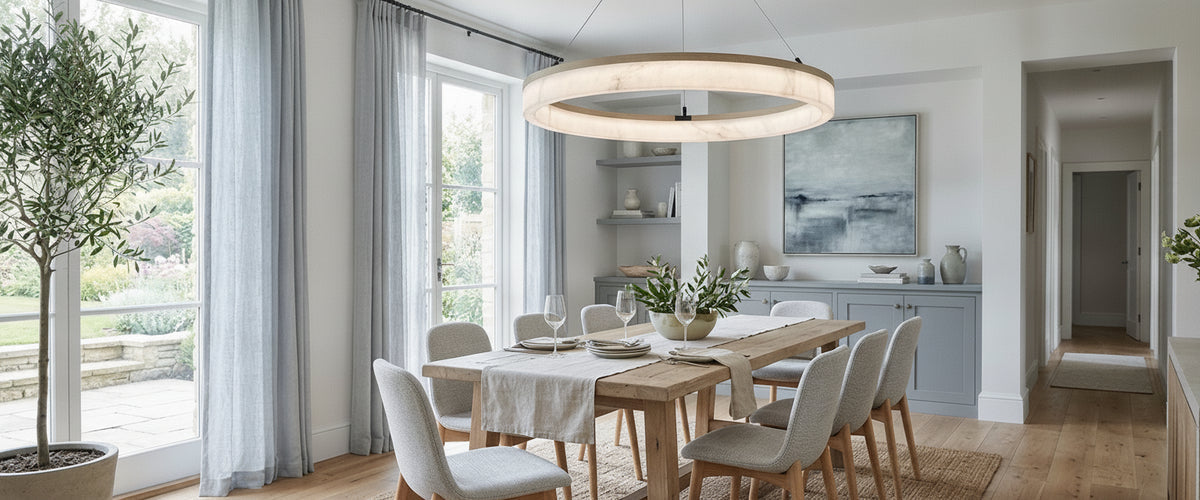

Most large dining room chandeliers fail for one dull reason: the fixture was chosen before anyone measured the room. The piece arrives, goes up, and sits either two sizes too small above a three-meter table or so low that guests on the far side lose eye contact. Scale is the whole game, and it is decided by arithmetic long before it is decided by taste. Get the sums right and even a quiet alabaster drum will hold a formal dining room; get them wrong and no amount of crystal will rescue it.
What counts as large: in practice, a large dining room chandelier is any ceiling fixture wider than about 80 cm (31 in), heavier than about 5 kg (11 lb), or carrying six or more light sources. Past any one of those three thresholds the specification changes: the fixing becomes structural, the drop has to be calculated rather than eyeballed, and the finish starts behaving differently across a bigger surface. Buyers typing large chandeliers dining rooms into a search bar are almost always solving one of three problems: a long table, a high ceiling, or a plasterboard ceiling with nothing solid behind it. The consolation is that big fixtures are easier to specify than small ones, because the numbers are blunt enough to tell you what to buy.

At a Glance
Width: aim for roughly half to two thirds the width of your table, never wider than the tabletop, and leave at least 15 cm (6 in) of clear surface on each side.
Quick sizing sum: add the room's length and width in meters, then multiply by about 10 to get a sensible fixture diameter in centimeters. A 6 m by 4 m room lands near 100 cm (39 in).
Drop: hang the lowest point 76 to 91 cm (30 to 36 in) above the tabletop, raising it slightly on ceilings above 2.4 m (8 ft).
Weight: large dining room chandeliers above about 5 kg (11 lb) need a confirmed structural fixing into a joist, noggin or timber pattress, not a plasterboard rose.
Output: budget roughly 2,500 to 4,000 lumens across the whole fixture for a 6 m by 4 m dining room, every lumen of it dimmable.
Light quality: warm 2700K, CRI 90 or better, and a dimmer matched to the driver. Dining light should flatter food and faces.
Material: alabaster and onyx diffuse from the body of the fixture, so they read as large without reading as heavy.
One of the quietest specifications available is also one of the simplest: a wide alabaster drum sized to two thirds of the tabletop, hung 80 cm above the surface, on its own dimmed circuit.

Why "Large" Is Relative: The Sum Most Buyers Skip
There is no absolute threshold where a chandelier becomes large in a real room. Large dining room chandeliers are defined by the table beneath them, not by a diameter on a spec sheet. A 90 cm drum looks generous over a four-seater in a city apartment and looks apologetic over a 3.2 m refectory table under a 3.5 m ceiling. That is why the two measurements that matter are the table length and the ceiling height, not the room's floor area.
Start with the table, because that is what the fixture has to answer to. Take half to two thirds of its width for a round or drum form, and keep that clear border of tabletop on each side so nobody reaching for the salt meets a stone shade. Then check the room with the addition sum above. If the table answer and the room answer disagree wildly, the table wins, because that is where people sit and look.
Ceiling height sets the drop and the visual mass. Under 2.4 m (8 ft), favor shallow forms with a compact vertical profile. Between 2.7 m and 3.5 m you can use tiered or branch designs with real presence. Above that, a single fixture often looks lost, and two matched pendants or a long linear piece carry the space better. Among the briefs we see most often for large chandeliers, dining rooms in converted barns with apex ceilings are the hardest to settle, and there a fixed rod at a controlled drop does far more for the table than a long chain disappearing into the rafters.
Drum, Branch and Linear: Comparing Large Chandeliers for Dining Rooms
Three forms account for almost every brief: the drum, the branch and the linear run. Each behaves very differently once the piece gets big. With large chandeliers, dining rooms punish a bad match, so settle the table shape and the ceiling height before you fall for a finish. The short version:
Drum or bowl: round and square tables, ceilings under 2.7 m, soft even wash, low drama.
Branch or tiered: square and double-height rooms, ceilings 2.7 m and above, points of light that fill volume.
Linear or multi-pendant: rectangular tables over 2 m, any ceiling height, a run of light matched to the seating plan.
Drum and Bowl
A wide alabaster drum or shallow bowl is the calmest option and the most forgiving in rooms with busy joinery or patterned wallpaper. Light leaves through the stone in a soft wash, with a stronger pool downward. Best over round and square tables, and the pick among large dining room chandeliers where the ceiling sits under 2.7 m. The trade-off is drama: a drum reads as architecture rather than jewelry.
Branch and Tiered
Branch designs push outward on multiple arms, so they fill volume rather than covering area. They suit square rooms, double-height spaces and classic paneled interiors. Lit alabaster cups or stone shades on each arm scatter warm points of light around the room, which makes the whole space feel lit rather than just the table. Watch the overall diameter carefully; branch pieces of this type measure wider than most people picture. A tiered piece with a high light count, such as the Liberty 24 Light Crystal Chandelier in Gold Brass, only makes sense once you have confirmed both the diameter and the ceiling void, because that kind of mass needs volume above and around it to sit correctly.
Linear and Multi-Pendant
For any table longer than about 2 m, a linear form is usually the honest answer, and most of the large dining room chandeliers we specify for long tables end up shaped that way. Aim for a fixture length around half to two thirds of the table length, centered on the tabletop rather than the room. Three or five aligned alabaster shades work in the same way and give you more control, since you can space them at roughly 60 to 75 cm centers to match the seating plan. Where a long table needs a run of light rather than a single center point, a piece like the Zuma 6 Light Linear Chandelier in Satin Black and Gold speaks the right design language in a way a round chandelier at the same price cannot. We see the mistake often enough to predict it: a single round chandelier ordered for a 3 m table looks like a full stop on a long sentence, and switching to a linear piece with carved stone shades fixes the proportion immediately.
On tables over 2 m, a linear run of stone shades holds the proportion a single round form cannot.
Weight, Fixings and Structural Checks Before You Order
Large dining room chandeliers in stone are heavier than their metal and glass equivalents, and that is the single detail buyers most often discover too late. A 100 cm alabaster drum can weigh two to three times what a same-size metal frame weighs. Once you pass roughly 5 kg (11 lb), a standard ceiling rose is no longer the conversation; the fixing point is.
Confirm what is above the ceiling: joist, noggin, steel, or nothing but plasterboard.
Ask whether a timber pattress or a spreader plate is needed, and who is supplying it.
Check the ceiling void depth for the LED driver, the transformer and any surplus cable.
Decide on chain, rod or cable suspension early, because it changes the drop adjustment you can make on site.
In new builds and refurbishments, get the fixing point specified before the ceiling is boarded and skimmed. Retrofitting is always more disruptive.
Have the installation carried out by a qualified electrician working to the current BS 7671 wiring regulations. Heavy fixtures over a table are not a DIY job.
For hospitality projects, add access to the list. A wide stone fixture in a private dining room with a 4 m ceiling needs a maintenance plan for relamping and cleaning, and it is much cheaper to agree that before the scaffold tower leaves site.
Why Polished Metals and Dark Finishes Read Differently at Chandelier Scale
A finish that looks refined on a table lamp can turn aggressive at 100 cm across, which is why the finish on large dining room chandeliers deserves a second look. Polished nickel and chrome mirror everything around them, including the window, the ceiling spots and the backs of chairs, so at large scale they add visual noise. If polished nickel is the right call for the room, keeping the light count tight is what stops it shouting: a restrained four-light form such as the Aries 4 Light Large Crystal Chandelier in Polished Nickel reads as considered where a twelve-arm version in the same finish would read as glare. Antique or brushed brass absorbs more and holds its edges. Satin black and bronze frames recede in daylight, then almost vanish at night, which is why black linear chandeliers can look like floating light rather than a fixture.
This is where natural stone earns its place. Alabaster is a fine-grained gypsum, soft enough to carve thin and naturally translucent, which is why it has been used to filter light in architecture since antiquity; the British Geological Survey groups it with the gypsum minerals in its mineral planning factsheets. In practice, that means a big alabaster shade glows from within instead of throwing hard reflections. Veining gives a big shade something to look at when it is switched off, which matters in a dining room used in daylight. Onyx pushes the drama further with amber and honey banding; marble gives you weight and opacity for accent and detail rather than diffusion. You can compare how those materials behave across forms in our alabaster lighting collection.
Lumen Output and Dimming: Enough Light to Eat By
Dining rooms are the one space where over-lighting is more common than under-lighting. The chandelier should be the visual center and part of the light source, not the only one. Plan for three layers: the chandelier for atmosphere and table light, wall lights or a pair of table lamps on a sideboard for depth, and something discreet washing art or shelving.
Specify a warm color temperature at 2700K, or a dim-to-warm lamp that shifts towards 2200K as the level drops. Choose lamps at CRI 90 or above; food and skin tones look gray under poor color rendering, and in a stone fixture a low-CRI lamp also flattens the veining. Total output matters less than control. A wide fixture running near the top of its range will feel like a canteen, while the same piece at 30 to 40 percent feels like dinner.
Match the dimmer to the driver rather than guessing. Trailing-edge dimmers suit most LED drivers, and integrated fittings often need a specific compatible control or a dedicated driver. Put the chandelier on its own circuit so you can drop it independently of the rest of the room, and if you are running a smart system such as a DALI or wireless control platform, confirm the fixture is dimmable through it before ordering. Browse fixture types across the full lighting range if you are still deciding how the layers will work together.
Proportional Mistakes That Keep Appearing in Large Dining Room Chandeliers
Centering on the room, not the table. If the table is offset, the fixture follows the table. Every time.
Buying one size down. Buyers hedge when the number feels bold, then regret it. In a large room, the safer-looking size is the wrong one.
Ignoring the sideboard sightline. A deep branch chandelier can block a mirror or a piece of art on the wall behind.
Forgetting the extending table. If the table pulls out to seat twelve, size the fixture for the configuration you actually host in.
Mixing too many metals at scale. One dominant finish, echoed in the wall lights, keeps a big chandelier from fighting the room.
Treating the drop as fixed. Ask about adjustable suspension before ordering, particularly in rooms with sloping or coffered ceilings.
Cleaning stone with the wrong products. Alabaster is water-sensitive and easily dulled. Dry dust with a soft brush, avoid acidic or abrasive sprays, and never let a damp cloth sit on the surface.
How to Brief Your Supplier
When you ask about large dining room chandeliers, send the table dimensions, the ceiling height, the ceiling construction, the wall color and one photograph of the room in daylight. That short list lets a specialist tell you whether a drum, a branch or a linear form suits, and whether the drop needs a rod or a chain. Cost depends on the stone, the scale, the number of light sources, the metalwork and the engineering behind the suspension, so ask for a tailored quote against your actual measurements rather than working from a guess.
Niori's work centers on alabaster and natural stone, which shapes the advice we give on large chandeliers for dining rooms: a big fixture in translucent stone can be visually generous without becoming overbearing, because the light comes from the material instead of from exposed lamps. The pieces that work hardest are the ones matched to a measured room rather than a mood board. If you want to see how the forms sit together across pendants, chandeliers, wall lights and lamps, start at the Niori homepage and work down to the pieces that match your ceiling height.