
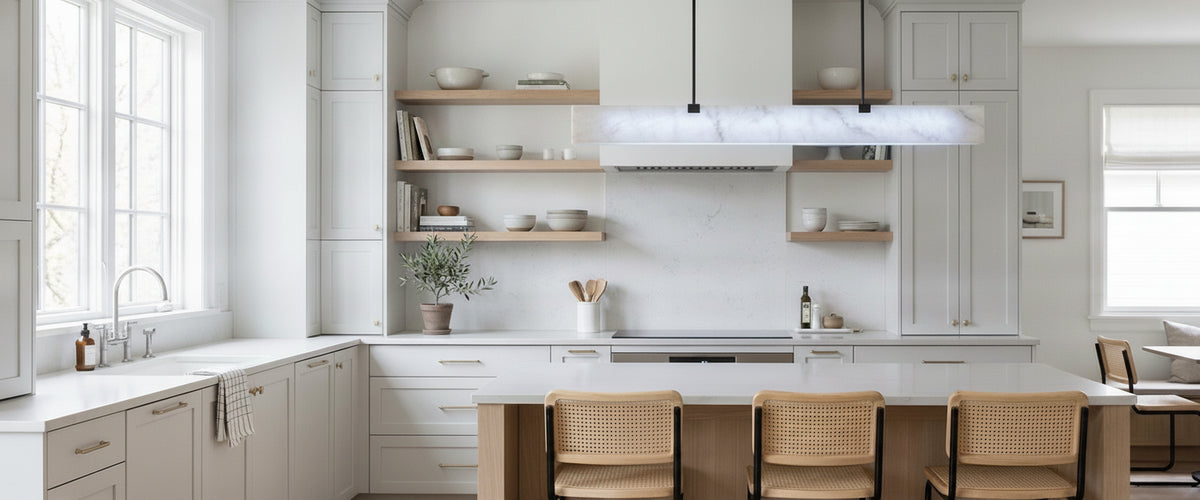

Three separate pendants in a row over an island is the default. It is also the arrangement most likely to end up fractionally off centre, unevenly spaced against the hob, and quietly irritating for the next decade. industrial bar pendant lights settle that argument at the factory: one canopy, one continuous spine, several lamp holders already set at equal intervals. You hang it once and the geometry is fixed. What is not fixed, and what most buyers underestimate, is how much the span, the metal finish and the shielding of the bulb change the room.

Key Takeaways
- Industrial bar pendant lights wash a surface in a continuous band; single drops create pools with dim gaps between them.
- Aim for a fitting roughly two thirds the length of the island or table below, centred on the worktop rather than the room.
- Raw steel, aged iron and blackened brass photograph similarly and live very differently.
- Exposed filament bulbs flatter at standing eye level and punish at seated eye height over a dining table.
- Alabaster and onyx diffusers soften the output without losing the linear form.
- Budget follows span, lamp count, metal finishing and whether stone is hand-carved, so ask for a tailored quote.

Why a Horizontal Bar Distributes Light Differently from Single Drops
Put three individual pendants over a 2.4 metre (roughly 8 ft) island and you get three bright discs on the worktop with softer ground between them. Fine for atmosphere, irritating for prep, because the chopping board always lands in a gap. A linear bar behaves like a continuous strip: the lamp holders sit close enough that their beams overlap before they reach the surface, producing an even band along the counter.
The difference shows up most in reflected glare. Single drops with polished shades throw a hard hotspot onto gloss quartz or honed marble, whereas industrial bar pendant lights spread the same lumens across more points, so each reflection is weaker. A multi-lamp spine such as the Priscila 5 Light Glass & Steel Bar Pendant is the clearest expression of that logic: five modest sources on one canopy instead of three strong ones fighting the worktop. That is the practical case for industrial bar pendant lights over a run of separate fittings, and why designers keep specifying it in schemes that are otherwise not remotely industrial. One canopy also means one ceiling point and one alignment decision, which matters if your joists run the wrong way.
Raw Steel, Aged Iron and Blackened Brass: How Each Finish Reads
Photographs flatten these three into "dark metal". In a real room they diverge quickly.
Raw and Brushed Steel
Cool, slightly grey, honest about being machine-made. Steel works hard alongside concrete, stainless appliances or steel-framed glazing. It can feel clinical in a warm, timber-heavy kitchen, where it reads as a component rather than a light.
Aged Iron
Matte and faintly textured, with a brown undertone that keeps it from going flat black. The forgiving choice in period properties and kitchens with oak, walnut or painted cabinetry: it absorbs light rather than bouncing it, so the glow does the talking.
Blackened Brass and Bronze
The warmest of the three, with a hint of gold surfacing where the patina has worn. This is where an industrial pendant bar light stops looking like workshop salvage and starts looking specified. If you want to test that warmth at small scale first, a single bronze-toned drop such as the Provence 1 Light Adjustable Wall Light/Pendant in Old Bronze shows the tonal difference against timber and stone more honestly than any swatch. Flat black goes dead under a 2700K lamp; brass beneath a dark patina keeps a little life in it, and it sits beautifully against alabaster or onyx.
Sizing the Span to the Surface Below
Most sizing mistakes with industrial bar pendant lights come from measuring the room, or worse the photograph. Size the fitting against the surface directly beneath it.
- Length: roughly two thirds of the island or table. On a 2.4 m (8 ft) island, 1.5 m to 1.7 m (about 5 ft to 5 ft 6 in) looks resolved. Shorter looks stranded; full length reads as a beam.
- Drop height: allow 75 to 90 cm (30 to 36 in) from worktop to the bottom of the fitting. Over a dining table you can go slightly lower.
- Centring: centre on the island, not the ceiling. An honest asymmetry beats a compromise that matches neither.
- Sightlines: check the view from adjoining seating. A wide bar at eye level from a low sofa blocks the window behind it.
- Ceiling height: below about 2.4 m (8 ft), a slim bar with compact shades protects headroom.
A long bar also magnifies any slope in the ceiling, so insist on independently adjustable suspension cables.
Bulb Exposure and Glare: When a Filament Flatters and When It Punishes
Exposed filament lamps became shorthand for the industrial look, borrowed from the bare-bulb workshop fittings held in collections such as the Science and Industry Museum. The original point of a bare bulb was output, not ambience. Used well today, a low-output filament is something you look at rather than read by.
It flatters above a bar counter or island, where the filament sits above standing eye level and downlights or under-cabinet strips handle the real work. It punishes over a dining table, at seated eye height, when guests spend two hours staring into an unshielded coil. That is the most common complaint we hear about an industrial pendant lighting bar chosen on looks alone.
- Shield the source. A shallow cone, a cage with a frosted lamp, or a stone diffuser puts material between filament and eye.
- Lower the output per lamp and add more of them. Five gentle points read better than three harsh ones.
- Dim properly. Use 2700K lamps at CRI 90 or above on a trailing-edge dimmer, ideally on a circuit of their own. Dim-to-warm lamps suit patinated metal particularly well.
Any rewiring, new ceiling point or dimmer change should go to a qualified, registered electrician; guidance from Electrical Safety First is a sensible reference before you book anyone.
Where Industrial Bar Pendant Lights Fit, and Where They Fight the Architecture
They belong over islands, breakfast bars, long refectory tables, pool tables, workshop-style home offices and back bars. Anywhere the surface below is long and rectangular, a linear fitting agrees with the geometry.
They struggle over round tables, where the bar contradicts the circle; something like the Duo 2 Light LED Cluster Pendant keeps the graphic, dark-metal language while following a circular footprint. They also struggle in low-beamed cottages and in highly decorative rooms with cornicing, where the raw-metal vocabulary feels imported. There, a carved stone pendant usually solves the same problem without the argument; our alabaster lighting collection is a useful place to compare the two approaches.
The Middle Path: Stone Shades on Industrial Frames
You do not have to choose between warehouse aesthetics and soft light. The most successful industrial bar pendant lights we ship pair an honest metal frame with alabaster, marble or onyx shades: the metalwork keeps the discipline, the stone handles the diffusion.
Alabaster transmits light rather than merely blocking it, turning a hard filament into a warm, veined glow. Onyx is more dramatic, with stronger banding when lit; marble is largely opaque and works better as a cap or base. Across the wider lighting range the same logic runs through wall lights, table lamps and floor lamps, which helps a scheme hold together. One caution: alabaster is a gypsum stone, far softer than marble, and the technical advice published by Historic England treats it accordingly. Keep it clear of direct steam and grease above a hob.
Buyer's Checklist Before You Order
- Measure the surface below, not the room, and test the two-thirds rule against your seating layout.
- Confirm the drop is adjustable on site and that each suspension point levels independently.
- Check lamp holder count and cap type, then decide wattage per lamp before buying bulbs.
- Ask whether the canopy is one rectangular plate or several round ones; it changes how forgiving the fixing is.
- Match the metal finish to the warmest material in the room, not the coolest.
- If stone shades are involved, ask whether each piece is cut from the same block, since veining varies.
- Request a tailored quote: span, lamp count, finishing and hand-carved stone all shift the figure.
Living With It: Care and Maintenance
Brushed steel takes a dry microfibre cloth and nothing else; abrasives cross-scratch the grain. Aged iron and blackened brass should never meet metal polish, which strips the patina in one pass. Dust alabaster and onyx with a soft dry brush, and avoid glass cleaner, ammonia, vinegar and degreasers, all of which can dull or etch stone. Never spray cleaner directly onto a shade.
Replace every lamp at the same time. One newer, brighter bulb in a row of five is visible across the room and undoes the reason you chose a linear fitting. If you are weighing industrial bar pendant lights against something softer and more sculptural, browsing the Niori range of alabaster and natural-stone pendants alongside the metal options is the fastest way to work out which side of the line your room sits on.