
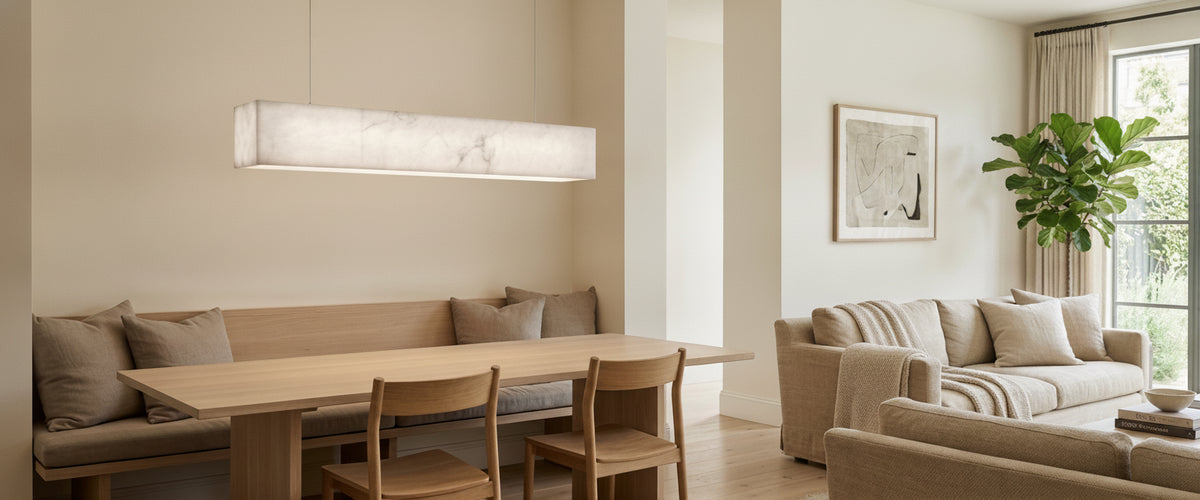

A box pendant always looks its best on the day it goes up. The real test arrives eighteen months later, after 300 covers a night, an extract system that never quite keeps up, and a cleaning crew armed with a spray bottle and no instructions. Choosing a commercial box pendant has far less to do with the render your designer sent over and far more to do with which frames, fixings and finishes still hold their line after two winters of trading.

Key Takeaways
An enclosed commercial box pendant controls glare and keeps a clean edge in a busy, noisy room better than an open shade.
Steel gives you weight and rigidity; aluminium gives you lighter suspension loads. The powder coat spec matters more than the base metal.
Hang the bottom of the fixture roughly 75 to 90cm (30 to 36in) above a dining table, and space a run at 90 to 120cm (35 to 47in) centres.
Alabaster and stone panels belong in the dining room, not directly over the pass. Grease and heat are unkind to soft, porous materials.
Give your electrician the weight, driver type, dimming protocol and IP rating before asking for a quote, not after.

Why the Enclosed Geometry of a Commercial Box Pendant Outworks an Open Shade
Open shades throw light in two directions and leave the source visible from half the room. Sit a guest at the wrong angle and they are staring straight into a lamp for the length of a two-hour dinner. A commercial box pendant closes that gap. The panels sit between the light source and the eye, so what reaches the table is diffused rather than direct, and the fixture reads as a solid block of glow rather than a bright point.
The geometry also holds up in a cluttered room. Restaurants are full of competing shapes: chair backs, bottle shelves, extract ducting, artwork, staff moving through. A rectilinear box has clean edges that repeat cleanly down a room. Cluster pendants and organic forms can dissolve into background noise once the room is at capacity. That is the practical case for commercial pendant lighting in restaurants that leans on simple geometry rather than sculptural complexity, and it is why box forms keep reappearing in hospitality schemes that have to work at 6pm and again at 11pm.
That said, the box form is not the answer everywhere in a venue. In a lounge corner or a low-ceilinged bar nook where you want a softer, less architectural gesture, a scattered form such as Opaz 3 Light Cluster Pendant Light, Smoked Black is closer to the right design language, because nothing in that zone needs to line up with a table grid.
There is an acoustic side benefit too. A deep commercial box pendant hung low over a table drops a visual ceiling on that seating position, which makes a loud room feel smaller and more contained. It does nothing to the decibels. It does a great deal to the perception of privacy.
A run set at 90 to 120cm centres keeps the pools of light overlapping down a communal table.
Steel, Aluminium and Powder Coat: What Lasts Above a Pass
Mild steel frames are the workhorse of commercial box pendant construction. They are rigid, easy to weld into crisp mitred corners, and they carry stone or glass panels without flexing. The trade-off is weight, which matters when you are fixing into a plasterboard ceiling with limited joist positions, and corrosion risk if the coating is ever breached.
Aluminium extrusion is lighter and will not rust, which makes it the sensible pick for long suspended runs or anywhere near a washdown zone. It is softer, though, and a knock from a ladder during a refit leaves a dent you cannot easily dress out. Stainless steel sits at the top for corrosion resistance and is worth the premium in coastal sites or anywhere with sustained humidity.
The finish decides more than the metal beneath it. Wet-sprayed paint is cheap to apply and chips at every fixing point. A properly cured polyester powder coat, applied over a chromate or zinc-phosphate pre-treatment, is the specification worth insisting on for any commercial restaurant pendant lights heading into a high-traffic space. Ask the supplier two things: what the pre-treatment is, and whether the powder is rated for interior or exterior use. An exterior-grade powder holds colour far better under UV from a glazed frontage.
Where Alabaster and Stone Panels Belong in a Commercial Box Pendant
This is the part we get asked about most, and the honest answer is not always the one the mood board wants. Alabaster is gypsum-based and sits around 2 on the Mohs scale, softer than a fingernail. It is porous, water-sensitive and will mark if someone attacks it with an acidic kitchen cleaner. What it gives you in return is a quality of light no acrylic or frosted glass can fake: the panel itself glows, veining shows as amber and honey shadows, and the output lands warm without looking yellow.
A restaurant group came to us wanting alabaster panels in a run of box pendants directly over an open chef's counter. We moved them. The alabaster went two metres out into the dining room where guests actually sit, and the pass got a glass-panelled version in the same frame profile and finish. Two years on, the dining room fixtures look as they did on day one and the pass fixtures get wiped down weekly without anyone worrying. Same visual language, different material logic. You can see the range of stone and alabaster panel work across our alabaster lighting collection if you want a sense of how veining behaves at different panel thicknesses.
Where stone is the wrong call and you still want the source softened rather than bare, smoked glass is the useful middle ground: it takes the hard edge off the LED, wipes clean in seconds and shrugs off degreaser. The tinted, wipe-down glass on Ovila 13 Light Glass Cluster Pendant, Smoked Grey & Brandy gives a fair read on how that material behaves under warm LED before you commit a whole pass-adjacent run to it.
Marble and onyx are denser and less absorbent than alabaster, so they cope better with cleaning, but thicker slabs transmit less light. Backlit onyx in a commercial box pendant needs careful LED placement or you get hot spots reading straight through the stone. Thin-sawn panels, an even diffuser layer behind them and a driver that holds a steady output are what separate a considered fixture from a blotchy one.
Grid Spacing and Suspension Height: The Numbers That Decide the Mood
Get these wrong and every other decision is wasted. Over a standard dining table, the bottom of a commercial box pendant wants to sit roughly 75 to 90cm (30 to 36in) above the tabletop. Higher than that and the pool of light spreads out, the table loses its focus, and the room starts to feel like a canteen. Lower and you block sightlines across a four-top.
Over a bar or high counter, measure from the counter surface rather than the floor and work to the lower end of that range. The counter already sits higher, so a shorter drop still clears sightlines. For a run of pendants down a communal table, 90 to 120cm (35 to 47in) between centres keeps the pools of light overlapping without creating a continuous wash. Tighter spacing on smaller fixtures; wider on anything with a broad panel face.
Ceiling height changes the maths. Above about 3.2m (10.5ft), a short drop leaves a dead zone of unlit ceiling and the pendants look stranded. Longer suspensions solve it, but they also introduce swing, so specify rigid rod rather than cable anywhere with door draughts or air conditioning throw. The Chartered Institution of Building Services Engineers publishes detailed guidance on lighting levels and quality for hospitality spaces that is worth reading before you finalise a layout, through its knowledge portal.
Thin-sawn alabaster reads as amber and honey veining once the panel is lit from behind.
How Finish Choice Shifts a Room from Canteen to Considered
Matt black frames are the default on a commercial box pendant because they disappear against a dark ceiling and photograph well. They also show dust and fingerprints at close range, and in a low-lit room they can read as heavy. Bronze and antique brass frames pick up candlelight and warm LED, giving the fixture a second life after dark when the frame edges catch and the panels glow. If you are trying to judge how an aged gold or antiqued brass frame behaves once the lights are dimmed, a piece like Esparta 3 Light Pendant, Aged Gold Leaf shows how a warm leafed finish holds depth rather than flattening into yellow.
Brushed brass with a lacquer looks precise on installation and can discolour unevenly once heat gets to it. Unlacquered brass will patina, which some operators love and others chase with polish forever. Decide which camp you are in before you order, because you cannot change your mind afterwards without a re-finish.
A useful rule: let the frame finish echo one existing metal in the room, usually the bar rail, the door furniture or the chair frames. Introducing a third metal into a hospitality scheme is where things start to look accidental. If you want to compare frame finishes across pendants, wall lights and floor pieces in a single visual language, our broader lighting range is organised to make that easy.
Glare, IP Ratings and What Your Electrician Needs Before Quoting
Glare in a restaurant is a seated problem, not a standing one. Walk the room at eye level from a chair before you sign off. If you can see the LED board or a bright edge through a panel joint, the fixture needs a deeper reveal or a secondary diffuser.
On lamping, warm output does the heavy lifting: 2400K to 2700K suits alabaster and stone, and a colour rendering index of 90 or above stops food looking grey on the plate. Dimming protocol matters more than most people expect. Domestic trailing-edge dimmers struggle across long runs of multiple drivers; commercial schemes are usually better served by DALI or 1-10V control with drivers sized to the circuit.
Interior dining areas need nothing more than IP20. Covered terraces and anywhere near a washdown line should be IP44 as a minimum, and fully exposed exterior positions want IP65. Any electrical work must be carried out by a qualified electrician working to BS 7671, and the IET publishes accessible summaries of the current wiring regulations if you want to understand what you are being quoted for.
Send your electrician the weight of each commercial box pendant, the suspension method, the driver location, the dimming protocol and the IP rating in one document. Quotes issued without that information get revised, usually upwards, usually mid-install.
What Fails First in Kitchen-Adjacent Heat and Grease
Heat and airborne grease work through a commercial box pendant in a fairly predictable order, and it is almost never the panels that go first.
Fabric-braided flex. It absorbs airborne grease, stains unevenly and cannot be cleaned. Specify smooth cable or rigid rod anywhere within reach of kitchen air.
Lacquered brass near heat. The lacquer breaks down in patches and the brass beneath oxidises through the gaps. It looks like damage rather than patina.
Silicone gaskets and adhesive-set panels. Sustained heat hardens gaskets and can let adhesive creep, which shows up as a panel sitting a millimetre proud.
Plated finishes meeting acidic cleaners. Chrome and nickel pit quickly if degreasers are used at full strength. Brief the cleaning team in writing.
Undersized fixings. Stone-panelled fixtures are heavy. Insist on a secondary safety wire and fixings rated well above the fixture weight.
Buyer's Checklist Before You Sign Off the Order
Confirm the frame material and the powder-coat pre-treatment in writing.
Check panel material against its position: stone and alabaster for dining zones, glass for pass-adjacent positions.
Agree suspension height from finished floor level, not from the ceiling, so it survives a floor build-up change.
Set out grid spacing on the reflected ceiling plan and cross-check against table layout, not just ceiling geometry.
Specify colour temperature, CRI and dimming protocol on the same line as the fixture code.
Ask for spare panels and a replacement driver at the time of order, so a future repair matches.
Request a tailored quote rather than a headline figure. Cost on a commercial box pendant moves with panel material, frame scale, engineering, finish and installation complexity, and a single-line price rarely reflects any of it.
Niori works in alabaster and natural stone across pendants, chandeliers, wall lights, table lamps and floor lamps, and most of our hospitality conversations about a commercial box pendant scheme start exactly where this article ends: what goes where, what will survive, and what the electrician needs to know. If you are scoping a project, come with your ceiling heights and table plan and the rest gets much easier.