
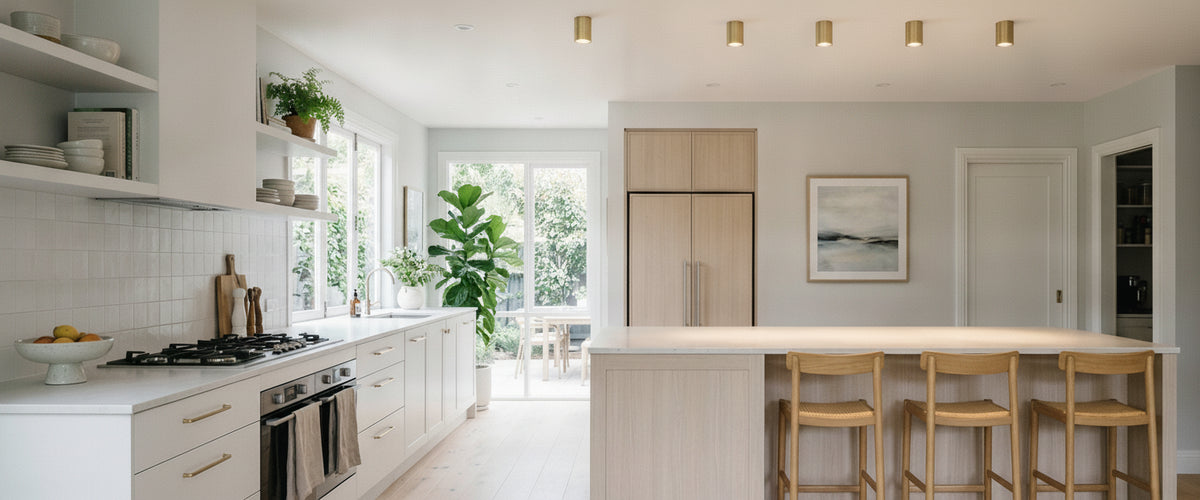

Turn the lights off and look up. That is the moment brass recessed downlights either earn their place or confess to being an afterthought. For maybe five hours a day a downlight is a beam of light; for the other nineteen it is a piece of metal jewelry sitting in your ceiling, catching daylight, reading either intentional or cheap. Most buyers specify the lumens and the beam angle, then pick the finish from a thumbnail. With brass recessed downlights, that order of operations is backwards.

Key Takeaways
Finish first. Matt, antique and polished brass recessed downlights produce three genuinely different ceilings. Choose the one that matches your hardware and metalwork, not the one that photographs best on a white background.
Check the cut-out and the depth together. A 150mm aperture is a big hole; plenum depth and joist positions decide whether it is even possible.
Spacing is about task zones, not even coverage. A uniform grid is what makes a kitchen ceiling look like a retail aisle.
Flicker is decided by the driver and dimmer pairing, long before anyone argues about color temperature.
Ask three questions before ordering: fire rating, IP rating, and whether the brass is solid metal, plated, or painted.
Downlights are the background layer. The character of a room comes from alabaster pendants, wall lights and lamps. Brass recessed downlights support them.

Why the Trim, Not the Beam, Defines the Ceiling
Ceilings are the largest uninterrupted surface in most rooms, and the eye is unforgiving about repetition across them. Twelve identical circles of bright white plastic read as infrastructure. Twelve rings of brushed brass read as a decision. This is why brass recessed downlights have moved from specialist spec sheets into ordinary residential projects: the metal gives the ceiling a warm punctuation mark rather than a dot of visual noise.
There is a practical reason too. Brass reflects light with a warm bias at the aperture edge, so the transition from ceiling plane to light source is softer than the hard white halo you get from a painted steel bezel. In a room finished in lime plaster, limewash or a warm off-white, a white trim actually stands out more than brass does. Designers working in warm neutral palettes tend to figure this out on the second project, not the first. The logic reverses in a cooler or darker scheme: against a charcoal ceiling or a slate-toned kitchen, a recessed matt black fitting such as the Himal LED Recessed Downlight, Black reads as a shadow rather than a highlight, which is the same principle working in the opposite direction.
One practical caution. Brass recessed downlights reward good plastering. Because the metal catches light, any ripple or shadow gap around the aperture is visible from across the room. Budget for a careful skim, or use trimless-style detailing if your ceiling finish is not immaculate.
Matt Brass, Antique Brass, or Polished: Three Very Different Rooms
Matt or satin brass is the quiet option. Low sheen, minimal reflection, and it reads almost as a warm gray from a distance. This is the finish to pick when you want brass recessed downlights to disappear into a calm ceiling and let a sculptural pendant do the talking. It is also the most forgiving of fingerprints during installation. Where the ceiling should recede and the pendant should lead, a low-sheen round fitting such as the Jura Downlight, Satin Brass is closer to the right design language than a mirrored bezel.
antique brass recessed downlights behave differently. The darkened, slightly uneven surface gives a ceiling depth and age, which suits period properties, timber beams, and rooms where you want the lighting to feel inherited rather than installed. Antique finishes vary wildly between makers, though. One brand's antique brass is a soft honey bronze; another's is nearly chocolate. Always request a physical sample and look at it under the light temperature you plan to run, not under showroom fluorescents.
Polished brass is the boldest choice and the hardest to live with. It mirrors, it shows every mark, and it draws the eye upward. In a hallway with polished brass door furniture it can be excellent. In a kitchen with fifteen apertures it becomes busy. If you love the look, use polished brass recessed downlights on a handful of feature positions and run matt everywhere else.
A note on aging: unlacquered brass tarnishes, and copper alloys develop patina in response to humidity, handling and atmospheric sulfides, which is exactly why conservation bodies treat brass as a living surface rather than a fixed one (see the Getty Conservation Institute for background on metal conservation). Lacquered brass holds its factory color for years but cannot be re-patinated easily. Decide which behavior you want before you order your brass recessed downlights, because you cannot swap it later without changing every fitting.
How 150mm Cut-Outs Catch Experienced Installers Off Guard
Specifying 150mm recessed downlighting in brass sounds simple on paper. A 150mm aperture pushes more light with less glare than a small aperture, and the wider bezel gives the metal room to be seen, which is half the reason people choose brass recessed downlights in the first place. Then the first hole gets cut.
Three things go wrong repeatedly. First, joist and truss spacing. At 150mm you have far less room to slide a fitting sideways when you meet a structural member, so the grid you drew in CAD may need rethinking on site. Second, plenum depth. Larger apertures often need more depth behind the ceiling for the housing and the driver, and a shallow void above a bathroom or a concrete slab can kill the spec outright. Third, insulation. Where brass recessed downlights sit under loft insulation, you need a housing rated to be covered, or a purpose-made hood, otherwise you are creating a heat trap.
Measure the depth above the ceiling before you finalize anything. Then measure again in the corner of the room where the roof pitch drops. That corner is where projects lose their brass recessed downlight positions.
Grid Spacing Logic That Avoids the Supermarket Ceiling
The fastest way to make an expensive kitchen look institutional is to divide the ceiling into equal squares and put a light in each one. Uniform lux is a warehouse requirement, not a domestic one. Better approach: light the things people actually use, and let the layout of the brass recessed downlights follow those tasks.
Kitchens
Run downlights in a line parallel to the counter, set roughly 300 to 450mm out from the wall cabinets so the beam falls on the worktop and not on your head while you chop. Keep the island lighting separate; pendants usually do that job better. A single row of well-placed brass recessed downlights plus two pendants beats a grid of nine every time. Aperture shape matters once the fittings line up in a row: where the run sits parallel to cabinetry and tiling joints, a square trim like the Jura Square Downlight, Satin Brass follows those lines, while a round trim is the safer choice in a room with curves, arches or no dominant grid.
Hallways
Fewer, warmer, dimmer. Hallways are transitions, not workspaces. Consider running brass recessed downlights along one side to graze a wall and hang art, then let wall lights carry the mood at night.
Open-Plan Zones
Break the space into circuits by activity rather than by geometry. Dining, seating, cooking and circulation each want a different level, and they should not share a switch. One open-plan project came to us with eighteen brass recessed downlights on a single circuit; splitting them across four and adding alabaster wall lights over the console made the room feel calmer and larger after dark, without changing a single fitting.
If you want the layered version of this, the background layer should always be recessed and the character layer should be visible. You can see how the two work together across the alabaster lighting collection, where translucent stone shades give warmth at eye level while brass recessed downlights handle the working light above.
Dimming and Driver Spec: Where Flicker Is Decided
Buyers blame the bulb. With brass recessed downlights the culprit is almost always the driver and dimmer pairing. LED drivers respond to different dimming protocols, and a trailing-edge dimmer on a driver built for leading-edge control will give you flicker, buzz, or a dead zone at the bottom of the dial. Ask for the compatibility list, in writing, from whoever supplies the fittings.
Points worth settling early:
Protocol: mains dimming, 0-10V, DALI or wireless. Pick one system across the project.
Dim-to-warm: some fittings shift from around 3000K toward 2200K as they dim. Lovely in a dining zone; confusing over a worktop if the two zones are in the same sightline.
Minimum dim level: 10% looks bright in a dark hallway. Ask whether the fitting reaches 1%.
Flicker performance: visible and invisible flicker affects comfort and can cause headaches, which is why lighting research groups such as the Lighting Research Center treat it as a measurable quality metric rather than a nuisance.
Color temperature discipline: keep everything in one room within a narrow band. 2700K to 3000K suits brass and stone; 4000K makes brass look green.
All wiring, circuit splitting and dimmer selection should be done by a qualified electrician. Installing brass recessed downlights touches the ceiling fabric and the fire compartment, so it is not a weekend job.
Fire Rating, IP Rating, and Finish Authenticity
Three questions to ask before you order brass recessed downlights.
Is it fire rated, and to what duration? Cutting holes in a ceiling breaks the barrier between floors. Fire-rated housings restore it. Ask for the tested rating and the certification, and check that it applies to your ceiling build-up rather than a generic assembly.
What is the IP rating, and where can it go? Bathroom and shower zones have specific requirements, and outdoor soffits need more protection than most buyers assume. A fitting rated for a hallway will not survive a covered porch in coastal air. Salt accelerates corrosion on any exposed metal, brass included.
Is the brass actually brass? Solid or thick-plated brass recessed downlights age gracefully. Thin electroplate over pressed steel can flake at the bezel edge within a few years, especially where cleaning products get involved. Powder-coated "brass effect" is paint, and it looks like paint under raking daylight. Ask what the substrate is. A supplier who knows their metalwork will answer in one sentence.
How Brass Downlights Sit With Alabaster and Stone
Recessed light is efficient and characterless by design, which is exactly why it pairs so well with natural stone. Alabaster transmits light rather than reflecting it, so a pendant or wall light in alabaster glows from within while brass recessed downlights quietly cover the working light. The brass trim then picks up the brass detailing on the stone fixtures, and the whole scheme reads as one idea rather than two shopping trips.
At Niori we build around alabaster and natural-stone lighting: pendants, chandeliers, wall lights, table lamps and floor lamps, with brass and glass detailing. Clients often arrive with a downlight-only scheme and leave with half the recessed fittings and one significant stone piece per room. Stone at eye level; metal overhead. Browse the wider lighting range if you want to see how the layers stack in practice.
A studio observation from sample testing: hold an antique brass trim next to a honey-veined alabaster shade under 2700K and the two materials read as a family. Do the same under 4000K and the brass turns cold while the stone turns gray. Color temperature is a material decision as much as a comfort one.
The Pre-Order Checklist
Measure plenum depth in the tightest corner of the room, not the middle.
Confirm the exact cut-out size and whether the bezel covers a rough hole.
Request physical finish samples and view them under your chosen color temperature.
Check joist and truss positions against your proposed layout before plastering.
Get the dimmer compatibility list from the supplier in writing.
Confirm fire rating, IP rating and insulation coverage for each location.
Ask whether the brass is solid, plated or coated, and whether it is lacquered.
Split circuits by activity zone, then add one visible stone or glass fixture per zone.
Order one or two spare fittings from the same batch; finishes drift between production runs.
Book a qualified electrician before you order, not after the boxes arrive.
Budgets for brass recessed downlights vary with fitting quality, trim material, driver specification, fire and IP requirements, and the labor involved in ceiling preparation, so treat any quick online figure with suspicion. If you are pulling together a layered scheme, ask us for a tailored quote against your actual room plan; you can start from the Niori homepage and tell us what the ceiling is made of.
Get the trim right and nobody notices the brass recessed downlights. That is the goal. The lights people remember should be the ones you can actually see.