
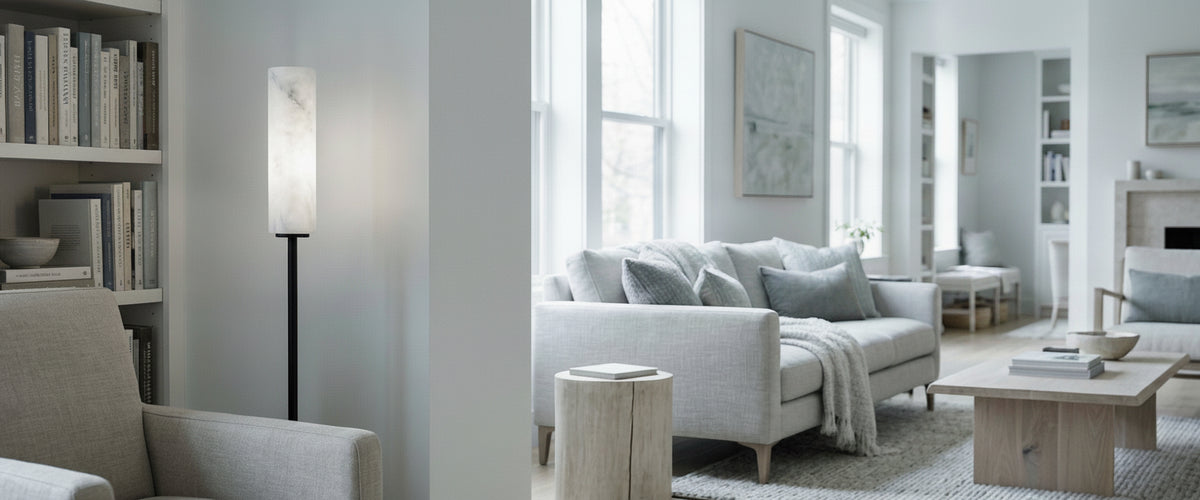

Ask five people to recommend the best floor lamps and you will get five product names and almost no useful information. A floor lamp is a job first and an object second. Until you can say what you want it to do, whether that is filling a dark corner with soft ambient light, throwing a clean pool onto a book, or grazing light up a plastered wall, no shortlist can be right. The best floor lamps are the ones that answer a brief you have actually written down. Get the brief straight and the choice narrows fast, which is when material, shade opacity and base engineering start to matter more than the photograph.

Key Takeaways Before You Shortlist
Name the job first. Ambient, task or accent. Each one wants a different shade, a different height and a different dimming range.
Shade material sets the mood. Translucent alabaster and onyx glow from within; opaque metal or fabric shades push light up or down and leave the rest of the room dark.
Base weight is a safety spec, not a detail. The best floor lamps pair a tall stem and wide reach with real ballast, ideally stone or weighted brass.
Dimming is non-negotiable. A natural-stone shade does its best work well below full output, so buy the dimming with the lamp.
Cable route and switch position decide whether you actually use the lamp or trip over it.

Ambient, Task and Accent: Three Jobs, Three Different Lamps
The best floor lamps for ambient light lift the general level in a room without glare. That means a large diffusing shade, a light source mounted low relative to eye level, and a wide dimming range so the lamp can carry an evening on its own. Alabaster is very good at this because the stone itself becomes the light source rather than hiding it. You see a warm, softly veined glow instead of a bright bulb.
The best floor lamps for task work answer a much tighter brief. You want a controlled pool of light landing on a page or a laptop, with the source positioned just above and behind the shoulder when you are seated, usually somewhere around 105 to 125cm (roughly 3ft 5in to 4ft 1in) from the floor. Arc and swing-arm forms earn their keep here because the shade can sit over the arm of a sofa rather than beside it; where the seating is deep and there is no room for a lamp alongside it, a cantilevered form such as the Arc Floor Lamp in white reaches the reading position without adding another object to the floor plan. The Society of Light and Lighting publishes sensible guidance on task illuminance if you are speccing for an office or a hospitality scheme, and it is worth a look before you guess (CIBSE SLL).
Accent lighting is the one most people skip. A slim column lamp tucked behind a plant, a low uplight washing a stone chimney breast, a narrow alabaster cylinder marking the end of a hallway. The output is modest, the effect is structural. In an accent role, the best floor lamps are what stop a room feeling flat after dark, and they are usually the cheapest change you can make to a scheme that already has good furniture.
Opacity and Diffusion: What the Shade Really Does
Every argument about the best floor lamps eventually comes back to the shade. Opacity determines where light goes; diffusion determines how harsh it feels when it gets there.
A fully opaque shade in metal or a lined fabric creates two beams, one up and one down, and leaves the mid-room in shadow. That can be exactly right beside a reading chair and exactly wrong as your only light source in a large sitting room. A translucent shade does something different. Light passes through the body of the material, so the fixture reads as a glowing form and spills light in every direction at low intensity.
Alabaster sits in a sweet spot most materials cannot reach, which is why so many of the best floor lamps built around natural stone start with it. It is dense enough to hide the lamp inside it and translucent enough to transmit a warm, honeyed light that shifts as the veining changes thickness across the shade. Onyx goes further, with stronger banding and more color, and reads as a deliberate statement. Marble is generally the most opaque of the three and works better as a base or a solid arm than as a glowing shade. If you want to see the difference across a range of shapes in one place, the alabaster lighting collection at Niori is a quick way to compare how thickness and form change the glow.
One practical note from the studio: two alabaster shades cut from different blocks will never match exactly. A designer in Edinburgh once ordered a pair for either side of a fireplace and asked whether they could be sequenced from the same block. That can be requested, but the honest advice was to embrace the variation. Lit low, the difference in veining reads as craft, not error. Switched off, it reads as two related pieces rather than clones.
Base Weight, Cable Routing and Switch Placement
These are the details buyers notice on day two, not day one. A floor lamp with a tall stem and any horizontal reach is a lever, and the base has to resist it. The best floor lamps solve that honestly, with stone or weighted metal bases; hollow bases filled with a token disc of steel do not. If a lamp has an arc or a cantilevered head, check what the base is made of before you check anything else, especially in a home with children, dogs, or a lot of foot traffic around the sofa.
Cable routing is the second thing, and it is where the best floor lamps quietly fail. Work out which side the flex exits and how far it needs to travel to reach a socket, then decide whether it runs behind furniture, under a rug edge, or across a walkway. If the answer is "across a walkway", rethink the position rather than taping the cable down. In UK homes, a 5-amp lamp circuit switched from the door is the neatest solution for ambient lighting, because the whole scheme comes on together. That work should be planned and installed by a qualified electrician; it is not a weekend job.
Switch placement decides whether the lamp gets used, and even the best floor lamps lose to a switch you cannot find in the dark. An inline foot switch you can hit with a toe beats a rocker halfway up a flex you have to fish for behind a chair. Touch dimmers on the stem suit bedrooms and frustrate anyone who wants to set a level once and leave it. If you are running a wider scheme, matching all your plug-in fixtures to the same dimming method saves a lot of irritation later.
Statement or Recessive: How Loud Should It Be?
Not every one of the best floor lamps wants to be seen. In a room that already has a strong ceiling piece, patterned upholstery and art on three walls, the floor lamp's job is to disappear and just produce light. Slim stems, small shades, quiet finishes in brushed brass or blackened steel.
The opposite case is a large, under-furnished space with nothing holding the middle of the room: an open-plan kitchen and living room, a loft, a hotel lounge. Here a generous alabaster column or a big arc reading over a sofa becomes an architectural element, and a recessive lamp would look apologetic. Some of the best floor lamps for rooms like this are deliberately oversized. At that scale a full-height piece such as the Atria LED Large Alabaster Floor Lamp in brushed brass holds a corner the way a small fabric shade cannot, because the stone stays visually present even when the output is dimmed right down. A good test is to stand in the doorway and count how many things already compete for attention. Three or more, choose recessive. One or none, go bigger than feels comfortable.
Room by Room: Where the Best Floor Lamps Actually Earn Their Keep
Living Room
Most sitting rooms are over-lit from the ceiling and under-lit at eye level. A pair of floor lamps at opposite corners, both dimmable, will do more for the room than any downlight layout. The best floor lamps for a living room keep the light source below eye height when seated to avoid glare, and sit at least 30cm (about 12in) clear of upholstery for heat and access.
Bedroom
Bedside tables are often too small for a lamp big enough to read by, which is why some of the best floor lamps end up beside a bed rather than in a corner. Look for a shade that shields the source from a lying position, a warm color temperature, and a dimmer that reaches genuinely low. Alabaster is a natural fit here because the stone keeps producing a soft glow even at the bottom of the dimming curve, which suits late-night reading far better than a bulb winking down to orange. Where the gap between bed and wall is tight, a smaller-footprint version such as the Atria Small LED Alabaster Floor Lamp sits in the same design language as a full column without crowding the bedside.
Home Office
Screen work needs even, low-contrast light so your eyes are not jumping between a bright monitor and a dark wall. The best floor lamps for a desk throw light up onto the ceiling and down onto the work surface, positioned to the side rather than behind the screen, which kills reflections. Avoid anything that puts a bright shade directly in your peripheral vision for eight hours.
Hallways and Dining Areas
Hallways rarely have space for furniture, so the best floor lamps here are narrow, tall and set close to a blank wall, giving depth and marking the route at night. In dining areas, a floor lamp is a useful counterweight to a pendant over the table, filling the corners so the room does not collapse to a single bright island.
Bulbs and Dimming for Stone Shades
Natural stone is unforgiving about what you put behind it, and even the best floor lamps can be ruined by a cheap bulb. Use these rules:
Color temperature: 2700K for living spaces and bedrooms. 3000K only if the room has cool grays and a lot of pale stone.
Color rendering: CRI 90 or above. Cheap LEDs flatten the warmth in the veining and make alabaster look like plastic.
Diffusion: opal or frosted lamps, not clear filament bulbs, unless the shade is thick enough to hide the hotspot. A bright point source behind thin stone creates a visible bright patch.
Dimming: trailing-edge dimmers for most LED retrofits, and check the driver is marked dimmable. Integrated LED lamps should state their compatible dimmer types.
Heat: keep halogen out of enclosed stone shades. Sustained heat and stone with natural fissures is a combination worth avoiding.
The Buyer's Checklist for Choosing the Best Floor Lamps
Write the job in one sentence: ambient, task or accent.
Measure the seated eye height in the spot the lamp will serve, then check the shade sits above or below it as the job requires.
Decide translucent or opaque before you decide on a style.
Check base material and weight against the lamp's reach.
Trace the cable route from lamp to socket, in real life, not on paper.
Confirm the dimming method and that it will work with your existing switches.
Look at the fixture unlit as well as lit. Half its life is spent switched off.
Ask about lead times and whether the stone is selected or randomly allocated, especially for pairs.
Budget is the last question, not the first, because it moves with the material, the scale of the stone, the complexity of the metalwork, the driver and dimming specification, and the finishing. A slim brass stem with a small shade and a large hand-worked alabaster column are not the same proposition, and the best floor lamps for your room are rarely the cheapest or the dearest thing on the page. Set the brief, then request a tailored quote for the pieces that genuinely answer it. Browsing the full lighting range alongside your shortlist also helps you see whether a floor lamp is the right fixture at all, or whether a wall light and a table lamp would serve the corner better.
Living With Stone: Care That Takes Minutes
Alabaster is a form of gypsum, which makes it soft and slightly soluble in water, a fact worth remembering before anyone reaches for a spray bottle (British Geological Survey). The best floor lamps in alabaster ask for about two minutes of care a month. Dust with a dry, soft, lint-free cloth. Skip water, glass cleaner, vinegar and anything abrasive. Keep the lamp away from radiators and out of long hours of direct sunlight, and lift it by the base rather than the shade when you move it. Do that and the stone outlasts every other component in the fixture, including the LED.
The best floor lamps are the ones you stop noticing because they are always doing the right job at the right level. Niori builds around alabaster and natural stone for exactly that reason: the material does the diffusion work that engineering otherwise has to fake. Start from the job, choose the shade material that serves it, and the shortlist writes itself.