
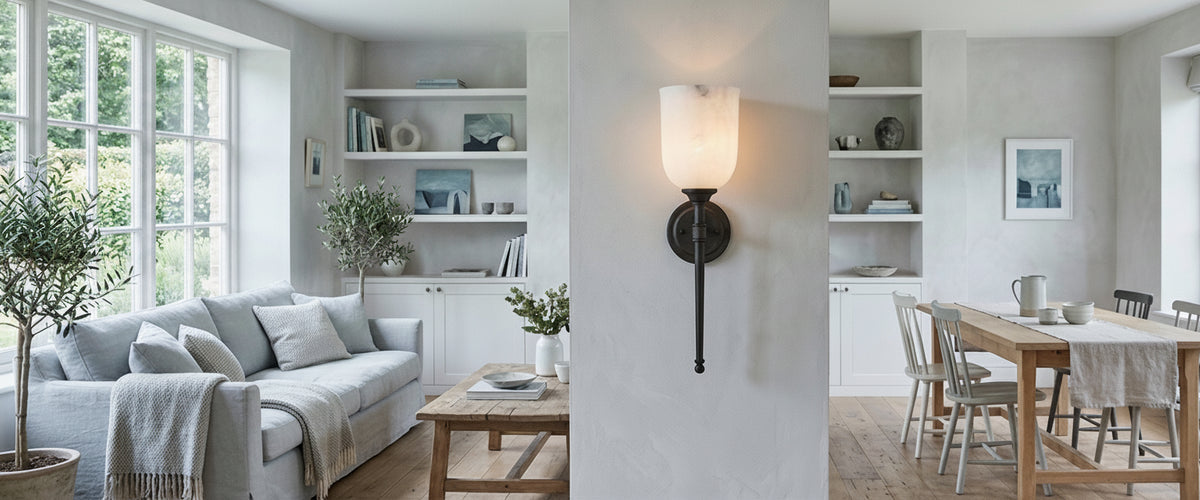

Black hides detail until the wrong black is on your wall. Then it shows everything: the flat plastic sheen of a cheap coating, a backplate two sizes too small, a shade throwing light at the ceiling when you wanted it on the art. A traditional black wall lights is one of the most useful fittings in a house, and one of the easiest to specify badly, because most people shop the silhouette and ignore the finish, the scale, and the direction the light actually travels.
Get those three right and a pair of sconces will do more for a hallway than any ceiling fixture. Get them wrong and the whole wall looks like an afterthought screwed into plaster.

At a Glance: What Decides a Good Traditional Black Wall Light
- Finish: lacquered black reads formal and slightly reflective; powder coat is the workhorse; aged or hand-forged iron has depth and slight irregularity, which is what most people actually mean by "traditional".
- Backplate: too small is the single most common mistake. The plate should feel proportionate to the arm and shade, not like a washer holding it on.
- Direction: up-light for mood and ceiling height, down-light for tasks and texture, diffused for even, glare-free wash.
- Height: roughly 168 to 183 cm (66 to 72 inches) to the centre in circulation spaces, lower over beds and consoles.
- Bulb: 2200K to 2700K, dimmable, and shielded so the filament is never in a seated sightline.
- Pairing: black gains warmth beside alabaster, aged brass and honed stone, and goes cold beside chrome and cool grey.

Lacquer, Powder Coat, Aged Iron: Why Traditional Black Is Not One Finish
Three fittings can all be listed as black and look like three different materials on the same wall. Lacquered black sits closest to a painted furniture finish. It has a faint sheen, holds crisp edges, and suits formal rooms with panelling or joinery. It also shows scuffs, which matters in a narrow hallway where bags and shoulders pass.
Powder coat is the practical choice, particularly outdoors, and most people specifying a traditional black wall light for an exterior wall end up here. The powder is applied dry and cured into a hard film, which is why it resists chipping better than a wet paint layer of similar thickness; the Powder Coating Institute is a useful primer if you want the technical detail. Matte and textured powder coats absorb light rather than bounce it, so they read quieter and flatter than lacquer.
Aged or hand-finished iron is the finish people picture when they search for a traditional black wall light. It carries slight tonal variation, sometimes a graphite or brown undertone, and it catches light along hammered or forged edges. Wrought iron sconces and candle brackets have been doing exactly this job for centuries, and the character comes from surface irregularity as much as from shape. The practical consequence: aged iron forgives fingerprints and weathering in a way a flat black coating never does.
One more distinction worth checking before you buy. Ask whether the black is a coating over steel, a coating over aluminium, or a patinated finish on solid metal. Exposed coastal and estuary sites are brutal on thin coatings over cheap substrates, and the failure point is almost always a fixing screw or a seam, not the visible face.
Rooms Where Black Anchors the Scheme, and Rooms Where It Fights
Black works hardest where you need punctuation. Against warm white plaster, limewash, or a soft clay-toned wall, a traditional black wall light acts like a dark frame: it defines the rhythm of a corridor, marks the head of a stair, and gives a fireplace wall a pair of vertical accents that stop the mantel floating.
It also sits well in stone-heavy rooms. Travertine, limestone and honed marble all have enough surface interest that a black fitting reads as contrast rather than clutter. In a pale plaster corridor over a limestone floor, black arms and shades give the run something to hold onto by day, and the warm glow does the rest after dusk. Without them the same corridor reads as blank wall with the lights off.
Where black fights: cool grey schemes with chrome hardware, small rooms with low natural light and dark floors, and any wall already carrying a busy wallpaper. In those cases the fitting becomes a smudge rather than a line. Alabaster, glass, or a lighter stone body with black or bronze detailing usually solves it; you can compare bodies and finishes across the full lighting range before committing to an all-black scheme.
Backplate Proportion: The Detail That Reads Deliberate or Accidental
Interior designers notice backplates. Homeowners notice that something looks off and cannot say why. This is where a traditional black wall light either looks commissioned or looks bought in a hurry, because the plate is the visual footing of the fitting, and when it is undersized the arm appears to sprout from the wall with nothing holding it.
A few working rules. On a broad wall, such as either side of a fireplace or a wide console, a taller or larger plate gives the fitting presence. In a tight hallway, a slim vertical plate keeps the projection honest and stops shoulders clipping the shade. Where the corridor is narrow and you want the rhythm without the bulk, a single-arm fitting such as the Chartwell 1 Light Traditional Wall Light in black holds its proportions better than a wide two-arm design squeezed onto the same plaster. If you are mounting onto panelling or a tiled surface, check that the plate covers the existing back box cleanly, because a halo of old paint or an exposed cut edge undoes the whole thing.
Projection matters as much as the plate. In corridors under about 107 cm (42 inches) wide, keep the projection short. A lantern that steps 23 cm (9 inches) off the wall is beautiful in a double-height entry and a nuisance in a narrow passage, which is why a bracketed shape like the Burford outdoor wall lantern in black belongs beside a generous front door rather than halfway down a tight hall.
Up-Light, Down-Light, Diffused Glow: Shade Direction Changes Everything
The same traditional black wall light body can create three completely different rooms depending on where the aperture points.
Up-Light
Throws a soft arc onto the ceiling, lifts the perceived height of a room, and creates ambient light with almost no glare. Good in living rooms and stairwells with clean ceilings. Bad if the ceiling has patchy plaster or spotlight scars, because the wash reveals every flaw.
Down-Light
Grazes the wall, pulls out texture in plaster, brick or stone, and gives a pool of usable light at a console or bedside. Outdoor down-lights on a porch have a practical advantage too: less spill into the night sky and less light thrown into a neighbour's window. Where the aim is a contained wash down a stone or render elevation rather than a glowing lantern read from the street, a shielded fitting such as the Norfolk 1 Light outdoor down wall light in black is closer to the right design language.
Diffused
This is where a black frame around a translucent shade earns its keep. Alabaster, onyx and frosted glass all soften the source into an even glow, so you get light without a hot filament in your eyeline. Alabaster in particular scatters light through its crystalline structure rather than simply blocking it, which is why a stone shade reads warm and honeyed while a paper shade reads flat.
Pairing Black Fittings with Warm Metals and Natural Stone
Straight black against straight cool metal is the fastest way to make a room feel unfinished. Introduce one warm element and the whole wall settles. Aged brass, antique bronze and unlacquered brass all sit comfortably beside black because they share a low-reflectance, slightly broken surface.
Stone does the same job with more softness. A black arm holding an alabaster shade gives you contrast in daylight and warmth after dark, which is the combination most people are actually chasing when they specify a traditional black wall light. If you are building a scheme rather than buying a single fitting, it is worth seeing how stone shades behave beside darker metalwork across the alabaster lighting collection, because the difference between a translucent stone shade and an opaque one changes the whole mood of a corridor.
Two pairings to be careful with. Polished black marble next to a gloss black fitting can read as one dark mass, so break it with a lighter shade or a brass accent. And black against cool white LED light looks clinical fast; keep the colour temperature warm and the problem disappears.
Mounting Height: The Numbers That Matter
Mounting height for a traditional black wall light is convention rather than regulation, and the numbers should flex to your ceiling height and the people living in the house.
- Hallways and circulation: 168 to 183 cm (66 to 72 inches) from finished floor to the centre of the fitting. Space pairs and runs roughly 2.4 to 3 m (8 to 10 feet) apart so the pools of light overlap rather than strobe.
- Flanking a mirror or fireplace: centre roughly at eye level, usually 152 to 168 cm (60 to 66 inches), and keep both sides identical to the millimetre.
- Bedside: around 76 to 91 cm (30 to 36 inches) above the mattress top, offset toward the outside edge of the bed so light falls on the page, not the pillow.
- Stairs: measure from the tread nose, not the floor below, or the run will step out of alignment.
- Outdoor and entry: centre near 168 cm (66 inches) beside a door, and choose an IP-rated fitting suited to exposure. Covered porches are more forgiving than an open coastal wall.
In rooms with ceilings above 3 m (10 feet), raise everything slightly or the fittings will look like they slid down the wall. Always have a qualified electrician handle the wiring, the back box and the dimmer compatibility.
Bulbs and Dimming
Lamping is where a good traditional black wall light is undone most often. Choose 2200K to 2700K. Anything above 3000K makes black metalwork look grey and kills the honeyed quality of a stone or glass diffuser. Look for a CRI of 90 or higher so timber, textiles and stone veining hold their colour.
Dimming is not optional on wall lights. Sconces are the layer that carries a room at low light, and a fixed-output sconce at full brightness is the reason so many hallways feel like a corridor in a clinic. Confirm the driver and dimmer are matched, and buy the bulbs before the electrician's final visit so trailing-edge compatibility can be tested on site.
Buyer's Checklist Before You Order
- Confirm the finish type in writing: lacquer, powder coat, or hand-applied patina.
- Measure the wall and check projection against corridor width and door swings.
- Check backplate size against the existing back box position.
- Decide the light direction before the shape. Up, down, or diffused.
- Test the black against your wall colour in both daylight and lamplight.
- Specify dimmable, warm, high-CRI lamps and a compatible dimmer.
- For exterior walls, confirm the IP rating suits the exposure, not just the location.
- Ask about replacement parts and whether the finish can be touched up later.
Keeping It Looking Right
Upkeep on a traditional black wall light is light work, but it is not nothing. Black fittings show dust more than brass does, particularly matte powder coat. Dry microfibre, once a month, is usually enough. Skip solvent cleaners; they dull matte coatings and can lift a patina permanently. Aged iron benefits from an occasional thin wax in damp rooms or coastal air.
If your fitting combines black metal with a stone shade, treat the stone differently from the frame. Gypsum alabaster is soft and water-sensitive, so wipe with a dry cloth and never soak it; conservation guidance from institutions such as the Getty Conservation Institute is consistent that moisture is the main risk to soft stone surfaces. Niori builds around alabaster and natural stone for exactly that reason: the material rewards care with a quality of glow that no printed diffuser replicates. If you want to see how stone bodies, glass and darker metal detailing sit together across pendants, chandeliers, wall lights and lamps, start from the Niori collections and work back to the wall lights once the palette is set.
A traditional black wall light is a small purchase with an outsized effect on how a room feels at night. Decide the finish, size the backplate honestly, point the light where you need it, and keep the colour temperature warm. Everything else is detail.