
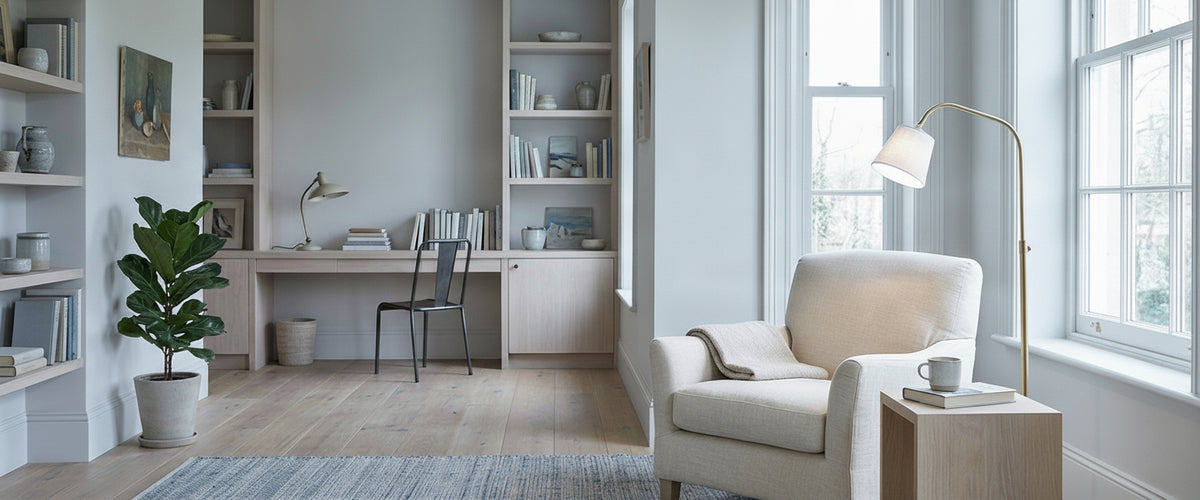

Most reading lamps fail for a dull, avoidable reason: the light lands on the arm of the chair rather than the page. You end up tilting the book toward the window, or squinting through a soft golden haze that looks lovely in photographs and does nothing for a paperback at ten o'clock at night. A brass reading floor lamp fixes that, but only if you buy it as a task light with a decorative finish, rather than a decorative object you hope will behave like a task light.
At Niori we spend most of our time with alabaster, marble and onyx, materials that scatter light rather than throw it. That background is exactly why we are fussy about reading lamps. Diffused stone light is what you want across a room; a directed beam is what you want over a book. The best schemes use both, and a well-specified brass floor lamp for reading is usually the piece doing the precise work.

Key Takeaways
Reach matters more than height. The head of a brass reading floor lamp needs to travel out over your lap, not sit politely behind the chair.
Pivot without lock is useless. Test whether the joint holds its angle when the shade is warm and the arm is extended.
Aperture sets the mood. A narrow open-bottomed shade gives a crisp pool; a wider cone with an alabaster or opal diffuser gives softer, longer-lasting comfort.
Finish changes after dark. Polished brass sparkles and can glare; brushed brass reads calm, and antique brass almost disappears into a dim corner.
Check the dimming chain (bulb, driver, switch) before you buy, not after the lamp is standing in the room.

Reading Lamp Versus Ambient Lamp: A Different Specification Entirely
Ambient floor lamps are designed to lift a room's general light level. They usually have closed or heavily diffused shades, often uplight, and they are judged on how evenly they fill a space. A brass reading floor lamp is judged on one thing: how much usable light reaches a page roughly 40 to 50 cm (16 to 20 in) from your eyes, without glare bouncing back off the paper.
Brass suits the task better than most materials, and not only for looks. It is rigid enough to hold a cantilevered arm steady at full extension, it machines into fine threaded joints that stay tight, and it has enough mass at the base to stop a tall lamp pitching forward when the head is swung out. Sight-loss charities and lighting specialists make the same point about reading: you want the light source close to the task and shielded from direct view, which is precisely what the jointed metal arm on a good brass reading floor lamp lets you achieve. The RNIB's guidance on lighting is a sensible sanity check if anyone in the household reads for hours or has aging eyes.
Where stone comes in is the other half of the room. Put a single bright task light into a dark corner and you create a hard contrast that tires the eye quickly. Balance it with a low-level alabaster table lamp or a wall light on the opposite side and the whole arrangement becomes comfortable. That pairing, a directional brass reading floor lamp plus diffused stone, is the arrangement we recommend most often in our alabaster lighting range.
Reach, Pivot and Lockability: The Mechanics That Decide Everything
Here is the brass floor lamp reading test we apply in the studio. Sit in your chair. Hold a book. Now measure from the spine of the book to the point on the floor where the lamp base will realistically stand, usually just behind and to one side of the chair. That horizontal distance is the reach you need. Many handsome brass floor reading lamps offer 20 to 30 cm (8 to 12 in) of usable overhang. A deep-seated club armchair can demand nearer 45 cm (18 in).
Three mechanical details separate a brass reading floor lamp that works from one that annoys you daily:
The shoulder joint. Plain friction joints loosen with use. A knurled brass knob, a collar clamp or a proper counterweight will still be holding position years later.
The head swivel. Look for tilt and rotate, not just tilt. Rotation is what lets one lamp serve both an armchair and the sofa beside it.
The base-to-head ratio. Swing the head to its furthest point and check for a rocking base. A weighted marble or cast-iron disc under brass solves it elegantly; a light stamped base does not.
Counterweighted designs are worth singling out here, because they solve the holding problem with physics rather than friction. Where a brass reading floor lamp needs to sit out over a lap and stay there, something like the Balance Floor Lamp in Black & Polished Brass is the structural logic you are looking for: the mass sits opposite the head, so the angle you set in the evening is the angle you still have at midnight.
A client fitting out a book room in a Bath townhouse learned this the awkward way. They chose a slim swing-arm brass reading floor lamp, beautifully made, then set it on a thick wool rug. The pile let the base tilt just enough under load that the head crept downward over the course of an evening. We swapped in a heavier stone-based version and the problem vanished. Rugs are the silent enemy of tall adjustable lamps.
Shade Aperture and Diffuser Choice: Focused Beam or Softened Cone
The open bottom of the shade is the single biggest influence on how a brass reading floor lamp behaves. A narrow aperture with a tall cone produces a tight, bright pool with sharp edges; excellent for small print, less pleasant if you read for two hours. A wider, shallower shade throws a broader cone with gentler edges, spilling enough light to keep the surrounding area from going black.
The interior finish counts too. A white-lined shade reflects light forward cleanly. A gold or brass-lined interior warms the beam and flatters the room, but you lose some output and can pick up a slight color cast on white pages. For pure legibility, white lining wins.
Where Alabaster Earns Its Place
A solid alabaster shade will not give you a reading beam. The stone's translucency is its whole point: light enters, scatters through the calcite structure and emerges as a soft, honeyed glow with visible veining. Wonderful over a dining table, wrong over a novel. What does work beautifully is alabaster used as a partial diffuser: a slim disc or ring beneath the bulb on a downlight head, or a stone element in the body of the brass reading floor lamp that glows while the head does the directional work. You get the warmth of natural stone and the precision of a task light in one object.
If you like the material but need real function from a brass reading floor lamp, that hybrid approach is the one to brief your supplier on. It is also the reason we keep both directional metalwork and stone diffusers in the wider lighting collection.
Brushed, Polished and Antique Brass in a Lit Corner
Finishes behave very differently once a brass reading floor lamp is switched on and the room around it is dim.
Polished brass creates specular highlights. Attractive from across the room, occasionally distracting in your peripheral vision when you are two feet from a curved, mirror-bright stem. Best where the lamp stands slightly behind your sightline.
Brushed or satin brass scatters reflections into a soft sheen. It is the safest choice for a brass reading floor lamp you sit next to every evening, and it hides fingerprints around the adjustment knobs.
Antique or aged brass absorbs more than it reflects. In a low-lit study it recedes almost completely, leaving the pool of light as the only visible event. Pair it with darker joinery and it looks like it has always been there.
In a paneled study or a room with dark joinery, where you want the beam to be the only bright thing in view, an aged finish such as the Provence Industrial Floor Lamp in Aged Brass is closer to the right design language than anything mirror-bright. Where the brass reading floor lamp sits within arm's reach of the chair and will be handled every night, a warmer satin tone like the Remyck Floor Lamp in Brushed Gold keeps reflections soft and fingerprints invisible.
Unlacquered brass will patinate, and whether that is a feature or a fault depends entirely on your taste. Handled edges stay bright while sheltered areas darken, producing that uneven, lived-in tone that furniture restorers prize. Lacquered brass holds its original color, though the coating can eventually craze near the hot head of a brass reading floor lamp. The V&A's advice on caring for metalwork is a useful primer: gentle dusting, no abrasive polishes on lacquer, and restraint generally.
Placing the Lamp: Armchair, Sofa and Bedside
Shadows are cast by whatever sits between the bulb and the page, and that is usually your own head or shoulder. Position is what makes or breaks a brass reading floor lamp, and getting the brass reading lamp floor position right is pure geometry.
Armchair
Stand the brass reading floor lamp just behind the chair and offset to your non-dominant side, so your writing or page-turning hand is not casting across the text. Aim for the bottom of the shade to sit around 100 to 125 cm (40 to 50 in) from the floor, which puts the shade edge between shoulder and eye level when you are seated. Higher and you see the bulb; lower and you lose coverage.
Sofa
Sofas invite slouching, which drops your eyeline and changes everything. Choose a lamp with generous vertical adjustment as well as reach, and test it while reclining rather than sitting upright. An arched or swing-arm brass reading lamp standing on the floor beside the end cushion will serve one seat properly; a two-seat sofa realistically needs a lamp at each end or a pair of wall-mounted readers.
Bedside
A brass reading floor lamp beside a bed works well where there is no room for a table, and it solves the perennial problem of a bedside lamp that lights the ceiling instead of the book. Keep the head tight over the pillow line and specify individual switching so one person can carry on reading. A small alabaster or marble table lamp on the opposite side gives a gentle glow that stops the bedroom feeling like an interrogation room.
Bulbs, Dimming and Cord Routing: The Checks That Prevent Regret
Color temperature: 2700K for most living rooms, 3000K if you read technical material or do close handwork. Anything cooler feels clinical against brass.
Color rendering: look for CRI 90 or above. Cheap LEDs render warm metals and printed images poorly.
Output: a genuine reading pool from a brass reading floor lamp needs meaningfully more light on the page than an ambient lamp puts into a room. Specify by lumens, not by old wattage habits, and choose a bulb with a clear, controllable beam rather than a wide-scatter globe.
Dimming chain: confirm the bulb is dimmable, the dimmer is rated for LED loads, and the minimum load of the dimmer is below the lamp's draw. One bulb on a dimmer designed for filament loads is the classic cause of flicker.
Switch position: an inline foot switch beats a fiddly rotary under a hot shade every time.
Cord routing: measure from the base to the socket and add slack for the arm's full travel. Plan the run behind furniture, not across a walkway.
Electrics: plug-in lamps are straightforward, but any hard-wiring, socket relocation or dimmer replacement should go to a qualified electrician.
What Drives the Budget
Cost on a brass reading floor lamp comes down to material weight and quality, the engineering of the joints, whether the brass is solid or plated, the presence of hand-worked stone, and the finishing work. A cast and hand-finished solid brass arm with a cut alabaster diffuser and a marble base occupies a different world of labor from a pressed tube with a coated finish. If you are specifying for a project, or want stone elements matched across several pieces, ask for a tailored quote rather than working from a headline figure; the variables move too much for a single number to be useful. You can see the range of fixture types, from pendants and chandeliers to floor and table lamps, on the Niori homepage.
Buyer's Checklist
Measure reach from your actual seated reading position, not from the wall.
Check that the pivot on the brass reading floor lamp locks and holds under load at full extension.
Decide between a tight beam and a softened cone based on how long you read.
Match finish to sightline: brushed for close quarters, antique for dim studies.
Confirm base weight against your floor covering, especially deep rugs.
Specify bulb color temperature, CRI and dimmability together.
Plan cord routing and switch type before delivery day.
Add a secondary diffused source, ideally alabaster or onyx, to soften contrast.
Living With It
Brass wants very little: a dry microfiber cloth, an occasional wipe, and no household sprays near the joints, which can strip lubrication and stiffen the action. Alabaster wants even less intervention but more care, because it is softer than marble and reacts badly to water and acidic cleaners. Dust it dry, never soak it, and keep it away from steam. Do both of those things and a brass reading floor lamp with a stone element will still be doing its job long after the fashionable pieces around it have been replaced.