
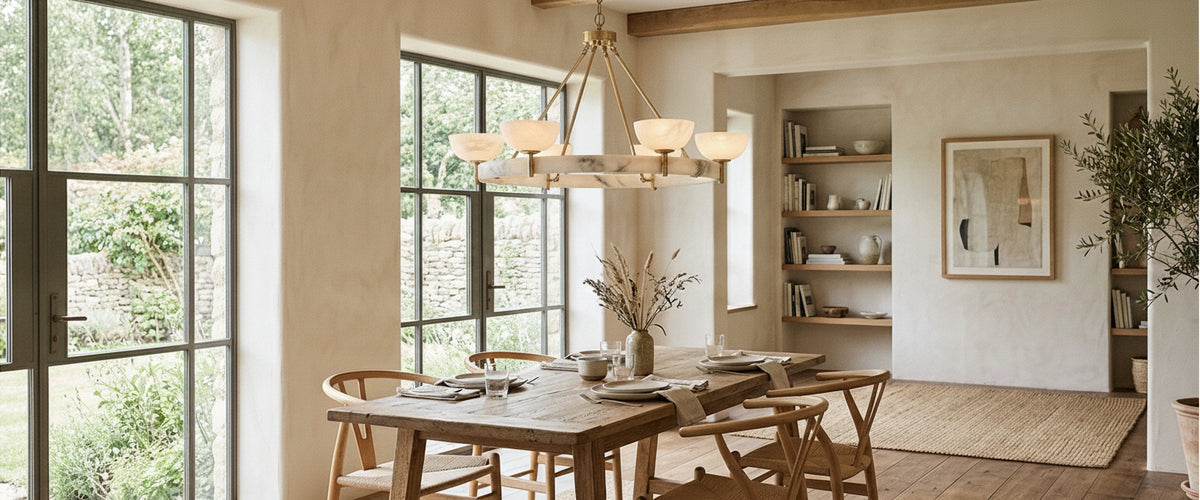

The romance of a vintage chandelier usually survives right up until an electrician opens the canopy. What looks like a hundred years of patina from the floor can turn out to be brittle rubber-sheathed flex, a repurposed gas arm and a ceiling rose never designed to carry twelve kilos of cast brass. None of that means you should avoid antique fittings. It means you should buy a vintage chandelier the way a dealer does: hands on the casting, torch in the canopy, questions about provenance asked before the card comes out.

Key Takeaways
Weight tells the truth. Solid cast brass arms and hand-cut crystal feel heavy and cold; spun tube and moulded acrylic do not.
Assume rewiring. Any vintage chandelier older than about forty years should be rewired and tested by a qualified electrician before it goes live.
Certification rarely travels. A vintage chandelier almost never carries a current Underwriters Laboratories listing or a UKCA/CE mark, and that affects insurance and commercial installation.
Drop height is the silent killer. Period pieces were hung in rooms with far taller ceilings than most modern homes.
Light quality differs by material. Crystal scatters, pressed glass softens, brass warms, and alabaster diffuses in a way glass cannot imitate.

Reading the Construction: Casting Weight, Canopy Depth and Wiring Age
Pick the piece up if you can. A genuine vintage chandelier in brass is cast or spun from thick-walled stock, and the arms resist flexing when you press them gently near the join. Later reproductions use thin tube with soldered collars that give under thumb pressure. Look at where the arms meet the central column: hand-finished work shows file marks and slight asymmetry, while modern castings are uniform to the point of sterility.
The canopy is where sellers get caught out. A shallow pressed canopy usually means the fitting was designed for a surface-mounted ceiling plate, not the recessed back boxes used in some refurbished UK properties. Open it and you will learn the real age of a vintage chandelier from the wiring: cotton-braided flex, red and black conductor colours, or porcelain connector blocks all point to pre-1970 origins. Rubber insulation that crumbles when flexed means a full rewire, and that is a legitimate point to negotiate on price.
Check the suspension chain and the hook it hangs from. Original chains often have open links worn thin at the contact points, and a chandeliers vintage enough to predate central heating has hung through decades of soot, damp and temperature swings. Ask whether the ceiling can take the load. We have seen more than one beautiful vintage chandelier held up by a plasterboard fixing and optimism.
Crystal, Pressed Glass and Brass: What Each Vintage Chandelier Actually Does to Light
A vintage crystal chandelier throws light in shards. Lead crystal has a higher refractive index than ordinary glass, which is why hand-cut drops split a filament source into visible spectral colour across walls and ceilings. The effect is theatrical and slightly restless, brilliant over a polished dining table and tiring in a bedroom. Hold a drop to the light: hand-cut facets meet at crisp, faintly irregular edges, while moulded pieces show soft, rounded edges and often a faint seam line. The Corning Museum of Glass is a good primer if you want to understand how cutting and polishing methods changed across the nineteenth and twentieth centuries.
A vintage glass chandelier built from pressed or blown components behaves differently. Pressed glass scatters rather than refracts, so you get a broader, gentler wash with far less sparkle. Murano-style blown arms fall somewhere between the two, adding colour into the beam. Then there is the vintage stained glass chandelier, usually Arts and Crafts or Tiffany-influenced, which does something unusual: it tints the light itself. Amber and green leaded panels produce a warm, low-lumen pool that reads beautifully over a stair half-landing and poorly over a kitchen worktop.
A vintage brass chandelier without glassware relies entirely on the metal. Unlacquered brass develops a dark, uneven patina that absorbs a surprising amount of output, so a six-arm antique fitting may deliver less usable light than a modern three-light piece. That is not a fault. It is a design assumption from an era of candle and early filament lighting. Where you want the warmth of brass but need the room to be genuinely lit, something like Balance 5 Light Chandelier in brown and polished brass keeps the metal reading warm while positioning the lamps where they can do useful work. With a true vintage chandelier, plan for supplementary table and floor lighting rather than expecting one fitting to carry the room.
Period Tells: French Empire, Mid-Century Starburst and Art Deco Geometrics
Style is not decoration here; it dictates how the room reads once the fitting is up. A vintage French chandelier in the Empire manner, with its beaded swags and tiered basket of drops, is symmetrical and formal. It anchors a room with cornicing and a fireplace, and it looks lost in a plain-plastered extension. Louis XV-influenced cage and birdcage forms are lighter and more decorative, better suited to a landing or a dressing room than a dining space that needs actual output.
A vintage chandelier in the mid-century starburst or Sputnik idiom makes the opposite argument. Radial arms, exposed lamps, minimal glassware. They work in rooms with clean lines and low ornament, and they punish rooms with busy wallpaper. Art Deco geometrics sit between the two camps: stepped tiers, frosted slip shades, chrome or nickel rather than brass. If your property has any 1920s or 1930s DNA, a Deco fitting will feel inevitable rather than imported.
One practical warning. The period style of a vintage chandelier sets an expectation for everything around it. Hang an Empire crystal piece in a minimal room and you will spend the next six months buying furniture to justify it.
Drop Height: Why Vintage Proportions Rarely Suit Modern Ceilings
Georgian and Victorian reception rooms routinely ran to 3.5m (around 11ft 6in) and above. Contemporary UK new-build ceilings often sit close to 2.4m (about 8ft). A vintage chandelier designed to hang two-thirds of the way down a tall room becomes a head injury in a standard one.
The workable rules are simple. Over a dining table, aim for 76cm to 91cm (30 to 36 inches) between tabletop and the lowest point of the fitting. In circulation space, keep at least 2.1m (7ft) of clear headroom below the fitting, more if the piece has sharp drops at eye level. In a stairwell, the lowest point should clear the highest tread by at least 2.1m, and the fitting should be visible from the floor below.
Chains can be shortened; that is routine. Rigid-rod fittings and fixed-canopy designs are harder to adjust, and shortening a chain on a piece with cascading crystal changes the proportion of the whole design, not just its height. Measure your ceiling, your table and the sightline from the doorway before you fall for anything. If a vintage chandelier will not work at your ceiling height, a modern one designed for current proportions is the less painful answer: in a standard 2.4m room, a compact fitting such as Aries 4 Light Small Crystal Chandelier keeps the cut-glass language without eating the headroom a period drop demands. Our full lighting range is built around the heights people actually have.
Rewiring and Certification: Underwriters Laboratories, UK Standards and Responsible Sourcing
Here is where buyers get caught. An Underwriters Laboratories listing on a vintage chandelier, if one ever existed, does not survive decades of rewiring, part swaps and international shipping. UL certification applies to a specific product as manufactured and tested, so a fitting reassembled from period parts has no valid listing at all. The same logic applies to UKCA and CE marking in Britain: the mark belongs to the product as placed on the market, not to the antique frame inside it.
For domestic use in the UK, the practical requirement is that the installation complies with BS 7671 and is carried out by a competent person. The IET's wiring regulations guidance is the reference point your electrician will work from. Responsible sourcing means the dealer can tell you when the vintage chandelier was last rewired, what flex and lampholders were used, whether the metalwork is earthed, and whether it has been tested or inspected. Vague answers are your answer.
Commercial buyers face a stricter position. Hotels, restaurants and licensed venues generally need certified fittings for insurance and fire risk assessment purposes, and an uncertified vintage chandelier in a public dining room is a conversation you do not want to have with an assessor. Many hospitality projects solve this by using period-influenced new fittings in public areas and keeping genuine antiques in private or back-of-house spaces.
Where a Vintage Chandelier Commands a Room
Dining rooms remain the strongest case. A single centred fitting over a table has a job to do and a clear focal point to occupy. Where the table needs sparkle but the room cannot take a wide tiered basket, a tighter crystal frame such as Shoal 4 Light Crystal Chandelier holds the centre without dominating the sightline from the doorway. Entrance halls and stairwells come next, because a chandelier seen from two floors gives you a return on the drama. Principal bedrooms can carry one if the crystal count is modest and the output is dimmable.
Where a vintage chandelier goes wrong: open-plan kitchens, where grease and steam attack patinated brass and cut glass relentlessly; low-ceilinged snugs, where the piece crowds the room; and bathrooms, where damp and IP ratings rule most antiques out entirely.
A recurring conversation in the studio runs like this. A client finds a 1920s five-light crystal piece at auction, loves it, then discovers the room needs soft, even light for everyday use and sparkle only occasionally. That is usually the point where alabaster enters the discussion. Stone diffuses light through its own body, producing a warm glow with no glare and no refracted flicker, and the veining gives visual interest that does not depend on cut facets catching a filament. Our alabaster lighting collection sits in exactly that territory, and several of the chandeliers pair stone with brass detailing that reads as period-sympathetic without the wiring risk.
The Vintage Chandelier Buyer's Checklist
Weigh it or lift it. Thin, light arms suggest later reproduction.
Open the canopy and photograph the wiring before you buy.
Count missing or mismatched drops and price the replacements.
Check arms for previous soldered repairs and hairline cracks near the joins.
Confirm the lampholder type and whether it takes current lamps.
Ask when the vintage chandelier was last rewired, by whom, and whether it is earthed.
Measure ceiling height, table height and doorway sightlines first.
Confirm your ceiling structure can take the load, with a joist fixing or a proper support plate.
For commercial use, confirm certification status in writing before purchase.
Budget for rewiring, cleaning, replacement crystal and installation, not just the hammer price.
Vintage or New: Making the Call
Choose a vintage chandelier when the room has period architecture worth answering, when you want a piece with genuine history, and when you have the appetite to manage restoration. Choose new when certification matters, when you need reliable dimming and current lamp technology, or when the ceiling height simply will not accommodate a period drop.
Cost is rarely a clean comparison. A restored antique can end up well above an equivalent new fitting once rewiring, replacement crystal, specialist cleaning and installation are added, or well below if you buy well and do the work yourself. The budget for any chandelier depends on material, scale, complexity and finishing, so price the whole job rather than the object. If you are weighing the restoration of a vintage chandelier against a new commission, ask us for a tailored quote and compare like with like.
The thing that unites good vintage chandelier buying and good new buying is the same: knowing what the light will actually do once it is switched on. Cut crystal sparkles, stained glass tints, patinated brass absorbs, and alabaster glows. Decide which of those you want in the room, then find the fitting. You can see the full approach we take to stone and glass across the Niori range, where alabaster and natural stone are the starting point rather than an afterthought.