
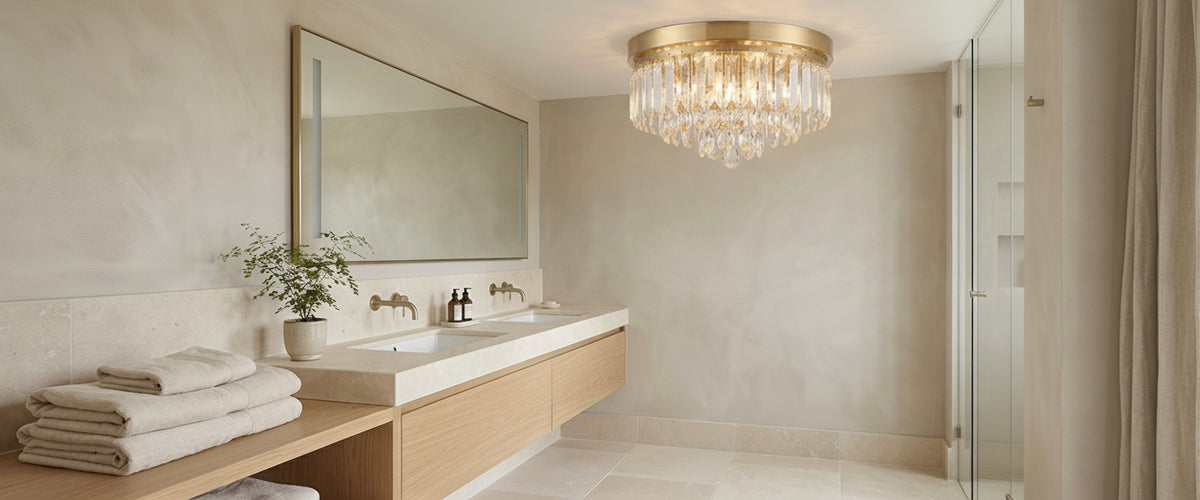

Most crystal bathroom flush fittings fail at the spec sheet, long before anyone switches them on. The shape is right, the price is agreed, and then the fitting arrives with the wrong IP rating for the zone, a diameter better suited to a hallway, and a bulb that turns every facet into a spike of glare across the mirror. A crystal bathroom flush can look superb in a small tiled room, but only if you treat it as a technical purchase first and a decorative one second.

Key Takeaways
Zone before style. Establish which bathroom zone your ceiling sits in, and the minimum IP rating that follows, before you shortlist a single crystal bathroom flush. Everything else is negotiable; this is not.
Warm light flatters crystal. Around 2700K keeps refraction golden. Daylight bulbs above 4000K turn cut glass hard and clinical against white tiles.
Go smaller than instinct suggests. Showroom ceilings are high and wide; bathroom ceilings are neither.
Never center a crystal bathroom flush directly over the basin mirror. You will light the top of your head and throw glare into your own eyes.
Alabaster and stone behave differently. Crystal splits light; alabaster spreads it. Gypsum alabaster also dislikes damp, so placement rules change.

IP Ratings: Which Bathroom Zone Your Ceiling Sits In
UK bathroom wiring divides the room into zones, and each zone sets a minimum level of protection against water. Zone 0 is inside the bath or shower tray itself. Zone 1 covers the area directly above the bath or shower up to 2.25 meters (roughly 7 feet 4 inches) from the floor. Zone 2 extends 0.6 meters (about 2 feet) beyond Zone 1, and most electricians apply the same thinking to the space immediately around a washbasin. Anything outside those areas is generally treated as outside the zones, though steam still travels.
In practice, a ceiling in a compact bathroom with a shower over the bath will often sit in Zone 1, which means IP65 is the sensible target. A ceiling above a basin, or in a wider room where the fitting is well clear of the bath, usually calls for IP44 as a minimum. Ceilings in a downstairs cloakroom with no shower often fall outside the zones entirely, which is exactly where the prettiest crystal bathroom flush fittings can live. The current requirements sit within BS 7671, the national wiring regulations maintained by the IET, and your electrician will confirm the zone on site rather than from a floor plan.
One caution specific to cut glass: many decorative crystal bathroom flush fittings carry no IP rating at all, because they were designed for bedrooms and landings. If a listing does not state a rating, assume there is none. A crystal bathroom flush without a declared IP figure belongs in a ventilated cloakroom at most, and even then only with a qualified electrician's sign-off on the installation and circuit protection.
Warm Versus Daylight: What Bulb Color Does to Crystal Refraction
Crystal is a prism. Whatever color you feed a crystal bathroom flush, it splits and amplifies. In a small room finished in white gloss tile, that amplification is unforgiving.
At 2700K, refracted light picks up a faint amber edge and the facets read as warm sparkle. Skin tones stay flattering and grout lines soften, while brass and chrome both look intentional. Push to 4000K or beyond and the same fitting throws cold white shards that bounce off tile, mirror and chrome, then land back in your eyes. Bathrooms are the most reflective rooms in the house; you are effectively lighting the space three or four times over.
Two more details worth specifying. First, choose lamps with a color rendering index of 90 or above, so makeup and shaving actually work under the light. The Society of Light and Lighting, part of CIBSE, publishes guidance on lighting quality and glare that is worth a read before you finalize a scheme. Second, check that the fitting and its driver are genuinely dimmable. A crystal bathroom flush at full output is a morning light. At 30 percent it becomes a bath light, which is when crystal is at its best.
The Diameter Trap: Why Showroom Scale Rarely Translates
Showrooms have generous ceiling heights and open floor plates, so a broad crystal bathroom flush looks balanced on the display rail. Move that same piece into a bathroom of roughly 2 by 2.5 meters (about 6.5 by 8 feet) with a 2.4 meter (7 foot 10 inch) ceiling and it swallows the room.
A useful starting rule when sizing a crystal bathroom flush, or any semi-flush fitting: add the room's length and width in meters, then treat that number in centimeters as an upper limit for diameter. A 2 by 2.5 meter bathroom gives you 4.5, so around 45 centimeters (about 18 inches) is the maximum, and something closer to 30 to 35 centimeters (12 to 14 inches) will usually sit better. Then check drop separately. Anything hanging more than about 15 centimeters (6 inches) below the ceiling becomes a hazard in a room where people step out of a bath with their arms up. At that scale, a tight three-light form such as Brinley 3 Light Semi-Flush Ceiling Light, Brushed Brass holds the middle of the ceiling far better than a wide multi-arm frame borrowed from a hallway.
The trap is not floor area at all. Boxed-in soil pipes, extractor ducting and existing downlight positions all eat into the ceiling, and a crystal bathroom flush sized correctly for the room can still miss the only usable center point by half a meter. Measure the ceiling, not the floor, and mark the actual mounting position with tape before you order anything.
Chrome, Brushed Nickel or Brass Against White Grout
The metal surround on a crystal bathroom flush is the part your eye reads first when the light is off, and each finish behaves differently in a tiled room.
Polished chrome disappears cleanest against white grout and gloss tile, because it mirrors its surroundings. It also shows every water spot and fingerprint, which matters in a family bathroom.
Brushed nickel reads slightly warmer and gray, hides limescale better, and sits comfortably alongside older chrome taps without pretending to match them.
Brass is the boldest choice. Lacquered brushed brass holds its color and pairs beautifully with crystal, since both carry a warm cast. Unlacquered brass will patina in humid air, which some buyers want and others discover with dismay.
If the ceiling sits in a zone that demands a rated fitting and the scheme is already leaning warm, a bathroom-specified brass piece such as Talvenne Bathroom 4 Light Semi-Flush Ceiling Light, Brass is closer to the right design language than an unrated decorative crystal bathroom flush pressed into service. A quick test: photograph your existing tap and shower valve, then compare against the fitting image on screen. Mixed metals work well when the difference is obvious. They look accidental when the two finishes are almost, but not quite, the same.
Mirror Glare: Why the Basin Is the Wrong Center Point
Centering a crystal bathroom flush directly above the basin feels logical and produces the worst possible result. Downward light from that position casts shadows into your eye sockets and under your chin, which is unhelpful for shaving or makeup, and the mirror doubles every facet straight back at you.
Better to place the ceiling fitting toward the middle of the room, or slightly toward the bath, and light the face from the sides. Two wall lights flanking the mirror at roughly eye level, around 1.6 to 1.7 meters (about 5 feet 3 inches to 5 feet 7 inches) from the floor, do the job the ceiling light cannot. This is where alabaster and natural stone earn their keep, because a stone shade gives even, low-glare light across the face with no hotspots. Our alabaster lighting collection is worth browsing for wall pieces that pair with a crystal bathroom flush rather than competing with it.
Crystal or Alabaster: Two Very Different Kinds of Light
Crystal refracts. Alabaster diffuses. Cut crystal takes a point source and splits it into hundreds of bright specks, which is why a crystal bathroom flush reads as jewelry and why it can be so punishing at close range. Alabaster does the opposite: light passes through the stone, the veining catches it, and what leaves the surface is soft and even.
Opal glass sits between the two. Where a small tiled room needs an even glow rather than hundreds of bright specks, a fitting such as Hollis 5 Light Semi-Flush Ceiling Light, Black with Opal Glass gives much of the low-glare quality of stone without its sensitivity to moisture.
There is a material caveat that few retailers mention. True alabaster is gypsum, and gypsum is slightly soluble in water, which is why conservators keep alabaster sculpture away from humidity and never wash it. In lighting terms, that rules alabaster out of Zones 0, 1 and 2, and makes it a poor choice for a small bathroom with heavy shower use and weak extraction. In a well-ventilated bathroom, a guest cloakroom or a dressing area next to the bathroom, it is superb. Marble and onyx are denser and more tolerant, though they still want sealing and dry mounting positions.
If you want the sparkle of crystal in the bathroom itself and the warmth of stone elsewhere, that combination works. Keep the crystal bathroom flush as the sculptural center point, and let stone table lamps or wall lights carry the softer layers in the adjoining spaces. The wider lighting collection is a good place to see how the two materials sit together across a floor.
Five Spec-Sheet Checks Before You Commit to a Crystal Bathroom Fitting
IP rating stated in writing. IP44 as a minimum for most bathroom ceilings, IP65 where the fitting sits above a bath or shower. No stated rating means no bathroom.
Overall drop and diameter. Confirm both against your marked mounting point, not the room's floor area, and allow head clearance beside the bath.
Lamp type, cap and dimmability. Check the bulb base, maximum wattage, whether the fitting is supplied with drivers, and whether it dims on the switch type you already have.
Fixing method and ceiling type. Plasterboard, lath and plaster, and concrete all need different fixings. Weight matters more with crystal than with glass or metal shades.
Replacement crystal availability. Ask whether individual droplets or arms of your crystal bathroom flush can be replaced later. Discontinued components are the reason perfectly good fittings get scrapped.
Add a sixth informal check before you commit to a crystal bathroom flush: ask about lead time, and whether matching wall lights come from the same family. A ceiling fitting and two mirror lights bought together will match. Bought a year apart, they often do not, because finishes and crystal cuts shift between production runs.
Living With It: Cleaning and Long-Term Care
Hard water is the enemy. In limescale-heavy regions, steam settles on the cut facets of a crystal bathroom flush and dries into a fine chalky film that dulls refraction within months. Wipe the facets every few weeks with a lint-free microfiber cloth and a light mist of distilled water on the cloth rather than sprayed onto the fitting. Skip anything ammonia-based near lacquered brass, and never spray cleaner toward the lamp holder.
If you have stone pieces nearby, treat them differently. Dust alabaster and marble dry, use a soft brush around carved edges, and keep water off the surface entirely. Improve extraction if the mirror stays fogged for more than a few minutes after a shower, because chronic damp shortens the life of every fitting in the room, crystal included.
Get the zone, the diameter and the bulb color right and a crystal bathroom flush stops being a risk. It becomes the one piece in the room that looks considered rather than specified from a catalog, and it earns its place every time the light drops to half and the facets start doing what crystal is for.