
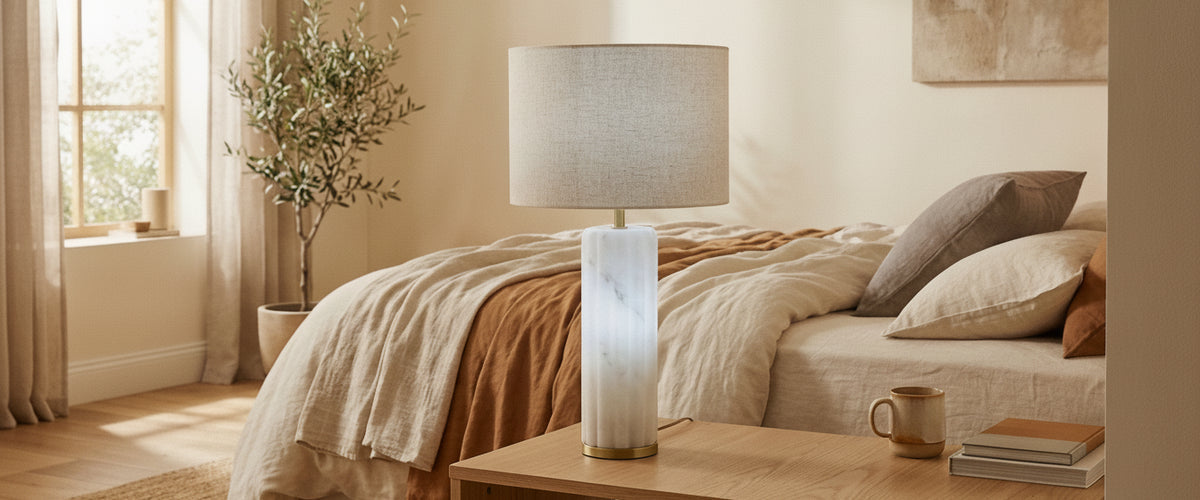

gold bedside table lamps fail for two boring reasons. The finish is too yellow for the room, or the shade sits at the wrong height and fires bulb glare straight across the pillow. Neither problem is about taste, and neither gets fixed by spending more. Both come down to a handful of measurable decisions: the tone of the metal, the distance from mattress top to the bottom of the shade, the shade material, and the bulb inside it.
We sell a lot of alabaster and natural-stone lighting at Niori, and gold bedside table lamps are what bedroom buyers ask about most often. They are also the pieces most likely to come back when the choice was made from a small on-screen thumbnail. So here is the practical version, in the order you should actually make the decisions.

At a Glance: Five Decisions Behind Gold Bedside Table Lamps
- Finish tone first. Warm gold, champagne and polished gilt behave like three different metals under real light. Pick against your wall color and hardware, not against the product photo.
- Height beats style. The bottom of the shade should sit close to eye level when you are sitting up in bed. Get this wrong and the prettiest lamp in the house becomes a glare source.
- Shade material controls spill. Linen throws a soft column up the wall, opaque card pushes light down, alabaster and glass glow all over.
- Bulb temperature makes or breaks gold. Around 2700K is the sweet spot for most gilt. Very cool light turns warm gold sour.
- A matched pair is optional. On a wide bed with asymmetric bedside furniture, two related but different lamps often look more considered.

Warm Gold, Champagne and Polished Gilt: Three Finishes, Not One
Gold is a family, not a color. Most gold bedside table lamps are sold under that single word, but warm gold, sometimes listed as antique or aged gold, has red and bronze in it. Champagne gold is desaturated and slightly gray, closer to a pale brass. Polished gilt is bright, reflective and mirror-like, and it reads far more formal than either.
Each shifts under different light. In north-facing daylight, champagne gold can drift toward silver and lose its warmth entirely. Warm gold, lit by an incandescent or warm LED lamp at night, gains saturation and starts to look almost copper. Polished gilt does something different again: it reflects whatever is around it, so a bright gilt base sitting next to a navy wall will pick up that navy in its highlights. This is exactly why gilt bronze had such a long run in European interiors, where the finish was prized for the way it carried candlelight; the Metropolitan Museum's notes on gilt bronze and ormolu objects are a good reminder that these finishes were engineered for firelight, not daylight.
Practical test: hold a sample of your bedding, your headboard fabric and your door hardware together, then look at the lamp finish in the evening, under the light you will actually use. If your hardware is nickel or chrome, champagne gold sits alongside it far more comfortably than warm gold does. If your room leans toward cream, oatmeal and oak, warm gold is the safer pick. Where you want the gilt to stay crisp rather than glow, a slim mirror-bright base under a pale shade, as on the Cross Table Lamp With Ivory Shade in polished gold, keeps the reflectivity to the metalwork and away from the light itself.
The Height Rule: Measure From the Mattress, Not the Floor
Most people choose gold bedside table lamps by overall look and then discover the shade is too low. The measurement that matters is the relationship between the top of the mattress and the bottom edge of the shade. Sit up in bed as if you were reading. Your eye level is roughly where the bottom of the shade should be, give or take a couple of inches (about 5 cm). Above that line, you see the bulb. Below it, the lamp lights your lap and little else.
Work it backwards. Measure floor to mattress top, which on a bed with a deep mattress and a platform base can be anywhere from 22 to 30 inches (56 to 76 cm). Then measure your nightstand height. The lamp needs to make up the difference plus the reading distance, which usually lands total lamp height somewhere between 24 and 30 inches (61 to 76 cm) for a standard nightstand. Tall bed, low nightstand, and you need a taller lamp than instinct suggests.
A note from the studio: the single most common fix we talk clients through is not a different lamp at all. It is a taller nightstand, or swapping a squat drum shade for an empire shade with more vertical depth. Both raise the effective shade line without changing the lamp you fell for.
Shade Material and Spill: Linen, Glass and Empire Shapes
The shade decides what the wall behind your bed looks like at 11pm, and on gold bedside table lamps it also decides how much of the metal you see lit.
Linen and Fabric
Ivory linen is the default for a reason. It transmits a warm, even wash through the shade wall and throws light both up and down, so the wall gets a soft vertical column of light. It flatters gold bases because the light bouncing off the inside of the shade picks up the metal tone. Darker linens and card-lined shades block side spill and behave more like a spotlight. If the wall behind the bed needs that diffused column rather than a hard pool of downlight, something like the Arabella Table Lamp with its gold quatrefoil base and ivory linen shade is closer to the right design language, since the open metalwork also lets a little light through the base itself.
Glass and Alabaster
A stone or glass shade glows as an object. Alabaster in particular scatters light inside the material itself rather than simply passing it through, which is why it reads as a warm, softly lit mass instead of a lit surface. That is lovely for ambience and less useful for reading a book. If your gold bedside table lamps are the only light source on that side of the bed, pair a glowing stone shade with a directional reading light elsewhere, or accept that the lamp is mood lighting.
Empire Versus Drum
Empire shades, wider at the bottom than the top, push more light downward onto the bedside surface and keep the ceiling darker. Straight-sided drums split light more evenly up and down. On a low nightstand, the empire shape usually wins because it gains you shade depth and keeps the bulb hidden from a seated position.
Pairing Gold Bedside Table Lamps With Dark, Pale and Upholstered Bedheads
Gold bedside table lamps read very differently depending on what sits behind them. Against a dark headboard (inky blue, charcoal, deep green), a gold base becomes a high-contrast silhouette. That is a strong look, but it demands restraint elsewhere; two brightly polished gilt bases against a dark wall can tip into showroom territory fast. Aged or warm gold, with its softer surface scatter, holds up better here, which is why a textured, broken-surface finish such as the Fragment Table Lamp in aged gold sits more comfortably against a deep-toned bedhead than a mirror-polished base would.
Against pale plaster or a cream wall, contrast drops away and the lamp needs form to carry it. This is where a sculpted base earns its keep: a fluted alabaster column with a slim gold collar, or a stone form with brass detailing at the neck and foot. The stone reads as mass, the gold reads as line. If you are browsing, the alabaster lighting collection is the easiest place to see how much difference a small amount of metal detailing makes against a soft stone body.
Upholstered bedheads are the forgiving option. Linen, boucle and velvet all absorb light rather than bounce it, so gold bedside table lamps beside them never compete. One caveat with velvet: it eats light. Expect to need a slightly higher lumen output than you would against a painted wall to achieve the same perceived brightness.
2200K Versus 3000K: The Color Temperature That Flatters Gold
This is where good gold bedside table lamps get ruined by a bad bulb. Correlated color temperature describes how warm or cool a light source appears, and it is standardized precisely so you can compare bulbs across brands; the International Commission on Illumination maintains the underlying definitions.
At 2200K you get a deep amber, candle-like light. It makes warm gold glow and is genuinely flattering at bedtime, but it flattens detail and can make cream linen look yellow. At 3000K the light is clean and warm-white, good for reading, though it starts to cool the red out of aged gold and can make cheaper plated finishes look thin and greenish. For most bedrooms, 2700K is the finish-flattering middle: warm enough to keep gold rich, clear enough to read by.
Two more specs worth checking. Look for a color rendering index of 90 or above, because low-CRI light is what actually makes a gold lamp bedside table setup look cheap. And check the bulb is dimmable with your dimmer type; the best bedside setups run at maybe 20 to 30 percent output at night. If you are adding hardwired wall lights alongside your lamps, have a qualified electrician do the install and the dimmer selection together, because mismatched dimmers and LED drivers cause most of the flicker complaints we hear about.
The Case for a Mismatched Pair
A matched set of gold bedside table lamps is the default, and on a symmetrical bedroom with two identical nightstands it is the right call. But wide beds create problems. On a king bed with 7 feet (roughly 2.1 m) between the two lamp positions, two identical lamps can read like bookends rather than a composition, especially if one side has a window and the other has wall.
Deliberate asymmetry works when you hold one variable constant. Keep the shade material and color identical and vary the base. Or keep the base finish identical and vary the height, which is genuinely useful if one nightstand is lower than the other. We shipped two alabaster and brass lamps to a client in Napa last year where one side of the bed had a built-in shelf and the other a freestanding table; matching lamps would have sat 4 inches (10 cm) apart in shade height, which is enough to look like a mistake. Two different bases with the same shade line solved it, and the room read as designed rather than decorated.
The failure mode to avoid: two unrelated lamps in two unrelated golds. Champagne on one side and warm gold on the other looks like you bought them in different years.
Buyer's Checklist Before You Order
Run through this before you commit to any gold bedside table lamps.
- Measure floor to mattress top and floor to nightstand top. Write both down before you look at any lamps.
- Match the gold to your hardware, not to your inspiration image. Door handles and drawer pulls are in the same sightline.
- Check shade depth, not just diameter. Depth is what hides the bulb from a seated position.
- Confirm the switch type. An inline cord switch is a nuisance in a bedroom. A base-mounted or socket switch you can find in the dark is worth paying attention to.
- Buy bulbs at the same time. 2700K, CRI 90 or above, dimmable, and a shape that suits the shade.
- Ask whether the gold is solid, plated or lacquered, because it changes how you clean it for the next decade.
- Request a tailored quote for larger or bespoke pieces. Cost on natural-stone lighting depends on the stone, scale, complexity of the carving, metalwork and finishing, so a quote is more useful than a guessed range.
Keeping Gold and Stone Looking Right
The surface on most gold bedside table lamps is plated or lacquered, and both dislike the same things: abrasives, ammonia-based glass cleaners and moisture left sitting on the surface. A dry microfiber cloth handles dust. If you need more, a barely damp cloth followed immediately by a dry one is the limit. Never use a brass polish on plated or lacquered gold; it strips the top layer and leaves a patchy bloom that cannot be undone.
Alabaster needs more caution again, because it is a gypsum stone and softer than marble. It is mildly water-soluble, so no wet cloths, no sprays, and definitely no bathroom cleaner near it. Dust with a soft dry brush and keep it away from humidifiers and open windows in wet weather. On a bedside table, the real risk is a water glass, so use a coaster or a tray under the lamp base. Done properly, these materials age beautifully; you can browse the wider lighting range to see how stone and metal are combined across pendants, wall lights and table lamps.
Get the finish tone, the shade line and the bulb right, and a bedside table gold lamp stops being a decorative gamble. It becomes the light you actually reach for every night, which is the only test that matters.