
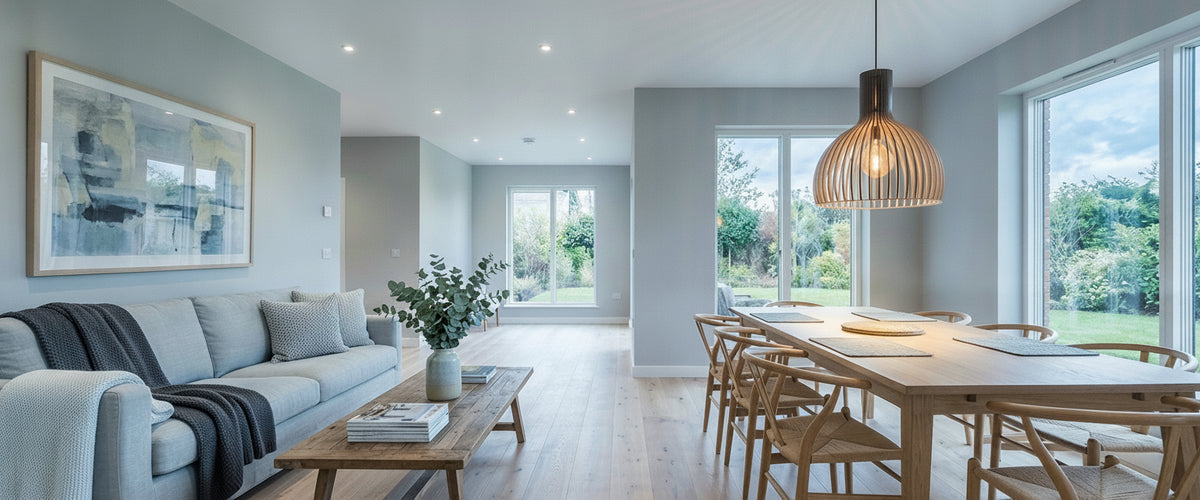

Hang the wrong timber shade over an island and you end up with a handsome object that does almost nothing useful for the room. That is the quiet problem with wood pendant lights: they photograph beautifully in a showroom, then land in a real kitchen at the wrong height, over the wrong worktop, with a bulb that turns warm oak the colour of weak tea. Wood is a demanding material to light with, because unlike alabaster or onyx it does not transmit light at all. It blocks, bounces and frames it. Every decision you make about species, finish and drop is really a decision about where the light goes.

At a Glance: The Short Version
- Species changes light quality. Pale ash and birch bounce light back into the room; walnut and smoked oak absorb it, so two wood pendant lights of identical shape can light a worktop very differently.
- Solid timber and veneered MDF look identical until a bulb is switched on at close range. Check edges, end grain and the inside of the shade.
- A kitchen wood pendant light needs task-grade output. A living room pendant needs the opposite: low glare, soft spill, dimmable to almost nothing.
- Drop height over an island usually sits around 75 to 90cm (30 to 35in) above the worktop, adjusted for ceiling height and sightlines.
- Match bulb colour temperature to wood tone. 2700K flatters mid-brown oak; go slightly cooler for pale timbers, slightly warmer for near-black walnut.
- Mixing materials solves most problems. A timber frame with an alabaster or glass diffuser gives you the warmth of wood and the glow of stone.

Oak, Walnut, Bamboo: Species Is a Light-Quality Decision
Designers tend to specify wood pendant lights from a colour swatch. The more useful question is how much light the species throws back. Pale ash, birch and white oak have high surface reflectance, so a downward-facing shade in those species lifts the whole zone beneath it; the inside face acts as a soft reflector and the light pooling on a worktop feels generous. Walnut, wenge and dark-stained oak do the reverse. They swallow the upward and sideways bounce, and you get a tighter, more theatrical cone of light directly below the fitting.
Bamboo behaves differently again. It is technically a grass rather than a hardwood, and woven or slatted bamboo shades leak light through the gaps, casting patterned shadow across ceilings and walls. Lovely in a garden room or over a breakfast table. Distracting above a dining table where you want faces lit, not stripes on the plaster. Timber also moves with humidity, which matters more in kitchens and bathrooms than most buyers expect; the technical guidance published by TRADA on moisture content and dimensional movement is worth a look if you are commissioning bespoke joinery-grade shades. Where the fitting will hang in a porch, a covered terrace or a damp garden room, a weather-rated lantern such as the Lindendale 1 Light Outdoor Pendant in Antique White copes with that moisture swing far better than an untreated timber shade will.
One practical note from the studio. We shipped a set of wood pendant lights to a converted threshing barn in Suffolk where the client had already installed reclaimed oak beams at low level. The dark timber pendants they originally specified disappeared completely against the ceiling structure. Swapping to a pale stone diffuser with a slim timber collar gave them contrast and light in the same move.
What a Bulb Really Shows About Solid Wood Versus Veneered MDF
Almost all wood pendant lights fall into one of two camps, solid stock or veneered MDF, and at two metres away a well-made veneer is indistinguishable from solid timber. At arm's length with a warm bulb behind it, the difference is obvious. Look at three things. First, the edges: solid timber shows continuous grain wrapping a corner, whereas veneer shows a hairline seam or a contrasting edge band. Second, the end grain, which on solid stock reads as open pores and growth rings and on MDF reads as a flat brown biscuit. Third, the interior of the shade, where manufacturers often stop finishing because they assume nobody looks up. You will.
Veneer is not automatically the wrong answer. For large, lightweight shades over long spans it can be the sensible engineering choice, and a good veneer avoids the splitting risk that solid timber carries near heat. What matters is honesty about which you are buying and whether the maker has sealed the inside face. Unsealed MDF near a lamp holder will yellow and, in a kitchen, absorb cooking grease. An unfinished interior also scatters light unevenly, which shows up as blotchy pooling on a pale worktop.
The Kitchen Pendant Versus the Living Room Pendant
Two identical fittings can do opposite jobs depending on the room, and this is where most wood pendant lights get misused. A wood kitchen pendant lights is a task fitting first. It needs enough output to chop, read a recipe and check whether the chicken is cooked, which usually means a narrower opaque shade delivering a controlled downward wash plus separate ambient light elsewhere in the room. Open-bottomed shades with a visible lamp are fine here as long as the bulb sits above eye level when you are standing.
In a living room the brief flips. You are lighting a mood, not a chopping board, so you want the source hidden, the spill soft, and the dimmer working down to a candle-level glow. This is where timber alone struggles, because a solid wood shade at low output gives you a small bright disc on the coffee table and darkness everywhere else. Pairing timber with a translucent material fixes it. Where the room needs a soft diffused glow rather than a hard downlight, a fitting like the Priscila 1 Light Textured Glass Pendant in Gold is closer to the right design language than a solid timber cone. Alabaster in particular holds light in the body of the shade rather than punching it downward, so the fitting itself becomes a soft lantern. If you want to compare how translucent stone behaves against solid timber, it is worth browsing the alabaster lighting collection with that difference in mind.
Over a dining table, split the difference. Enough light on the tabletop to make food look good, nothing glaring at seated eye level, and a colour temperature warm enough that skin tones stay flattering.
Proportion and Drop Height: Where Wood Pendant Lights Tip into Heavy
Timber is visually weighty. That is the point, but it is also the trap. A stone or glass pendant of the same diameter reads lighter because light passes through it; wood pendant lights of identical size read as solid blocks hanging in the air. As a rule of thumb, keep the visual mass lower than you would with translucent materials, or lift the drop height slightly to give the fitting breathing room.
For islands, work from the worktop up: around 75 to 90cm (30 to 35in) of clear space beneath the shade suits most standard ceiling heights. Raise it in a room with 3m (10ft) ceilings, lower it if the pendants are small and clustered. For multiples over a run, allow generous spacing between shades so they read as a rhythm rather than a fence, and keep the outer fittings well inside the ends of the island so the arrangement looks centred. Where joists or an existing single fixing point make three separate drops impractical, a linear fitting such as the Priscila 5 Light Glass & Steel Bar Pendant spreads light evenly along the worktop from one ceiling position, which is often the neater answer in a retrofit.
The other proportion check nobody does: stand in the doorway. Most people judge pendant height standing directly beneath it, which is the one position from which the drop always looks fine. From the entrance to the room you will see whether it blocks the window, decapitates the artwork on the far wall, or cuts across a sightline into the garden.
Matching Filament Temperature to Wood Tone
Colour temperature and wood tone are a pairing exercise, not a default setting. Warm white at 2700K is the safe centre ground and suits mid-brown oak, cherry and teak; it keeps the reds alive without going orange. Pale ash, birch, maple and light-washed oak can take 3000K without looking clinical, and the slightly crisper light stops very pale timber from reading yellow. Near-black walnut, wenge and smoked oak benefit from dropping to around 2400K, closer to filament warmth, because the extra warmth picks out the chocolate and purple undertones that cooler light flattens into grey.
Colour rendering matters just as much as temperature under wood pendant lights. Go for a lamp with a high CRI, ideally 90 or above, or every timber in the room will lose a layer of depth. Then check dimming compatibility before you buy: most LED retrofit lamps want a trailing-edge dimmer, and pairing them with an old leading-edge plate is the most common cause of flicker and buzz in otherwise well-specified schemes. Any rewiring or new circuit work should go to a registered electrician; in the UK, you can check credentials through bodies such as NICEIC.
Grain, Finish and Wiring Access: What to Inspect Before Committing
Use this as a pre-purchase checklist for wood pendant lights, whether you are ordering online or standing in front of a sample.
- Grain direction across a set. Multiple pendants should read as a family. Wildly different figure from shade to shade looks like offcuts, not a considered specification.
- Finish consistency inside and out. Run a hand around the inner rim. Rough, unsealed timber will discolour with heat and collect kitchen grease.
- Wiring and lamp access. Can you change the bulb without dismantling the shade? Ask how the cable enters and whether the ceiling rose allows for height adjustment after installation.
- Weight and fixing. Timber pendants can be heavier than they look. Confirm the fixing method for plasterboard ceilings before the electrician arrives, not while they are up the ladder.
- Heat management. Enclosed timber shades trap heat around the lamp holder. LED lamps run cooler, but check the fitting's maximum wattage rating and honour it.
- Cable and hardware finish. Braided fabric flex, aged brass or blackened steel details do more for the look than another 20mm of shade diameter.
Where Wood and Stone Work Together
Timber and alabaster are natural partners because they fail in opposite directions. Wood gives grain, warmth and structure but no glow. Alabaster gives glow, translucency and that honeyed veining that changes character as the dimmer moves, but on its own it can read soft in a room full of hard surfaces. The most successful wood pendant lights we ship are rarely pure timber: a shade that combines a timber or brass frame with a stone diffuser gives you both, and it is the combination we see specified most often for kitchen islands in period properties where a pure-modern fitting would jar.
If your scheme already leans heavily on wooden kitchen pendant lights elsewhere, consider stone or glass for the adjacent zones so the eye gets relief. A translucent pendant over the dining table, alabaster wall lights along the corridor, a stone table lamp on the console. There is a full spread of forms to compare across the wider lighting range if you are building a whole-house scheme rather than solving a single room.
Living With Timber and Stone Fittings
Wood wants a dry dust and nothing more. No wet cloths, no spray polish near the lamp holder, and an occasional wipe with a barely damp microfibre on lacquered surfaces. Oiled timber may need refreshing every few years, especially above a hob where heat and steam pull moisture in and out of the fibres. Alabaster and marble have their own rules: no vinegar, no citrus cleaners, no anything acidic, because these are calcium-based stones and even mild acids etch the surface permanently. A soft dry brush around the veining and a dry cloth over flat faces is enough.
Budget is the last conversation, not the first, and it depends on species, scale, whether the shade is solid or veneered, the complexity of the metalwork, the diffuser material and the installation itself. A single small pendant and a run of five large bespoke shades sit in completely different territory. Send through your ceiling height, worktop dimensions and a photo of the space, and ask for a tailored quote rather than working from a headline figure.
Get the species, the drop and the bulb right and wood pendant lights do something a metal fitting rarely manages: they make a hard-surfaced kitchen feel calm. Get them wrong and you have bought a handsome box that casts a hole in the light. The difference is about an hour of thinking before you order.