

Gold fails in two directions, and both are easy to buy into. Too yellow and the lamp reads like a hotel lobby offcut. Too much polished surface and a calm room develops a glare problem the moment the sun goes down. Gold table lamps sell steadily in British homes and get quietly regretted just as steadily, usually because the finish was chosen from a lit studio photograph rather than tested against the actual walls, timber and ironmongery of the room it has to live in.

At a Glance
- The room decides the register. Cool grey plaster wants gold table lamps in a brushed or antiqued finish; warm limewash and oak can carry something brighter.
- Finish quality shows at arm's length. Solid brass, plated steel and gold-finished resin age in completely different ways.
- The shade does most of the work. Opacity and lining colour control whether gold glows or glares.
- Proportion beats style. Get shade spread and base width right and almost any shape works.
- Bulb temperature changes the metal. At 2700K brass reads golden; at 3000K the same metal turns cooler and flatter.
- Gold sits beautifully next to stone. Brass detailing against alabaster is one of the few pairings that flatters both.

The Room Sets the Gold's Register Before You Switch Anything On
Hold a brass sample against a cool white wall and it turns slightly acid. Hold the same sample against a putty-coloured plaster and it settles into something closer to honey. Nothing about the metal has changed; the surroundings have simply pulled different notes out of it. This is why we ask clients to photograph the room in daylight before choosing between polished, brushed, antiqued or patinated gold table lamps.
Run through the fixed metals first. Door handles, window furniture, tap fittings, picture frames, the legs of a coffee table. If those are already in unlacquered brass, a bright plated lamp will look thin beside them. If the room is full of blackened steel and chrome, an antiqued or bronze-and-gold patina base gives you the warmth without a clash; something like the Amarilli Table Lamp in bronze and gold patina, where the metal is broken up rather than uniformly bright, sits far more comfortably in that kind of room than a high-shine finish. One London client with a kitchen full of polished nickel ended up with a softly patinated pair on the console outside it, precisely because the contrast was deliberate rather than accidental.
Textiles matter too. Gold table lamps in a room of flat linen and wool read as jewellery. Put the same pieces in a room of silk, glass and mirror and they start competing. Count the reflective surfaces you already have before adding another.
Plated Steel, Solid Brass and Resin: How Each Finish Holds Up
Three constructions dominate gold table lamps, and the price difference between them is not arbitrary.
Solid Brass and Bronze
Weighty, repairable and capable of developing a patina you actually want. Unlacquered brass darkens where hands touch it and stays bright where they do not, which is either the appeal or the problem depending on your tolerance. Lacquered brass holds its colour longer but can eventually craze at edges. Gilded and gilt-bronze mounts have been used on lighting and furniture for centuries, and the finest historic examples in museum collections show how well the material survives when it is solid rather than surface-deep; the Metropolitan Museum of Art holds a strong body of gilt-bronze decorative work worth studying for proportion alone.
Plated Steel and Zinc
Most gold table lamps on the market are plated. Done well, with a thick deposit and a protective clear coat, plating gives a clean, consistent colour that solid brass cannot match for uniformity. Done badly, it wears through at the switch, the neck and the base rim within a few years. Ask about coating thickness and whether the finish is lacquered. A plated base is a perfectly good buy; a thinly plated base in a high-traffic spot is not.
Gold-Finished Resin and Composite
Useful for sculptural forms that would be impossibly heavy in metal, and often the only way to get a highly modelled shape at a sensible weight. The tell is sound and temperature: resin sits at room temperature in the hand and rings dull when tapped. It also tends to look flatter under directional light because it lacks the micro-variation of cast metal. Fine for a decorative form on a side table, less convincing as the hero piece on a hall console.
Gold as Detailing on Stone
The fourth route, and the one we return to most often, is gold used sparingly as detailing on a natural material. Brass collars, stems and bases against carved alabaster give you the metal's warmth without a large reflective surface. The stone diffuses, the brass catches. You can see that logic across the alabaster lighting collection, where the metalwork is there to frame the stone rather than dominate it.
Shade Colour and Opacity: Where Refined Tips into Overstated
The shade is the single biggest lever you have on gold table lamps, and most buyers treat it as an afterthought.
An opaque shade in ivory linen or parchment sends light up and down in two clean cones and leaves the gold base to glow from reflected light only. That is the restrained option and it suits most sitting rooms. A translucent shade, whether silk, thin linen or stone, lights the whole volume and lifts the surrounding wall, which changes the lamp from a reading light into a soft ambient source.
Lining colour decides the temperature of everything below the shade. A white lining keeps the light neutral and honest. A gold or champagne lining throws warm light onto the base, the tabletop and anyone sitting under it, which flatters skin tones but can push an already-yellow brass towards orange. A gold base with a gold-lined shade under a warm bulb is three warm elements stacked; that is usually one too many.
Black, ink and deep bronze shades are the sharpest partners for polished gold. They contain the light, drop a strong pool onto the surface below and let the metal read as a graphic line. Where the gold is a detail rather than the whole body of the lamp, that pairing becomes easier to live with: the Camilia Table Lamp with gold leaf detail and a black shade is closer to the right balance, with the light held tight to the surface and the gilding doing the work of a single bright line. Shades like these also make a room noticeably darker, so use them where you have other layers to fall back on.
Where Gold Table Lamps Anchor a Room, and Where They Compete
Living rooms. A pair either end of a long console or flanking a sofa gives symmetry and a low light level that a ceiling fitting cannot. Keep the shades at roughly seated eye height so nobody sees the bulb.
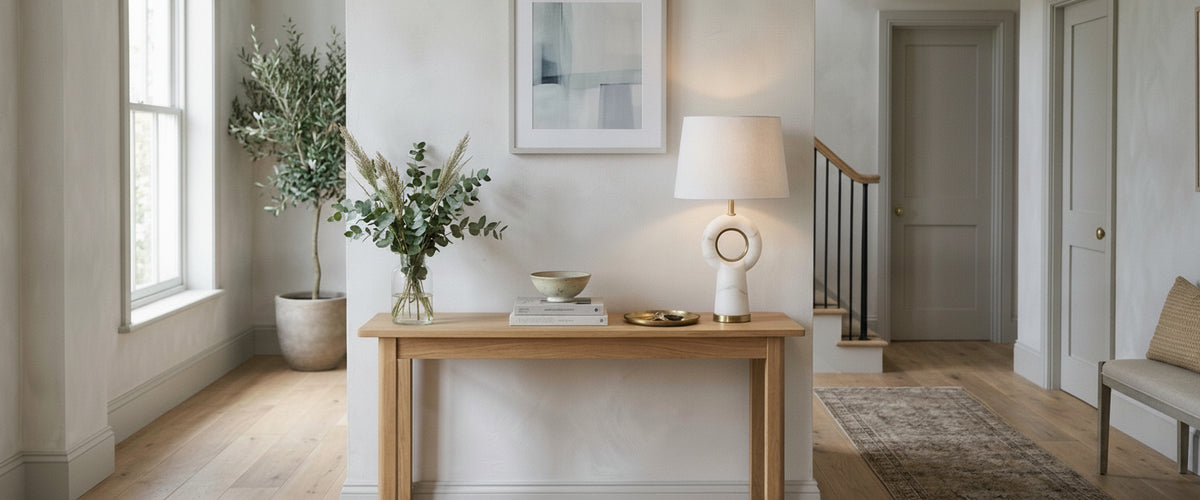
Entrance halls. The best single use for gold table lamps. A hall console is usually dark, usually passed through, and benefits from a warm point of light that reads from the front door. A sculptural base under an opaque ivory shade, along the lines of the Arabella Table Lamp with its gold quatrefoil base, gives the hall some structure in daylight and a contained pool of light after dark. Two lamps on a long console beat one lamp and an object every time.
Bedrooms. Bedside gold works if the shade is opaque and the switch is reachable without sitting up. Avoid highly polished bases directly opposite a mirror or television.
Studies and libraries. Gold behaves well against dark paint and leather. This is the one setting where a bright polished finish earns its keep.
Where it competes. Rooms already carrying a brass chandelier, brass wall lights and gold picture frames. In that case, move the table lamp to stone, glass or a painted ceramic base and let the overhead fittings carry the metal. Browsing the wider lighting range by fixture type rather than by finish makes those trade-offs much easier to see.
Height, Base Width and Shade Spread
Proportion is where most gold table lamps go wrong, and it is entirely fixable with a tape measure.
- Total height against the surface. On a console or sideboard, aim for a lamp roughly two-thirds the height of whatever sits behind it, such as a mirror or artwork, so the shade does not crop the frame.
- Bedside height. The bottom edge of the shade wants to land near eye level when you are sitting up in bed. A tall base with a shallow shade is the usual culprit behind bedtime glare.
- Shade spread versus base width. The widest point of the shade should comfortably overhang the widest point of the base. A shade that is narrower than the base makes the lamp look top-cropped.
- Surface depth. Leave at least 5cm (2in) of clear surface behind the base so the lamp sits square rather than tight to the wall and the shade never grazes the paint.
- Pairs. Identical pairs read calm; matched heights in different shapes read collected. Mismatched heights read like a mistake.
We shipped a pair of gold-based lamps to a mill conversion in West Yorkshire last winter where the console sat under a wide antique mirror. The client's first instinct was the taller of two options. The shorter pair won because the shades stopped clear of the mirror frame, and the reflected light doubled the apparent brightness of the hall without a single extra fitting.
Bulb Temperature and What Happens to Gold After Dark
Gold is a warm metal, so the bulb either agrees with it or fights it. At 2700K you get a golden, candle-adjacent light that makes brass look rich and makes ivory shades read cream. Push to 3000K and the same brass reads cooler and flatter, particularly against grey walls. Drop to 2200K and everything goes amber, which is lovely at midnight and muddy at seven in the evening.
Two practical rules. First, buy bulbs with a colour rendering index of 90 or above; low-CRI LEDs flatten the micro-variation in a brushed or antiqued finish and make good metal look cheap. Second, use dimmable lamps and a compatible dimmer, and check that the LED driver is rated for it. Warm-dim bulbs that shift towards amber as they lower are worth the extra outlay on gold table lamps, because they mimic the way incandescent light used to flatter metal.
Table lamps are plug-in fittings, so no installation work is normally needed. If you are rewiring an inherited base, converting an object into a lamp or adding a new socket for a console, use a qualified electrician; Electrical Safety First publishes clear guidance on when domestic electrical work needs a registered professional.
Care That Keeps the Finish Looking Intentional
- Dust with a dry microfibre cloth. Skip household sprays; they sit in the seams and dull lacquer.
- Never use brass polish on a plated or lacquered base. It strips the coating and the damage is not reversible.
- Wipe fingerprints off unlacquered brass if you want it bright, or leave them if you want patina. Choose one approach and stick to it.
- Keep gold table lamps out of direct salt air and away from unventilated bathrooms, where tarnish accelerates.
- If the base is stone with brass detailing, clean the stone with a barely damp cloth only. Alabaster is water-sensitive and gypsum-based, so no soaking and no acidic cleaners.
- Check the cord grip and switch annually on any lamp that gets daily use.
Gold Against Alabaster, Marble and Onyx
If you want warmth without a wall of reflective metal, pair gold with stone. Alabaster diffuses light through the body of the material itself, so the glow comes from within the piece rather than bouncing off a surface; a brass collar or stem then gives you the gold note in a controlled dose. White marble cools the pairing down and reads more architectural. Honey and amber onyx pushes it in the other direction, amplifying the gold to the point where the metal should be minimal.
That balance is the thinking behind much of what we make at Niori, where alabaster and natural stone do the light-shaping and brass detailing supplies the accent. If you are weighing gold table lamps against a stone pair for the same spot, ask which quality you actually want in the room after dark: reflected sparkle, or diffused glow. The answer usually decides the purchase faster than any style label. Have a look through the full range with that question in mind and the shortlist shrinks quickly.
A Quick Buying Checklist
- Photograph the room in daylight and hold finish samples against the wall colour.
- Audit the existing metals. Match deliberately or contrast deliberately.
- Confirm construction: solid brass, plated steel or resin, and whether the finish is lacquered.
- Choose shade opacity and lining before choosing the base shape.
- Measure the surface, the height of what sits behind it, and the clearance to the wall.
- Specify 2700K, CRI 90 or above, and a dimmer that is compatible with the driver.
- Decide if you need a pair. Halls and long consoles almost always do.
- Judge price by material, scale and finishing quality rather than by category, and ask what the plating thickness or metal gauge actually is.
Get those eight right and gold table lamps stop being a risk. They become the quietest kind of warmth a room can carry.