
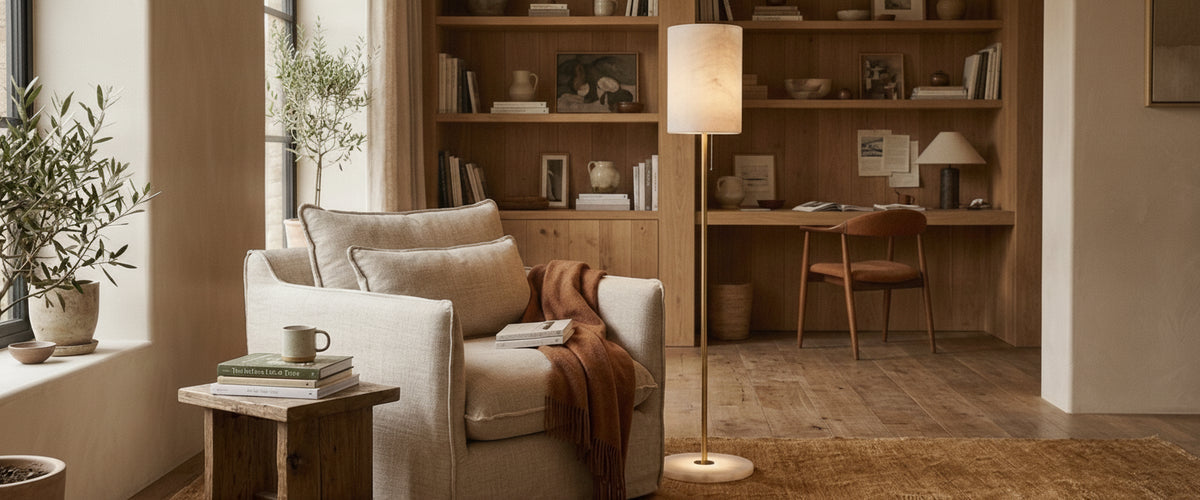

Most brass floor lamps disappoint within an hour of being unpacked, and it is almost never a quality problem. The metal is fine. The wiring is fine. What went wrong is that the finish reads yellow against cool grey walls, the shade is a size too narrow for the armchair beside it, and the foot switch sits where nobody's foot naturally lands. Brass is an unusually honest material. It rewards good decisions and exposes lazy ones, which is why the buying process deserves more thought than does it match the cabinet hardware.

At a Glance: What Actually Decides Good Brass Floor Lamps
Finish first. Unlacquered brass lives and darkens, brushed brass stays quiet and matte, antique brass arrives pre-aged and holds its tone.
Shade width over stem height. A shade that is too small makes even a well-proportioned stem look like a prop.
2700K is the safe bet. It flatters warm metal. 3000K can push polished brass toward a greenish cast.
Watch the surrounding metals. Chrome, nickel and cool-toned pewter within sight lines will make brass look yellow rather than warm.
Weight matters. A heavy, wide base means the lamp can stand unbraced beside a sofa without tipping when a cable is nudged.
Stone changes everything. Pair brass with alabaster or marble and the light stops being a beam and becomes a glow.

Unlacquered, Brushed and Antique Brass: Three Very Different Commitments
Three finishes account for most brass floor lamps, and they behave nothing alike once they are in the room.
Unlacquered (living) brass has no protective coating. It oxidises, picks up fingerprints, and slowly deepens into a soft brown-gold. One client's unlacquered brass stem developed a visible handprint pattern around the switch collar within a season, which she loved. Another buyer would have called it a fault. Ask yourself honestly which camp you are in before ordering.
Brushed brass is the diplomat. The directional grain scatters reflections, so it reads as a warm neutral rather than a statement metal, and it hides marks well. Under a warm bulb it looks like honey; under a cool one it goes slightly flat but never ugly. If you are buying brass floor lamps for a room you are still decorating, brushed is the finish least likely to fight future decisions, and a softly grained piece such as the Remyck Floor Lamp in Brushed Gold sits in that warm-neutral register without committing the room to a direction.
Antique or aged brass has been chemically darkened and usually sealed, so the patina you see is the patina you keep. It sits beautifully against walnut, oxblood leather and dark plaster walls. Against those materials a pre-aged finish like the Provence Industrial Floor Lamp in Aged Brass reads settled from the first day rather than waiting years to arrive there. In a pale, light-flooded room it can look heavy, almost bronze.
Polished brass, the fourth option, deserves a warning. Mirror-bright brass throws hard specular highlights and shows every smear. It works when there is real architecture to bounce off, less so in a low-ceilinged flat where it becomes the shiniest object in the room by a mile.
Brushed and aged finishes read as warm neutrals; polished brass throws far harder highlights.
Proportions That Commit: Shade Geometry and Stem Height
Brass floor lamps either read as furniture or as an accessory that wandered in. The difference is geometry.
For reading beside a chair, you want the bottom edge of the shade at roughly eye level when seated, usually somewhere between 100 and 122 cm (about 40 to 48 inches) from the floor. Higher and the bulb glares into your sightline. Lower and you light your knees.
Shade width is the number buyers get wrong most often. A drum or empire shade should feel visually equal to the arm of the chair it stands next to; err narrow and the lamp looks apologetic beside it. Tapered empire shades push light downward in a defined pool, ideal for reading. Straight drums spill light up and down evenly, better for ambient corners. Arched or cantilevered arms deliver light over a sofa without a base cluttering the floor in front of it, but they need serious counterweight at the foot.
Stem diameter is the quiet giveaway of quality. A slender tube on a wide base can look spindly. A column form, or a stem stepped with turned brass collars, reads substantial from across the room even when the actual footprint is small. Where the structure itself needs to do the visual work, a lamp with a defined architectural line such as the Balance Floor Lamp in Black and Polished Brass holds a corner far better than a plain thin tube of the same height.
The Pairing Trap: What Turns Warm Brass Cold
Brass has a yellow-orange bias. Put anything with a blue or violet undertone near it and the metal shifts toward mustard. Nothing undermines brass floor lamps faster than a cool-toned neighbour.
The usual offenders: grey paints with blue pigment, cool white walls in north-facing rooms, silver-toned rugs, and chrome or polished nickel fixtures in the same sightline. We once shipped a pair of brass and alabaster floor lamps into a guest room where the walls had been repainted a cool concrete grey between order and delivery. The lamps looked brassy in the worst sense. The fix was not new lamps; it was warming the wall to a soft greige and swapping the rug from silver-blue wool to an oatmeal flatweave. Same fixtures, entirely different room.
What genuinely flatters brass: warm whites with a cream base, clay and putty tones, olive, deep green, terracotta, walnut, oak, and natural stone in ivory or sand. Mixing metals is fine, but keep the temperatures on the same side of the line. Brass with aged bronze or blackened steel looks deliberate. Brass with bright chrome looks unresolved.
2700K Versus 3000K: The Bulb Temperature That Flatters Brass
Use 2700K. It is the temperature closest to traditional incandescent light, and it sits on brass the way evening sun does: golden, forgiving, dimensional. At 3000K the light gets whiter and the warm metal has nothing to lean on, so polished brass in particular can pick up a faintly green cast. Anything at 4000K or above turns brass clinical.
Two more specifications worth checking. Look for a colour rendering index of 90 or higher, which keeps the depth in brass, stone and fabric rather than flattening them. And confirm the lamp and bulb are dimmable together; a good dimmer takes brass floor lamps from a working reading light down to a low amber presence in the corner. Guidance on colour temperature and LED performance from the US Department of Energy is a useful sanity check when you are comparing bulb labels.
If the lamp has a translucent alabaster shade or diffuser, dimming behaviour matters even more. Stone reveals every flicker and every step in a cheap driver, because the material is doing the smoothing work and has nowhere to hide.
Where Brass Floor Lamps Genuinely Earn Their Place
In practice, five positions do most of the work.
Beside a reading chair. The clearest use case. Directional shade, seated eye-level bottom edge, switch reachable from the chair without leaning.
At the end of a sofa run. An arched arm reaches over the seat and gives you a defined pool of light where a table lamp cannot go. Watch the ceiling height; a tall arc under a 2.4 m ceiling feels cramped.
Flanking a console or fireplace in pairs. Symmetry gives a floor lamp architectural authority. Two slim brass columns with alabaster shades will do more for a hallway than one larger piece.
In a bedroom corner. A softly diffused floor lamp is the best late-night light in a bedroom, better than any overhead. Dimmable and warm, it becomes the last light on.
In hospitality settings. Hotel lounges and private dining rooms use floor lamps to break long walls and create pockets of intimacy. Stability and cable management matter far more here than in a home.
Where a brass floor lamps does not earn its place: any spot where a table lamp would light the same task better, or a bare corner with nothing to illuminate. A lamp lighting empty floor is just an object taking up space. If you are weighing a floor lamp against a wall light or pendant for that spot, it is worth browsing the wider niori lighting collection before committing to a form factor.
Brass and Stone: Why the Combination Behaves Differently
Brass is a reflector. Alabaster is a diffuser. Put them together and you get the quality of light Niori builds around: warm, low-glare, and dimensional rather than flat. Light entering alabaster scatters through the crystalline structure and emerges softened, carrying the faint veining of the stone with it, which is why a carved alabaster shade never gives the dead uniformity of frosted acrylic.
Stone shades glow across their whole surface, turning a task light into an ambient one.
Practically, stone changes what you should expect from brass floor lamps. Fabric shades push light down and stop it entirely at the sides. A stone shade glows across its whole surface, so the lamp itself becomes a source of ambient light in the room, not only a task light over a book. Marble and onyx bases add another advantage: mass. A stone base gives a tall lamp the low centre of gravity it needs, and it keeps the brass stem from looking top-heavy. If you want to see how stone and brass detailing work as a pair across pendants, wall lights and floor lamps, the alabaster lighting range is the clearest place to compare.
One caveat: natural stone is natural. Veining, translucency and tone vary piece to piece, and two shades cut from different blocks will not be identical twins. Buyers ordering a matched pair should say so at the point of order so pieces can be selected from the same run.
Before You Order Brass Floor Lamps: The Checklist Most Buyers Skip
Base footprint and weight. Ask for both. A wide, heavy stone or cast base resists the accidental nudge; anything light and tall needs to be positioned against furniture.
Switch type and position. Foot switch, in-line rotary, or a toggle on the stem? Reach for it from the seated position you will actually use, not standing.
Shade lining colour. White linings give crisp, neutral light. Gold or champagne linings warm it further and can tip the light amber. This is the single detail buyers notice too late.
Cord length, colour and exit point. Measure to the socket you will genuinely use. A brass-braided or fabric cord looks intentional where a white PVC lead does not.
Dimmer compatibility. Confirm the bulb, any integrated driver and your dimmer play together before installation day.
Finish protection. Ask whether the brass is lacquered. It determines your entire care routine.
Assembly and shipping. Stone shades and bases ship in separate protected sections. Check what arrives assembled and whether two people are needed to set it up.
Hardwiring. If you are converting to a floor socket or a wall switch circuit, that is work for a qualified electrician, not a weekend project.
Living with Brass: Care and Patina
Lacquered brass floor lamps need almost nothing. Dust with a dry microfibre cloth and keep abrasives and household cleaners away from them, because once a lacquer layer is scratched or clouded the damage cannot be polished out without stripping and refinishing.
Unlacquered brass is a relationship. It tarnishes because copper alloys react with oxygen, moisture and skin oils, and conservation guidance on caring for metal objects from the Canadian Conservation Institute is a sensible reference point: handle less, clean gently, and accept that polishing removes a thin layer of metal every time. If you want the aged look, do nothing. If you want brightness, polish sparingly with a product made for uncoated brass and buff dry.
For alabaster and marble components, keep water and acidic cleaners off the stone entirely. A soft dry brush for dust, and a barely damp cloth followed immediately by drying if something is spilled. Stone is porous, so standing moisture leaves a mark that no amount of wiping will lift later.
Budget for brass floor lamps depends on material, scale, engineering, hand-finishing and whether stone components are involved, so ask for a tailored quote rather than working from assumptions, particularly for matched pairs or hospitality quantities.