
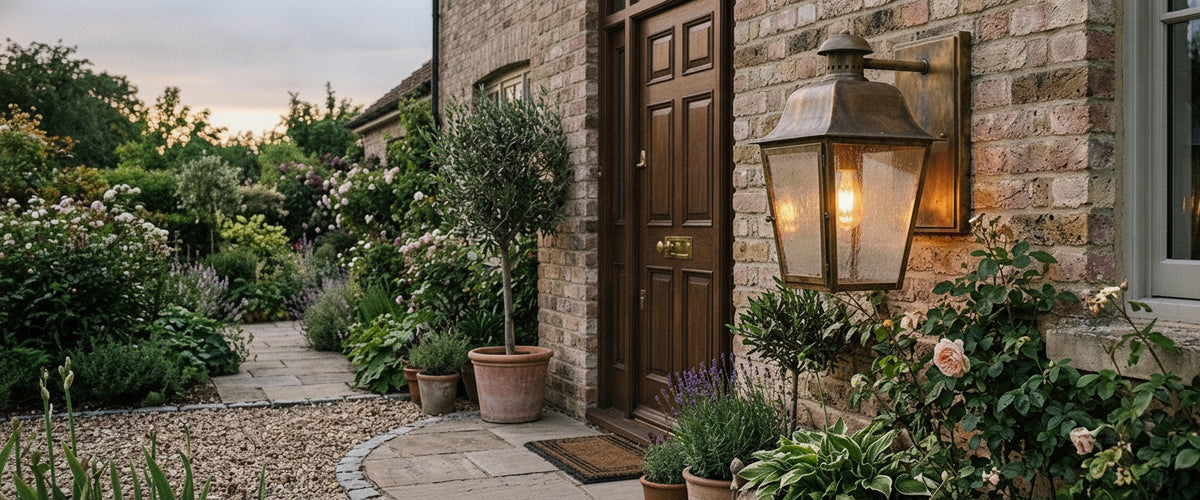

Brass never stays still outside. Fix a warm, hand-aged fitting to a south-facing wall in Norfolk and by the second spring it has made its own decisions about colour, regardless of what the brochure photograph promised. That is the whole appeal of antique brass outdoor lighting, and also the reason so many buyers end up disappointed: they expected a finish and bought a living surface instead.
Getting this right is less about picking a pretty lantern and more about understanding metal, coatings, gaskets and water. Antique brass outdoor fittings reward people who know what they are buying into. They punish anyone who treats an exterior wall like a hallway.

Antique Brass Outdoor Lighting at a Glance
- Solid brass ages well; brass-plated steel or aluminium usually does not. Plating wears through at edges and then rusts from underneath.
- Lacquer buys you time, not permanence. On an exposed elevation it will eventually break down, and it rarely breaks down evenly.
- Unlacquered brass is the honest option. It goes gold, then bronze, then a soft grey-brown, and coastal air speeds all of it up.
- IP rating and gasket quality decide longevity more than the finish does. Look for IP44 as a minimum under cover, IP65 where rain hits directly.
- Warm bulbs flatter aged brass. Anything above 3000K drains the gold out of it and reads clinical.
- Alabaster stays under cover. Gypsum alabaster is not an exterior material, so brass, glass and dense stone take over past the threshold.

Why Antique Brass Outdoor Lighting Behaves Differently on an Exterior Wall
Indoors, brass changes slowly and politely. Skin oils darken the handles you touch, the rest stays broadly where it started, and a dry hallway keeps the surface stable for years. Outside, the metal is in constant conversation with moisture, sulphur compounds in the air, chloride from road salt or sea spray, and the daily swing between warm afternoon sun and a cold, wet night.
Brass is a copper alloy, and copper alloys weather by forming a surface layer that then protects the metal beneath. The Copper Development Association describes this as a natural, self-limiting process rather than corrosion in the destructive sense, which is why a genuinely solid brass lantern can look better at fifteen years old than at one. The colour keeps moving. The structure does not fail.
The catch is that antique brass outdoor fittings usually carry a chemically aged finish applied over new metal, so you are starting the ageing process partway through. Where rain sheets down the body, the artificial patina thins and brightens. Where water sits and lingers, typically the underside of a hood or the bottom rim of a shade, it darkens faster. Expect variation. That mottled quality is exactly what people pay for on old garden lanterns, and exactly what makes nervous buyers ring us in month four.
Lacquered Versus Unlacquered After Two British Winters
This is the single most useful question to ask before ordering, and plenty of listings never mention it.
Lacquered Antique Brass
A clear coating seals the aged finish so it looks close to day one for a while. On a sheltered porch in the Chilterns, a good lacquer might hold for several years. On an exposed gable that takes driving rain and full afternoon UV, two winters can be enough to start micro-cracking. Once water gets under the film, the brass patinates in patches around the breach, and you get a blotchy effect that looks like damage rather than age. Stripping and recoating is possible but fiddly, and it is a job for a metal finisher, not a weekend.
Unlacquered (Living) Antique Brass
Left bare, an unlacquered antique brass outdoor lantern simply carries on. Year one gives you deepening amber and bronze tones. By the end of a second British winter you are into soft brown with a green cast in the crevices, more pronounced within a few miles of the coast. It is uneven, quiet and looks like it has always been there. We keep waxed and bare offcuts outside the studio door for exactly this reason: eighteen months apart, the two read as different metals.
If you want a specific colour held for a specific number of years, antique brass outdoor lighting is the wrong choice and a powder-coated finish is the right one. If you want the fitting to look older each season, go unlacquered and stop worrying.
IP Ratings and Construction Decide Whether Antique Brass Outdoor Lighting Ages or Fails
A beautiful patina on a lantern with a flooded terminal block is not a win. Finish is cosmetic; construction is whether the light still works in year six.
- IP44 under a deep porch or loggia. Protected against splashing water. Fine where rain cannot reach the body directly.
- IP54 to IP65 on open elevations, gate piers and boundary walls. IP65 means jets of water, which is closer to what a British storm delivers sideways.
- Solid brass, not plated. Ask for the base metal in writing. Brass-plated steel is the most common cause of rust streaking down render.
- Stainless or brass fixings. Steel screws in a brass body will bleed orange within a season.
- Silicone gaskets and a drainage path. Water gets in eventually. What matters is whether it can get out.
- Serviceable lamp holders. Ceramic or high-temperature holders and an accessible gland make a twenty-year fitting rather than a disposable one.
Installation matters as much as specification. Exterior circuits in the UK must comply with BS 7671, which covers RCD protection, cable routing and correct earthing, so all of this belongs with a qualified electrician rather than a capable DIYer. Seal the wall entry properly, mount on a bracket that lets air move behind the backplate, and avoid bedding an antique brass outdoor fitting tight into fresh lime render where trapped moisture has nowhere to go.
Where Aged Brass Earns Its Place on a Facade
Antique brass sings against warm materials. Limestone, buff brick, lime render, oak framing, terracotta, Bath stone: the gold undertone reads as part of the palette. It is excellent on a Georgian door surround, either side of a stable-block entrance, or stepping along a garden wall where the glow catches gravel.
It struggles against cold greys. On slate cladding, dark zinc or a crisp white contemporary render, aged brass can look apologetic once it browns off, and brushed stainless, bronze or a matt black powder coat holds its line better. Coastal sites deserve extra thought: within salt spray range, marine-grade stainless or solid copper will outlast most brass hardware, and if you set your heart on brass, specify it solid and unlacquered so it weathers rather than peels.
Do not forget the transition. Antique brass outdoor lighting works hardest when it rhymes with something inside. A brass-detailed alabaster pendant in the entrance hall, seen through a glazed door, gives the exterior lanterns a reason to exist. That pairing of warm metal and translucent stone is the thread running through the alabaster lighting collection, and it is why so many clients buy brass outside and stone inside. In a covered porch or a glazed entrance lobby, where the fitting is read from the drive but never touched by rain, a small warm-glass piece such as the Equinoxe Globe Pendant Light 15cm in antique brass and amber glass carries the same metal language across the threshold at a scale that suits a low porch ceiling.
One Caution About Stone Outdoors
Alabaster is gypsum. It is soft, slightly soluble in water and has no business on an open wall, which is why you will never see us recommend it for a facade. Under a fully covered loggia or a sheltered porch with no wind-driven rain, an alabaster wall light can work beautifully, but the moment water touches the surface regularly the stone will bloom and lose its crispness. Marble and granite are far more tolerant. Alabaster belongs indoors, or just inside the line where weather stops.
Where that sheltered spot has no cable run, and cutting one into old masonry is more disruption than the light is worth, a rechargeable brass fitting like the Ashstead LED Rechargeable Wall Light in aged brass solves the placement problem without pretending to be a weatherproof lantern. Bring it in over winter and the finish ages on your terms rather than the weather's.
Bulb Choice and Colour Temperature After Dark
Antique brass outdoor lanterns only look good within a narrow band of light. Push past it and the metal goes flat and greenish.
- Stay at 2200K to 2700K. Candle-warm to warm white keeps the gold alive. 3000K is the outer limit; 4000K makes aged brass look like dirty steel.
- Choose CRI 90 or above. High colour rendering pulls the depth out of patina and out of any brickwork or planting nearby.
- Keep output modest. Exterior wall lanterns are orientation lights, not floodlights. A low-lumen warm lamp inside a clear or seeded glass shade throws far better shadow than a bright one.
- Match glass to bulb. Clear glass wants a decorative filament lamp; frosted or ribbed glass lets you use a plainer LED without glare.
- Dim where you can. A dimmable driver on the porch circuit lets you drop levels late at night.
Terrace tables need their own answer, because a dining surface wants a pool of light rather than a wall wash. On a garden table, a cast metal rechargeable piece such as the Wanderer Brushed Brass Cast Aluminium Rechargeable LED Table Lamp holds the warm low output described above without a single cable crossing the paving, and the brushed brass sits comfortably alongside a more heavily patinated wall lantern.
Warm, low-level exterior lighting is also the responsible choice. Dark Sky International's outdoor lighting principles recommend shielded fittings and warmer colour temperatures to limit skyglow and reduce harm to nocturnal wildlife, which happens to be exactly the specification that makes aged brass look its best. Good taste and good practice land in the same place here.
Questions Worth Asking Before You Order Antique Brass Outdoor Lighting
- Is the body solid brass, or brass-plated? If the answer is vague, assume plated.
- Is the antique finish lacquered, waxed or bare? And if lacquered, what happens when it degrades?
- What is the IP rating, and was it tested on the complete assembly? A rated lamp holder inside an unrated body means nothing.
- What are the fixings and internal fasteners made from? Stainless or brass only.
- Is the lamp replaceable, and is the gasket available separately? Integrated LEDs with no spares are a ten-year fitting at best.
- Is it suitable for a coastal site? Ask specifically. Standard exterior ratings are not marine ratings.
- Can I see an aged sample, or a photograph of an installed fitting at two years old? Suppliers who make good brass are usually proud of this.
- What does the finish need from me? Usually a wipe and an occasional microcrystalline wax if you want to slow the patina, nothing if you do not.
We shipped a pair of aged brass wall lanterns to a converted coach house on the Kent coast a while back, and the owner emailed at month five convinced the finish was faulty. The seaward lantern had gone noticeably browner than its twin under the arch. Nothing was wrong. Salt air had simply pushed one lantern months ahead of the other, and by the following autumn the sheltered twin had caught up enough that the pair read as a set. That is the deal with antique brass outdoors: you choose the starting point, the weather finishes the piece.
If you are specifying a whole scheme rather than a single lantern, work from the inside out. Settle the hall, stairwell and living room pieces first, since those set the warmth and the metal language everything else answers to, then choose antique brass outdoor fittings that continue it. Our full lighting range is built around that logic, with brass detailing carried across alabaster pendants, chandeliers, wall lights and lamps so the thread holds from the front gate to the kitchen island.