
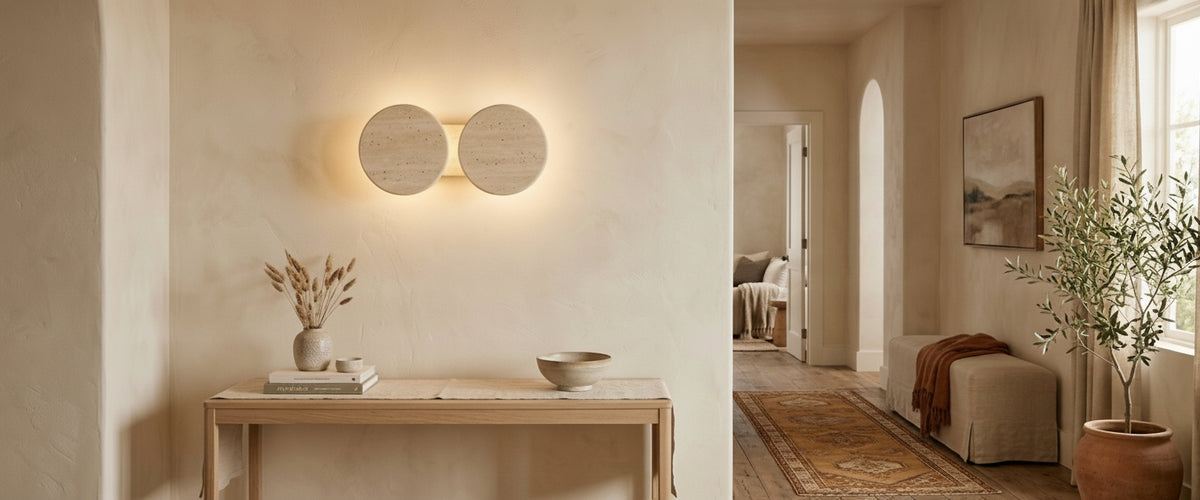

Fix one sconce to a long corridor wall and you get a bright halo in the middle with two dim stretches either side of it. That is the single-arm problem, and it is why travertine duo wall lights tend to solve rooms that a lone fitting only half-answers. Two light sources on one backplate spread the beam wider, balance the wall vertically, and give stone the chance to do what stone does best: glow slowly rather than flare.

At a Glance
A travertine duo wall light splits output into two softer pools instead of one hotspot, which reads calmer on a wall and reduces glare at eye level.
Veining match matters. Two travertine elements sat inches apart will be compared by the eye instantly; mismatched stone looks like a mistake, not a feature.
Centre height is usually 1.5m to 1.65m (roughly 59 to 65 inches) in corridors and hallways, lower beside beds, and flanking at eye level beside mirrors.
The wall finish behind the fitting changes the result more than most buyers expect. Matt plaster flatters travertine; high-gloss paint fights it.
Outdoors needs a different spec entirely: an IP-rated body, sealed stone, and corrosion-resistant fixings, not an indoor travertine duo wall light moved outside.

How a Duo Format Spreads Light Differently
Single-arm sconces concentrate. That is useful when you want a deliberate accent, say a pool of light over a console or beside a fireplace. The trouble starts on long walls and in circulation spaces, where one bright point creates contrast that the eye then has to work around. A travertine duo wall light splits the output between two points and widens the coverage, so the wash across the wall is gentler and the falloff at each end is less abrupt.
Travertine changes the maths again. The stone is dense enough to hold back a good share of the light and just translucent enough at its thinner sections to carry a warm, uneven glow, so output is softened before it ever reaches the room. Pair that diffusion with two sources and you get something close to ambient light rather than task light. Plan accordingly: a travertine duo wall light is superb for atmosphere and terrible as your only reading light.
Symmetry is the other argument. Two elements on a shared backplate give you a vertical axis, which means the fitting aligns cleanly with a door architrave, a mirror centre line, or the midpoint between two windows. Designers specifying for hotels and restaurants lean on the travertine duo wall light for exactly this reason: repeat the same fitting down a corridor and the rhythm looks intentional instead of scattered.
Matched Veining Within a Duo
Here is the detail buyers underestimate. Travertine forms as calcium carbonate precipitates out of mineral-rich water, which is why it carries those distinctive linear pores and banded colour shifts. No two blocks are identical, and when two pieces of stone sit within a few inches of each other on the same travertine duo wall light, the eye compares them immediately.
Well-made travertine duo wall lights cut both stone elements from the same block, or at minimum the same slab run, so the banding runs in a consistent direction and the beige-to-walnut tonal range stays close. A piece such as the Bravora Travertine Wall Light in Walnut Brown & Light Beige shows how a deep warm band can sit against a paler one without the two tones fighting for attention. Badly made duos do not manage it, and you end up with one warm cream element beside one grey-toned element, which looks like a repair rather than a design decision. The same logic scales up: specify six of them for a stairwell and the selection has to hold across every one, or climbing three floors becomes a series of near-misses instead of one continuous gesture.
Ask how stone is selected before you buy. If a supplier cannot tell you, assume they are picking from a bin. Across the Niori range of alabaster and natural-stone lighting we treat veining as part of the spec rather than a happy accident, and that holds for a travertine duo wall light just as firmly as it does for marble or the translucent pieces in our alabaster lighting collection.
Mounting Heights That Actually Work
Height decides whether a travertine duo wall light reads as architecture or as an afterthought. These are the positions we recommend most often:
Corridors and hallways: centre the fitting at 1.5m to 1.65m (59 to 65 inches) from the finished floor, spaced roughly 2m to 2.5m (about 6.5 to 8 feet) apart. Any closer and the pools merge into a strip; any further and you reintroduce the dark gaps you were trying to remove.
Bedrooms: mount lower, around 1.2m to 1.35m (47 to 53 inches), and set the fitting 250mm to 350mm (10 to 14 inches) out from the bed edge so the light falls onto the pillow rather than into the sleeper's eyes. A travertine duo wall light works particularly well here if one output angles up and one down.
Bathroom mirror flanking: position the light source close to eye level, generally 1.6m to 1.7m (63 to 67 inches), with a fitting on each side of the mirror. Side lighting fills in under-eye shadows; overhead lighting creates them.
Stairwells: measure from the nosing of the step directly below each fitting, not from a single datum. Otherwise the run will look level on paper and crooked in person.
Living rooms: treat a travertine duo wall light as a corner or flanking element around a fireplace, chimney breast or artwork, then bring in a table lamp or floor lamp for reading.
Scale is the quiet decision inside all of those heights. On a narrow landing or in a shallow alcove where a full duo would crowd the wall, something compact like the Caldera Small Disc Travertine Wall Light holds the same material language at a fraction of the projection, and it can be repeated in pairs to recover the symmetry a travertine duo wall light would have given you.
One caution on bathrooms. Any travertine duo wall light going near a bath or shower falls under zoning rules that dictate which IP ratings are permitted at which distances, and there are additional requirements around supplementary bonding and RCD protection. Get a qualified electrician to specify and install it; Electrical Safety First publishes plain-language guidance on bathroom zones worth reading before you commit to a position.
The Wall Behind the Light Is Part of the Fitting
Travertine throws light forward and sideways, but a good share of what you see from a travertine duo wall light comes from the bounce off the wall behind it. That makes the surface a design decision, not a background.
Matt or chalky emulsion in a warm off-white, clay, mushroom or soft putty tone reflects light gently and keeps the stone looking creamy. Gloss and satin finishes create a hard specular reflection that competes with the fitting's own glow and shows every ripple in the plaster. Textured surfaces are the real gamble: raked plaster, limewash and exposed brick will be grazed by the light, so any imperfection within about a metre of the fitting becomes obvious. Sometimes that is exactly the effect you want. On a freshly skimmed wall with a wavy patch, it is not.
Dark walls change the brief again. Against deep green or charcoal, a travertine duo wall light reads as a glowing object rather than a wall wash, and you lose most of the reflected ambient light. Where you want that glow to carry into the room rather than stop at the stone, a fitting that pairs travertine with a diffusing shade, such as the Arvella Travertine & Glass Wall Light, is closer to the right design language. Otherwise, budget for more fittings or an additional layer, such as a pendant or a pair of table lamps, so the room does not flatten out after dark.
Indoor Versus Travertine Outdoor Wall Light Specs
Travertine outdoor wall lights are a genuinely different product from the indoor cousin, and the difference is not cosmetic, so a travertine duo wall light picked for a hallway should never be repurposed for a porch. Travertine is porous by nature, which is why the Natural Stone Institute's care and cleaning guidance recommends sealing porous stone in exposed applications. Water that sits in those pores through a British winter will freeze, expand and eventually spall the surface.
What to check before specifying anything for a porch, garden wall or courtyard:
IP rating: IP44 is generally the minimum for a sheltered position under a deep overhang. Fully exposed walls that take driving rain want IP65.
Stone treatment: ask whether the travertine is filled and sealed, and with what. Unfilled travertine outdoors is a maintenance commitment, not a finish.
Fixings and internals: stainless steel or marine-grade fixings, gasketed housings and a properly rated gland. Coastal sites in Cornwall, Norfolk or the west of Scotland punish anything less.
Drainage: weep holes or a drainage path matter more than the headline IP number, because condensation forms inside every outdoor fitting eventually.
Reseal schedule: plan to reapply a breathable stone sealer every couple of years depending on exposure.
Plenty of travertine fittings sold online are indoor-only and never say so clearly. If the listing for a travertine duo wall light does not state an IP rating, treat it as interior. Browsing the wider Niori lighting collection is a useful way to compare which stone pieces are built for sheltered interiors and which are engineered for weather.
Bulbs, Dimming and Colour Temperature
Travertine is warm-toned. Push cool white light through a travertine duo wall light and the beige turns faintly grey and dead. Stay between 2400K and 2700K, and choose lamps with a colour rendering index of 90 or above so the stone's tonal range still reads properly.
Dimming deserves attention at the specification stage rather than after installation. Match the driver to the dimmer type, whether trailing edge, 0-10V or DALI on a commercial job, and test one fitting before the full run goes in. Flicker at low levels is the most common complaint we hear, and it is almost always a driver and dimmer mismatch rather than a fault in the fitting.
A Quick Buying Checklist
Confirm the stone in both halves of the travertine duo wall light is selected for tonal and directional match.
Mark your mounting height on the wall with tape and live with it for a day before drilling.
Check the switching plan: separate circuits for wall lights let you drop the room to a low glow without touching the pendants.
Confirm the IP rating if the fitting is going anywhere near a bathroom, boot room or exterior wall.
Check backplate depth against your wall build-up, especially with insulated plasterboard or stone walls.
Order spare lamps of the same batch so colour temperature stays consistent across the run.
Ask about lead time for stone selection on multi-fitting orders; matched runs take longer to prepare.
Keeping Travertine Looking Right
Dust with a dry, soft brush or a microfibre cloth. Skip anything acidic, because vinegar, lemon juice and many bathroom sprays will etch calcium carbonate and leave dull patches that cannot be polished out at home. A barely damp cloth with a pH-neutral stone cleaner handles marks; abrasives and scouring pads do permanent damage.
Indoors, a travertine duo wall light asks for very little beyond that occasional dusting. Outdoors, inspect the seal each spring, clear any debris from drainage points, and watch the lower edge of the stone where water tends to linger. Travertine that is looked after gains character over decades. Travertine that is scrubbed with the wrong product loses its surface in a season.