
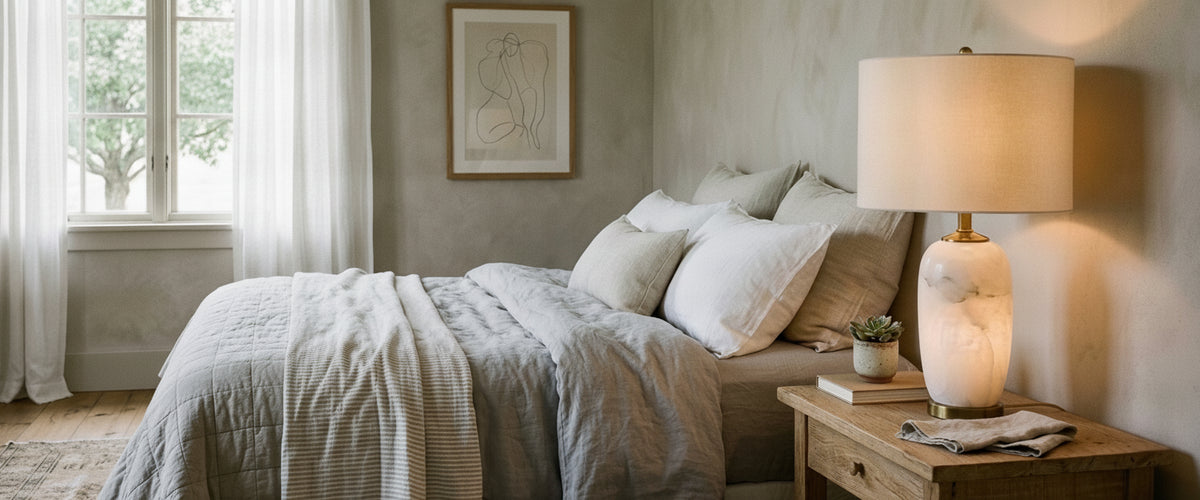

Traditional table lamps in the bedroom fail at 11pm, not in the showroom. Under gallery lighting, traditional bedroom table lamps look handsome on a sideboard at chest height. Then you get into bed, glance sideways, and the bare bulb stares straight back at you because the shade sits four inches (10cm) too high. Search traditional table lamps bedroom and you get a thousand handsome bases and almost no numbers, and most traditional table lamps bedroom guides stop at style names. So this piece is about the measurement nobody takes before buying traditional table lamps for the bedroom: the height of your eye when you are sitting up reading, and how that figure caps the lamp your nightstand can carry. Base material, shade lining, bulb temperature and stone versus ceramic all follow from it.
The good news is that traditional table lamps in the bedroom are unusually forgiving once you get that measurement right. A turned base with a properly proportioned shade throws light downward onto a book and outward onto the wall in a soft halo, which is exactly the behavior you want at the end of the day. Modern minimalist lamps often do the opposite. They expose the source.

Traditional Table Lamps Bedroom Rules at a Glance
Shade bottom should sit at or just below your seated eye level in bed, usually around 100 to 110cm (39 to 43in) from the floor. That one number rules out half the traditional table lamps bedroom shortlists we see.
Base material sets the temperature of the room: ceramic reads soft and domestic, brass reads warm and formal, turned wood reads rustic, alabaster and marble read quiet and architectural.
Shade lining matters more than shade color. A warm ivory or antique gold lining flatters skin tones; a stark white lining can look clinical.
Pairs beat singles in a bedroom with two occupants, and asymmetry only works if you plan it deliberately.
2700K on a dimmer is the default for bedside. 3000K is already a working temperature, not a resting one.
Budget for traditional bedroom table lamps follows material and scale more than ornament: hand-carved stone sits well above ceramic or turned wood, because every piece is cut and worked individually.

What Actually Makes a Lamp Read as Traditional
Traditional is a set of proportions before it is a set of ornaments. The giveaways are a visible waist in the base, a shade that tapers rather than sits as a straight drum, a neck and finial that are allowed to show, and a shade roughly two-thirds the height of the base and wider at its lower edge than the base's widest point. Column lamps, baluster lamps, ginger jar forms and candlestick forms all share that logic, and any of them can work as traditional table lamps bedroom candidates.
What makes traditional bedroom table lamps work is weight. A traditional base has bulk near the bottom, which grounds a bedside table that is usually cluttered with books, glasses and a phone charger. It also resists being knocked over at 3am, which we hear about from customers more often than you would think, particularly in guest rooms.
Traditional table lamps in the bedroom land more easily in a contemporary scheme than the same lamps do in a contemporary living room, because bedrooms are soft spaces already. Textiles, upholstery and low light do most of the work. A carved stone or ceramic lamp beside a plain linen headboard does not look like costume; it looks like the one object in the room with history in it.
Traditional Table Lamps Bedroom Height Rule: Shade Bottom Versus Seated Eye Level
Every traditional table lamps bedroom decision downstream depends on one measurement. Sit up in bed the way you actually sit when you read. Have someone measure from the floor to your eye. For most people on a standard divan or upholstered bed base, that lands somewhere between 100 and 110cm (39 to 43in). Now measure your bedside table height, typically 55 to 65cm (22 to 26in). The gap between those two numbers is the maximum overall height for a traditional table lamp in the bedroom.
Get it right and the shade edge cuts the bulb from your sightline while still spilling light onto the page. Get it wrong by even a few centimeters and one of two things happens. Too tall, and you get glare directly in the eye every time you look toward your partner's side. Too short, and the pool of light lands on the table rather than the book, and the room feels bottom-heavy and gloomy.
Two practical adjustments help when you are fitting traditional table lamps bedroom pairs into a real room. Lower bedside tables need taller lamps, so a low mid-century nightstand paired with a squat lamp is the most common mistake we correct. And if the two sides of the bed have different table heights, which happens constantly in older houses with a chimney breast on one side, match the shade bottoms rather than the lamps. Two different lamps at the same optical height look intentional. Two identical lamps at different heights look like an accident.
Where the nightstand is already tall and the gap to seated eye level closes to 35 or 40cm, one of the more compact traditional table lamps for the bedroom, such as Carlwood LED Rechargeable Table Lamp, Brass, keeps the shade bottom below the sightline in a way a full-height column lamp simply cannot.
Bases: Ceramic, Brass, Turned Wood and Alabaster
Base material does more work than any other decision in a traditional table lamps bedroom scheme. Each one changes the weight and warmth of the whole bedside arrangement, not simply its style label.
Ceramic and Glazed Pottery
Soft, forgiving, endlessly colored, and where most people start with traditional table lamps in the bedroom. A crackle-glazed or hand-thrown ceramic base sits comfortably in country and coastal schemes and takes a pleated shade well. It is opaque, so all of the light comes from the shade, which makes shade choice critical.
Brass and Antique Brass
Brass is the connective tissue of traditional bedroom table lamps. It picks up candlelight-toned bulbs and reflects them back with a slight amber cast, which is flattering at low levels. Unlacquered brass will patinate; lacquered brass will not. Decide which you want before you buy, because it is not something you change later.
Placement often decides the brass lamp you end up with. Where the socket sits awkwardly behind the headboard, or the bedside surface is a floating shelf with no cable route at all, a rechargeable base such as Danebourne LED Rechargeable Table Lamp, Brass solves the wiring problem without giving up the silhouette that makes traditional table lamps in the bedroom work in the first place.
Turned Wood
Walnut, oak and limed ash bases bring grain and matte texture. They are the quietest of the traditional table lamps bedroom options and the most likely to disappear into a room rather than lead it. Useful when the headboard or wallpaper is doing the talking.
Alabaster, Marble and Onyx
This is where our own bias shows. Alabaster is translucent, so the base itself glows faintly when lit, which no ceramic or wooden base can do. The result is a second, lower layer of light near the table surface, and it is the reason a stone lamp can feel calm at a brightness where other traditional table lamps in the bedroom feel harsh. Alabaster has been worked for centuries precisely because of that translucency, and Historic England records the medieval English carving trade that grew up around the Midlands alabaster quarries.
The trade-off is care. Gypsum alabaster is soft, roughly 2 on the Mohs scale, and it dislikes water. Marble and onyx are harder and more heavily veined, which suits a bolder, more graphic bedside. If you want to compare carved stone forms side by side, the alabaster lighting collection is the fastest way to see how veining changes when the light is on versus off.
Fabric, Opaque and Translucent Shades
The shade controls the pool of light at midnight, and this is where traditional table lamps bedroom choices earn their keep.
Fabric shades in silk, linen or cotton diffuse light through the sides as well as down. You get a warm wash on the wall behind the bed and enough spill to find a glass of water. Pleated shades scatter light slightly more than smooth ones and read more decorative. Where the base is deliberately plain and you want the shade to carry the pattern in the room, Ashstead LED Ikat Table Lamp, Brass, White & Natural is closer to the right design language than a flat drum in a solid color.
Opaque shades, including card-lined and metal versions, push light strictly up and down. The effect is dramatic and controlled, ideal if one person reads while the other sleeps, but the room stays dark outside the beam. Pair these with a second light source.
Translucent stone and glass shades behave differently again. Alabaster does not simply pass light through; it softens and warms it, because the mineral scatters the beam inside the material before it reaches you. That is the closest thing to candlelight you can get from an electric source, and it is why stone-shaded traditional table lamps in the bedroom rarely need a heavy dimmer to feel gentle.
Making Traditional Table Lamps Bedroom Schemes Feel Modern
The failure mode here is period-dressing: buying traditional table lamps for the bedroom, then adding a swagged pelmet, a dark timber nightstand and a patterned rug until the room reads as a museum set. Restraint is what keeps it current.
Three rules hold up for traditional table lamps bedroom styling. Keep the shade plain if the base is ornate, and ornate if the base is plain. Repeat the base material somewhere else in the room, a brass handle or a stone tray, so the lamp is not the only voice in that language. And keep the rest of the bedside surface modern; a traditional lamp next to a contemporary ceramic dish looks deliberate.
The version of this that works best is usually the most restrained one: a very plain upholstered bed, flat white walls, and a pair of carved alabaster lamps as the only classical element in the room. Read that way, the scheme feels calm and considered, and nothing else needs to change. Add three more period pieces and it tips.
Bulb Temperature and Dimming: 2700K Versus 3000K
The same traditional table lamp in the bedroom is genuinely a different object at 2700K and 3000K. Correlated color temperature describes where a light source sits on the warm-to-cool axis, a measure standardized by the International Commission on Illumination. At 2700K you get amber-leaning light that flatters skin, warms timber and makes alabaster veining glow honey-colored. At 3000K the light turns slightly neutral, whites look whiter, and the room shifts from restful to alert. Perfect for a dressing area. Wrong for a bedside.
Choose bulbs with a high color rendering index, ideally CRI 90 or above, so bedding and wall color stay true. Clear filament bulbs look right in traditional bases but glare through pale fabric shades, so frosted or opal bulbs are usually the better call unless the shade is fully opaque. Dim-to-warm LEDs, which drop toward 2200K as you lower them, work beautifully in stone lamps, and that combination is what most traditional table lamps bedroom setups are missing.
Check that the lamp's driver or transformer is dimmable, and match it to a trailing-edge dimmer rather than the older leading-edge type to avoid flicker and buzz. Any hard-wired bedside circuit or new switch position should be installed by a qualified electrician.
Traditional Table Lamps Bedroom Buying Checklist
Measure seated eye level and bedside table height before you shortlist any traditional table lamps for the bedroom.
Confirm overall lamp height and shade diameter against the width of your nightstand; the shade should not overhang the front edge.
Decide pair or single, and if single, plan the opposite side (a wall light or a taller reading lamp balances well).
Check switch type: inline cord switch, base-mounted toggle, touch dimmer or rechargeable. Reaching behind a lamp in the dark is a daily annoyance.
Check cable color and length against your socket position.
For stone lamps, ask about veining variation. Natural material means every piece differs, which is the point.
Choose 2700K, CRI 90+, dimmable, and confirm the dimmer type.
If you want a matched pair of traditional table lamps in the bedroom, check stock and lead time early; two pieces from the same batch are harder to source than one.
Care That Keeps Them Looking Right
Dust fabric shades with a soft brush attachment, working top to bottom, not with a cloth that drags the seam. For alabaster and marble bases, use a dry or barely damp soft cloth and avoid household sprays entirely; acidic and alkaline cleaners etch calcite and gypsum surfaces permanently. Never let water pool at the base. If a radiator sits directly under the bedside table, keep the lamp toward the front edge, because prolonged dry heat is harder on stone and timber than most people expect.
Brass needs a decision, not a routine. If you want it bright, polish occasionally with a product made for the finish. If you want patina, leave it alone and let fingerprints do their work.
Done properly, traditional table lamps bedroom pairs outlast three or four rounds of redecoration. That is the real argument for buying well once. If you are weighing traditional bedroom table lamps against pendants or wall lights for the same room, browsing the wider lighting range alongside the stone pieces tends to clarify the scheme faster than looking at lamps in isolation.