
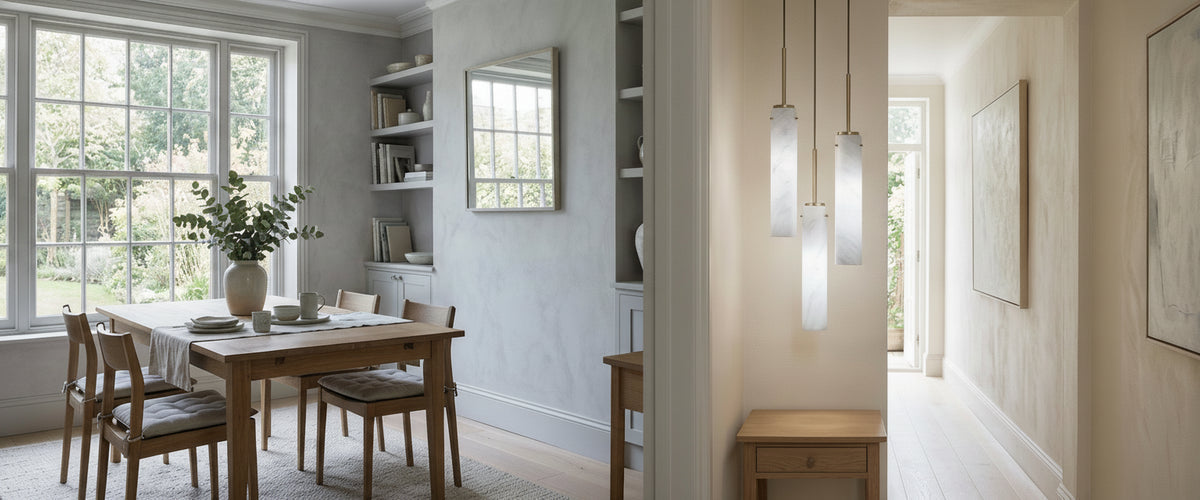

Walk through most halls and the lighting is the first thing that fails. A hallway pendant light hangs in the narrowest, busiest, least forgiving space in the house: no windows to soften a cold bulb, no furniture to absorb bad proportion, and a ceiling you pass directly beneath a dozen times a day. Miss the drop by 150 mm (6 in) and somebody catches it with a suitcase. Get it right and the hall stops being a corridor and starts reading as a room.
A hallway pendant light is any ceiling-suspended fitting hung in a circulation space rather than over furniture, and that one difference rewrites every rule. Over a dining table you can hang low, because nobody walks there. Over a walking route you cannot. Three numbers follow from it: clearance, shade diameter and spacing.

Key Takeaways
Clearance first: keep at least 2.1 m (about 7 ft) from floor to the lowest point of any hallway pendant light in a walkway. Never drop below 2 m (6 ft 6 in).
Scale down, not up: in a 900 mm (35 in) corridor, a shade wider than roughly a third of the hall width will feel oversized in person.
Rhythm beats size: two or three small pendants spaced evenly flatter a long hall more than one large fitting marooned in the middle.
Warm light wins: 2400K to 2700K, dimmable, because there is no daylight in a hall to correct a cold tone.
Material matters: alabaster and onyx glow rather than glare, which is exactly what a low-ceilinged hall needs.
Hallway Pendant Light Numbers at a Glance
Most questions about pendant lights in hallway schemes come down to six figures. These are the numbers we quote on the phone before anybody mentions finishes.
Minimum clearance: 2.1 m (7 ft) from the floor to the lowest point of the hallway pendant light. 2 m (6 ft 6 in) is the absolute limit.
Maximum shade width: one third of the hall width, measured at the narrowest point.
Typical total drop on a 2.7 m (9 ft) ceiling: 450 to 550 mm (18 to 22 in), shade included.
Spacing for a run: 1.2 to 1.8 m (4 to 6 ft) center to center, with end fittings at half that distance from the end walls.
Bulb specification: 2400K to 2700K, CRI 90 or above, on a trailing-edge LED dimmer.
Over a console table: around 700 mm (28 in) between the tabletop and the base of the shade.

Why the Hallway Punishes Pendant Mistakes
Every other room gives you cover. A dining pendant hangs over a table, so head height is irrelevant. A living room fitting sits above a sofa and gets judged from a seated position. A hall gives you none of that. You see the fitting at standing eye level, from below, from the stairs, and side-on as you walk past, all within a few seconds.
That moving sightline exposes everything. Visible cable joints, a cheap ceiling rose, a bulb glaring through a thin shade, a canopy sitting a few degrees off level against the coving. In a hall you notice all of it, because there is nothing else to look at. Hallway pendant lighting has nowhere to hide, which is also why the shade material on a hallway pendant light does more work here than anywhere else in the house: an opaque metal cone throws a hard pool on the floor and leaves the walls dark, while a translucent stone shade lights itself and spreads a soft wash along the whole passage.
We shipped a set of three small alabaster pendants to a Victorian terrace in Bath last spring where the hall was 1.1 m (3 ft 7 in) wide with a 2.9 m (9 ft 6 in) ceiling. The owners had originally specified a single large brass hallway pendant light. Hung on a mock-up, it filled the corridor like a parked car. Three smaller stone shades, spaced along the length, solved the problem in an afternoon.
Drop Length Versus Ceiling Height: The Numbers That Decide It
Start with clearance, not style. Every other decision about pendant lighting for hallway routes follows from that one number. The lowest point of the fitting should sit no less than 2.1 m (7 ft) above the finished floor on any route people walk. For households with tall family members, or halls that double as a route for furniture and prams, push that to 2.15 m (7 ft 1 in). The absolute floor is 2 m (6 ft 6 in), and at that point you are relying on everyone being short and careful.
From there, the ceiling decides the rest:
2.4 m (8 ft) ceilings: you have roughly 300 mm (12 in) of usable drop including the shade. That usually means a semi-flush stone fitting or a very short-stem hallway pendant light. Do not force a long drop here.
2.6 to 2.7 m (8 ft 6 in to 9 ft): the comfortable sweet spot. A total drop of 450 to 550 mm (18 to 22 in) reads deliberate without threatening heads.
3 m (10 ft) and above: you can drop 700 mm to 1 m (28 to 39 in) and the fitting will still feel anchored. Long drops in tall Georgian and Edwardian halls are where alabaster genuinely earns its keep, because the stone stays luminous at a distance.
Stairwells and double-height voids: hang so the lowest point is visible from both landing and entrance, and never lower than the clearance you would need to change the bulb from a ladder positioned on the stair.
How low can you go? Lower only where nobody walks. Above a console table, a niche, or a stair void you can drop further because the floor beneath is occupied. Measure to the object, not the floor, and keep around 700 mm (28 in) between the tabletop and the base of the shade.
Scale in a Narrow Plan: Why Modest Online Looks Enormous at 900 mm
Choosing a pendant light for hallway duty is mostly an exercise in restraint, because product photography lies about scale and halls are where that lie gets found out. A 400 mm (16 in) diameter pendant looks positively reserved on a white studio background. Hang it in a 900 mm (35 in) corridor and it swallows nearly half the width, with shoulders passing within inches of it.
A workable rule: the widest point of a hallway pendant light should sit at or under a third of the hall width. In a 900 mm hall, that means roughly 250 to 300 mm (10 to 12 in) across. In a 1.5 m (5 ft) entrance hall, 400 to 500 mm (16 to 20 in) is fair. Entrance halls that open into a square lobby can carry a proper chandelier, and that is a different calculation altogether.
Vertical proportion matters as much as width. Tall, narrow stone shades read elegantly in a corridor because they follow the geometry of the space. Wide, shallow discs fight it. In a tight Victorian corridor, a compact single-shade hallway pendant light such as the Arden 1 Light Mini Pendant Light, Matt Black holds its proportion where a broad statement shade would crowd the walls. If you are weighing up shapes, browsing a full alabaster lighting range side by side makes the difference between a column form and a bowl form obvious quickly.
Single Pendant Versus a Repeated Run
One fitting suits a hall under about 3 m (10 ft) long, or a square entrance lobby where a single hallway pendant light becomes the centerpiece. Beyond that, one light leaves dark ends and a bright middle, which shortens the hall visually.
Where a lobby is generous enough to carry a centerpiece rather than a modest single shade, a multi-globe fitting like the Havlen Pendant Light 7 Light with Swirled Glass Globes, Antique Brass is closer to the right design language, because its mass spreads across the ceiling instead of hanging as one solid block.
A repeated run does the opposite. Two, three or four matching pendant hallway lights spaced evenly stretch the eye along the passage and give it rhythm. Spacing guidance that holds up in practice:
Space fittings 1.2 to 1.8 m (4 to 6 ft) apart, center to center, depending on shade size.
Set the end pendants roughly half that spacing from each end wall so the run does not look shunted.
Keep every drop identical. Uneven drops in a corridor look like an error, never a design choice.
Center the run on the hall width, not on the joists. If the joists fight you, that is a conversation for your electrician before you buy.
Odd numbers tend to look more considered than even ones in long halls, though a pair either side of a stair opening can work beautifully. Where ceilings are low and a run of pendant lights in a hallway is impractical, alternate stone wall lights down one side instead; the effect is similar and the headroom problem disappears.
Finishes That Survive the Moving Sightline
In a hall you see the fitting from every angle, so the parts nobody photographs become important. Hallway pendant light fixtures get judged at arm's length here. Check the underside of the canopy, the finish of the rod or cable, and how the shade meets the metalwork. Antique or aged brass hides fingerprints and sits well against warm wall colors. Bright nickel and polished chrome are crisper but show every mark, which matters in a space where coats and bags brush past.
If the warm brass and glass route suits the house, the Hollena Glass Pendant Light, Aged Brass is the kind of fitting that stays quiet at close range, where an aged finish softens the join between frame and shade rather than drawing a bright line around it.
Alabaster and onyx bring something metal cannot: the shade is lit from within, so it stays visible and soft even when the room beyond is dark. Because alabaster is a fine-grained gypsum stone with genuine translucency, the veining reads differently lit and unlit, and each shade differs from the next. That variation is a property of the stone, not a flaw, and carvers have valued exactly this quality for centuries. Marble shades are denser and throw more light downward; glass with brass detailing sits between the two.
One practical note: alabaster is softer than marble and dislikes water. Wipe with a dry or barely damp soft cloth, never a household spray, and keep it away from the immediate splash zone of a front door in a wet climate.
Color Temperature With No Daylight to Borrow
Halls are usually the darkest part of a home, often with no window at all. That means the bulb you choose sets the entire mood, with no daylight to balance it. Go warm: 2400K to 2700K. Anything at 3000K or above reads clinical in a corridor and makes the stone in a hallway pendant light look gray rather than honeyed.
Other bulb decisions worth making properly:
Dimming: fit a trailing-edge LED dimmer. A hall at 20 percent at midnight is far more useful than a hall at full output.
CRI 90+: high color rendering keeps skin tones, timber floors and paint colors honest. It also stops alabaster veining looking flat.
Bulb shape: in a translucent shade, a frosted or opal lamp avoids a visible hot spot. Clear filament bulbs behind stone can show as a bright scar.
Match across a run: buy all bulbs from the same batch so the color is consistent down the hall.
Buyer's Checklist Before You Order
Work through these ten steps in order before you commit to a hallway pendant light.
Measure floor to ceiling, and hall width at the narrowest point.
Subtract 2.1 m (7 ft) from ceiling height to get your maximum total drop.
Check the hallway pendant light's maximum and minimum adjustable drop, and whether the rod can be shortened.
Confirm shade diameter against the one-third-of-width rule.
Cut a paper disc to the shade size and tape it up at the intended height. Live with it for a day.
Decide single or run, and mark ceiling positions before the electrician arrives.
Check weight against the ceiling construction, especially with stone shades on lath and plaster.
Confirm the fitting is dimmable and specify your bulbs at the same time.
Book a registered electrician. Hallway ceiling work is no place for DIY; use a competent person scheme such as NICEIC to find one.
Plan bulb access. If you need scaffolding to change a lamp, rethink the drop.
Layering Beyond the Pendant
Pendant lighting in hallway schemes rarely works alone. The hallway pendant light handles the vertical drama; a pair of wall lights at 1.5 to 1.6 m (about 5 ft 3 in) handles the human scale, and a small stone table lamp on a console gives you the low, warm light you actually want at 11pm. In hospitality projects we see the same layering logic applied to corridors, where a repeated pendant run is paired with low-level wall washers so guests never walk through alternating bright and dark patches. If you are specifying a whole entrance sequence, working across a broader lighting collection keeps finishes and stone tones consistent between the hall, the stair and the landing.
That consistency is the quiet difference between a hall that looks decorated and one that looks designed. Pendant lights in a hallway set the tone for everything behind the front door, and a well-judged hallway pendant light is seen more often than any other fitting you own.