
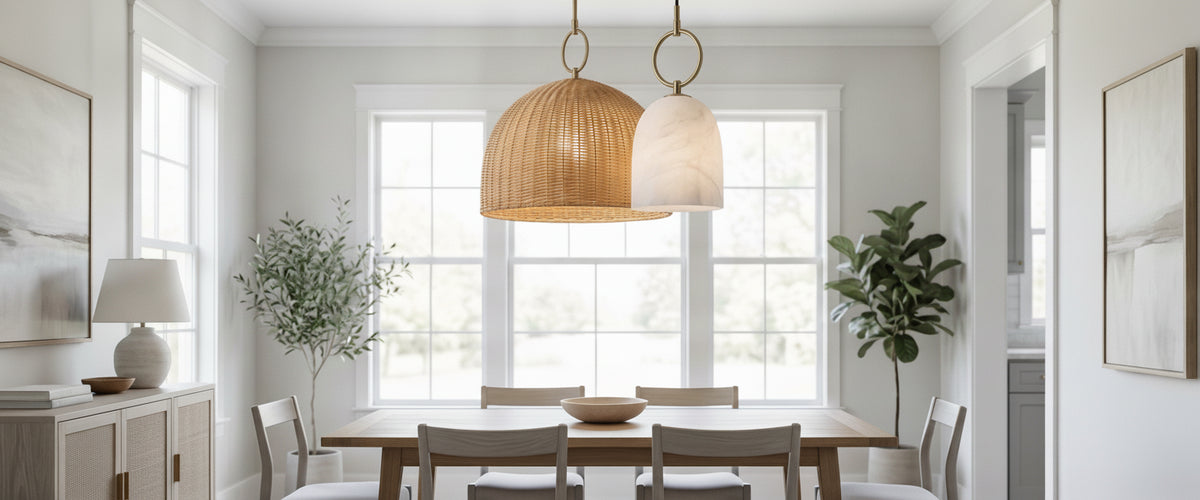

A dining room rattan pendant can photograph beautifully and still ruin dinner. We see it constantly: a client sends through a dining room shot where the shade looks warm and handsome by daylight, then admits that once the sun goes down the table is covered in a fine crosshatch of shadow and nobody can see what they are eating. Dining room rattan is one of the few lighting choices where the material's texture becomes part of the light itself, for better or worse. Get the weave, depth and drop right and you get a glow with real character. Get them wrong and you have bought a very stylish shadow projector.

Quick Answer: Dining Room Rattan at a Glance
Weave density is the main variable in any dining room rattan pendant. Open, airy weaves scatter light sideways and stripe the table; tight weaves push light downward and behave more like a solid shade.
Hang the bottom of the shade 30 to 36 inches (76 to 91 cm) above the tabletop. Higher on a rattan dome and you lose the pool of light entirely.
Diameter should be roughly half to two thirds the short dimension of the table, leaving at least 6 inches (15 cm) clear at each edge on a rectangular table.
Warm bulbs only. Natural fiber turns golden under 2700K and slightly dirty under 4000K.
Ask about the liner and the frame before anything hangs over food. Unlined open rattan above a dining table means glare, grease and dust.
Layer it. Dining room rattan handles character; alabaster wall lights or a stone table lamp on a sideboard handle the soft, even fill that makes faces look good.

Why Rattan Reads Differently Over a Dining Table
In a living room, rattan is largely decorative. It sits high, gets switched on at half brightness, and works alongside lamps at seated height. Nobody is examining a plate under it. Move the same shade over a dining table and its job changes completely: now it is the primary task light in the room, hanging at eye level for anyone standing, and it defines the entire mood of a two-hour meal.
That shift in role is why dining room rattan needs more scrutiny than rattan anywhere else in the house. The rattan palms behind these shades are tropical forest climbers, split and peeled into cane, then worked into furniture and basketry across Southeast Asia because the material is light, flexible and full of small gaps. Which tells you something useful: it was never designed to manage brightness. Any light control a woven shade offers is a by-product of how tightly somebody wove it.
Compare dining room rattan with the materials we work with at Niori. Alabaster and onyx transmit light through the body of the stone, so the shade itself becomes the light source. Rattan blocks light in some places and lets it through in others. Both can be lovely. They are solving different problems.
How Weave Tightness Controls the Light That Reaches the Food
Hold a woven shade up to a window before you buy, or ask the retailer for a lit photo taken at night rather than a styled daylight shot. It is the most useful test there is for dining room rattan. What you are judging is the ratio of cane to gap.
Open, Basket-Style Weaves
These throw pattern. Expect visible shadow lines on the table, strong sideways spill onto walls and ceiling, and noticeable glare from the bare lamp if you can see it from a seated position. They work best with a very low-output warm bulb, a frosted lamp, or an internal fabric liner, and they suit rooms where the dining room rattan pendant is atmosphere rather than the only source.
Tight, Fine-Woven Shades
A dense weave behaves much more like a linen drum: light mostly exits the bottom aperture, the surface glows a warm amber, and the table gets an even pool. This is the safer dining room rattan choice for a table that doubles as a homework desk or a place where people actually read menus, recipes and wine labels.
Domes Versus Bells Versus Cylinders
A deep dome hides the bulb well and concentrates light downward, which is flattering on a table but can leave the rest of the room dim. A shallow bell spreads light wider and lifts the walls. A tall cylinder is the most directional of all and usually needs a second light source, otherwise the room reads like a spotlit interview.
Scale is tied to that shape decision, and it is where dining room rattan schemes most often go wrong. A dome at around 20 inches (52 cm) across, such as the Caswell Rattan Dome Non Elec Pendant Light, suits a table roughly 36 to 43 inches (90 to 110 cm) wide as a single central pendant, or works in a pair over a longer run; anything much broader than that starts to dominate a standard dining room. Note also that it ships as a shade rather than a wired fixture, which is the norm for woven domes and something to price in early.
Shade Depth and Drop Ratios That Flatter a Table Without Crowding It
The number most people get wrong is drop. Designers aim for the bottom edge of the shade to sit 30 to 36 inches (76 to 91 cm) above the tabletop, and with dining room rattan we lean toward the lower end of that range. Rattan needs to be close to do its work; raise it another 6 inches (15 cm) and the light diffuses into a general haze instead of a defined pool.
Depth matters just as much. A shallow shade hung low will show the lamp to anyone sitting opposite, and there is no faster way to spoil a dinner than a bulb burning in a guest's eye line. Sight-line rule of thumb: sit in the chair, look across the table, and if you can see the bulb, you need a deeper shade, a lower-output lamp, or a diffuser at the base.
On width, roughly half to two thirds of the table's short dimension works for a single pendant. Long tables of 8 feet (2.4 m) or more usually look better with two or three smaller dining room rattan shades spaced evenly rather than one enormous one; the visual weight of a big woven dome can start to feel like a hat. On a 10 ft (3 m) table, a single broad dome overlights the middle and leaves both ends dim. Two narrower shades, hung slightly lower, fix the light levels and the proportion at the same time.
If your ceiling sits at around 8 ft (2.4 m), be honest about headroom. Dining room rattan in a low-ceilinged room needs a compact shade or a flush-mount alternative, and this is where a slim alabaster ceiling light or a pair of wall lights often outperforms a pendant entirely.
Warm Versus Neutral Bulbs, and Why Natural Fibre Amplifies the Difference
Rattan is a warm, tan material with a slight green-gold undertone. Put a neutral 4000K lamp behind it and the cane goes flat and grayish, closer to cardboard than craft. At 2700K or below, the same shade glows honey. Natural fiber exaggerates color temperature more than white glass or painted metal does, so the bulb decision is no small detail with dining room rattan.
Three practical rules for the lamp itself:
Go warm and dimmable. 2700K as a default, 2200K if you want candlelit. Check that the dimmer module and the lamp are a matched pair, since mismatched LEDs flicker and buzz at low output.
Chase color rendering, not wattage. A high CRI lamp makes food, wood and skin look correct. The Illuminating Engineering Society sets out how color rendering and correlated color temperature are defined, and it is worth a skim before you buy a box of bulbs.
Use a frosted or opal lamp in open weaves. Clear filament bulbs look wonderful in isolation and turn open dining room rattan into a glare grid.
Alabaster behaves in the opposite way. Because the stone diffuses light internally, a clear lamp inside a stone shade still reads soft, and the veining shows as warm movement rather than hard pattern. If you love the look of a visible filament, stone is the more forgiving host.
Finish Pairings That Keep Dining Room Rattan Looking Considered
Rattan drifts coastal by default. Pair it with driftwood tones, white linen and pale ceramics and you have a beach house whether you wanted one or not. To keep it reading as deliberate rather than themed, anchor it against something with weight:
Antique or brushed brass on the suspension, cord grip and ceiling rose. Brass against cane looks intentional; chrome looks like a compromise.
Dark timber or a stone tabletop. Marble, travertine or a honed limestone table turns the weave into texture contrast rather than another soft, sandy layer. A timber top with a hard metal base, like the Marca Sand Wash Acacia & Black Iron Dining Table, does the same job at a lower weight than stone while keeping the grain reading as structure rather than more beach texture.
Blackened metal accents on chair frames or a sideboard, used sparingly, to stop the palette going entirely warm-neutral. Where a full metal frame would feel cold, darker seating such as the Wycvorne Spindle-Back Dining Chair in black introduces the same visual weight with a softer silhouette under a woven shade.
One polished material in the room. An alabaster wall light or a marble table lamp on the sideboard adds the smooth, cool note that keeps woven fiber from dominating. Browsing the alabaster lighting collection alongside your dining room rattan shortlist is a fast way to see which stone tone sits happily next to cane.
The arrangement that works most often is the simplest one: keep the woven pendant over the table, then flank the doorway or sideboard with two alabaster wall lights. The stone does the flattering work on faces; the rattan does the character work overhead. That division of labour is the most reliable recipe we know for dining room rattan that still looks grown up after two years.
The One Durability Question Worth Asking Before Anything Hangs Over a Dinner Table
Ask how the shade is constructed and finished, because open-plan homes put dining room rattan directly in the path of cooking vapour. Woven fiber is porous. It absorbs airborne grease, holds dust in every crossing of the cane, and in very dry or very humid rooms it can shift slightly over time as the material moves with moisture.
Specifically, check:
Is it lined? A fabric or parchment liner cuts glare and keeps the interior cleaner.
Is it woven onto a metal frame? Frameless woven shades can lose their shape; a steel or iron armature holds the silhouette.
Is it sealed? A clear lacquer or sealed finish makes dusting realistic. Unfinished cane needs a soft brush attachment and patience.
Is it electrified or a non-electric shade? Many woven domes ship as shade-only and need a separate suspension kit. Either is fine, but the difference affects installation cost and lead time.
How is it cleaned? Dry dusting and a vacuum brush, not a damp cloth. Water on unsealed cane can stain and swell it.
Natural stone answers those questions differently. Alabaster wipes clean with a dry or barely damp cloth, does not absorb kitchen air, and holds its geometry indefinitely. It is heavier, which means fixing points matter, and any ceiling-mounted fixture over a table should be installed by a qualified electrician who can confirm the joist or backing box will carry the load.
A Short Buying Checklist for Dining Room Rattan
Look at a night-time lit photo, not a daylight styling shot.
Measure your table's short dimension and target a shade half to two thirds that width.
Plan the drop at 30 to 36 inches (76 to 91 cm) above the tabletop and check sight lines from a seated position.
Decide whether the pendant is the main light or an accent, and specify the second layer before you order.
Confirm weave density, liner, frame and finish with the retailer.
Buy warm, high-CRI, dimmable lamps and a compatible dimmer.
Book an electrician for installation and ask them to confirm the fixing before the box is opened.
If the weave-shadow issue puts you off, that is useful information rather than a dead end. Plenty of buyers arrive at Niori having tried dining room rattan over a table and wanting the same warmth without the pattern, which is exactly what translucent stone does. You can compare pendant, chandelier and wall light formats across the wider lighting range and see how the diffusion changes when the shade itself glows instead of filtering. Cost tracks material, scale and finishing, so ask for a tailored quote once you know the size and drop you need.
Dining room rattan rewards precision. Measure the drop, interrogate the weave, buy the right lamp, and pair it with one calm, polished material. Do that and the pendant stops fighting the meal and starts framing it.