
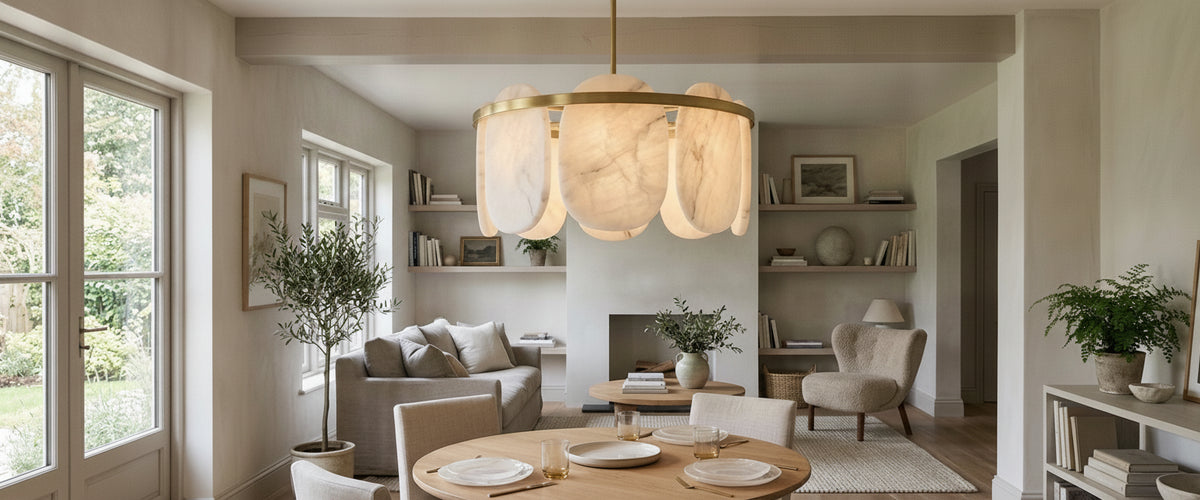

Most ceiling lights are chosen from a photograph taken in a room nothing like yours. That is why so many modern ceiling lights look convincing on screen and read wrong once they are up: the drop crowds a 2.3m (7ft 6in) ceiling, the diffuser throws a hard disc of light onto the floorboards, or the fitting turns out to be a third too small for the space it has to hold. Style is the easy part of this decision. Mounting type, diffuser material and physical scale are what decide whether you actually enjoy living underneath the thing.

At a Glance
- Modern ceiling lights split into four design languages. Pick one and stay in it, or the room loses coherence.
- Ceiling height rules out options before taste gets a say. Under about 2.4m (8ft), flush and semi-flush are your realistic field.
- The diffuser decides light character. Alabaster and onyx glow; opal glass diffuses evenly but flatly; bare metal shades push light straight down.
- Undersizing is the most common mistake we see in customer photographs, by a wide margin.
- Budget varies with material, scale, engineering and installation. Stone is cut, matched and finished by hand, so ask for a tailored quote rather than assuming a band.

The Four Sub-Styles Hiding Inside "Modern"
Search for modern ceiling lights and you will get at least four distinct looks filed under one label, and conflating them is how rooms end up feeling slightly argumentative. First, architectural minimalism: flat discs, shallow drums, recessed-looking forms, no visible hardware. Second, mid-century revival: sputnik arms, globe clusters, satin brass stems radiating from a central hub. Third, sculptural organic: irregular petals, stacked plates, tiered forms that behave more like a small ceiling sculpture than a lamp. Fourth, what we would call soft modern: clean geometry warmed by natural material, which is where alabaster and marble sit most comfortably.
The trouble starts when a room collects two or three of these. A sputnik in the hall, a hand-carved stone disc in the sitting room and a faceted sculptural piece over the stairs will each be defensible on its own, and collectively they will make the house feel like a showroom floor. Choose the sub-style that matches your joinery and furniture, then repeat its logic. Repetition is what makes a scheme look intentional.
Soft modern tends to be the most forgiving choice in British housing stock, because stone reads as material rather than fashion. A carved alabaster semi-flush fitting sits as happily under a Victorian cornice as it does in a new-build with plain plaster. That flexibility is a large part of why our alabaster lighting collection is the first place we send clients choosing modern ceiling lights for several rooms at once.
Ceiling Height Decides What You Can Even Consider
Before style, measure. Height rules modern ceiling lights out of contention faster than any other factor, and it is the step most buyers skip.
At roughly 2.3m to 2.4m (7ft 6in to 8ft), which covers a great many UK flats and post-war houses, you are in flush and semi-flush territory. The working rule we use is simple: keep the underside of any fitting clear of head height in circulation zones, and keep at least a hand's width of visual breathing room between the fitting and the tallest thing beneath it. Doorways, wardrobe tops and the swing of a loft hatch all matter here.
Between about 2.5m and 2.8m (8ft to 9ft), longer semi-flush fittings and modest pendants become viable, particularly over tables and islands where nobody walks. Above 2.8m (9ft), or in a stairwell or double-height space, a pendant drop or tiered chandelier is not just possible but usually necessary; a flush fitting at that height stops doing anything useful for the lower half of the room.
One genuinely useful test before you commit: cut a cardboard disc to the diameter you are considering, tape it to the ceiling, and live with it for two days. It looks absurd. It has saved several of our clients from a fitting that was 10cm too wide for a narrow hallway.
Flush, Semi-Flush or Pendant Drop: When Each Earns Its Place
Flush
A true flush fitting sits tight to the plaster. These are the modern ceiling lights for hallways, landings, cloakrooms, utility rooms and bedrooms with low ceilings, and for anywhere a door or a person needs to pass close by. The compromise is that light has nowhere to go but downwards and sideways along the ceiling plane, so the fitting itself has to be doing the aesthetic work. This is where a thin alabaster plate is genuinely superior to a plastic-lensed panel: the stone becomes a lit surface rather than a bright spot. In a hallway where a door swings within centimetres of the ceiling rose, something low-profile and warm in tone, such as the Collier 3 Light Flush Ceiling Light in Heritage Brass, solves the clearance problem without reducing the fitting to a lens.
Semi-Flush
The most underrated category of modern ceiling lights in the whole market. A semi-flush fitting drops a short distance from a central stem or canopy, which lets light wash the ceiling as well as the floor. That upward bounce is what stops a low room feeling compressed. Multi-light semi-flush designs, three or five shades arranged around a brass hub, spread light across a wider footprint than a single central source ever will, which makes them a strong pick for square bedrooms, snugs and kitchen circulation space. The Brinley 3 Light Semi-Flush in Brushed Brass is a fair illustration of that geometry: three separate sources at a short drop cover more floor than one large disc sitting flat against the plaster.
Pendant Drop
Pendants and chandeliers are positional lights, not general ones, and of everything in this category they are the easiest to put in the wrong place. Hang them where the function is fixed: over a dining table, an island, a stairwell void, a freestanding bath. A pendant in the middle of a walkable room is an obstacle with a light bulb in it. Get the drop right and a stone pendant does something no flush fitting can, which is define a zone and put warm light at eye level where conversation happens. Browse the broader lighting range if you are mixing a pendant over the table with flush fittings elsewhere in the same scheme.
What the Diffuser Material Does to Light at Floor Level
Two modern ceiling lights with identical bulbs and identical wattage can produce completely different rooms. The diffuser is why.
Alabaster is a gypsum stone, softer and more translucent than marble, which is exactly why it has been carved into windows, panels and lamps for centuries. Light entering a thin alabaster plate scatters inside the crystal structure before it leaves, so the surface glows rather than glares, and the natural veining reads as faint amber and grey striations when lit. Because alabaster is a sedimentary mineral with real variation between blocks, no two plates match precisely, which the British Geological Survey material records reflect in the wide range of gypsum deposits recorded across the country. In practice that means you are buying a natural surface, not a printed one.
Onyx pushes further: stronger banding, more dramatic colour, more theatre. It is the right call over a dining table where you want the fitting to be the event, and the wrong call in a corridor where you will pass it forty times a day.
Marble is largely opaque in the thicknesses used for lighting, so it behaves as structure rather than diffuser. Marble bases, collars and canopies pair well with alabaster or glass shades. Opal glass diffuses cleanly and consistently but flatly; it gives you even light with none of the depth stone provides. Metal shades and bare-lamp designs deliver punch and shadow, which suits task areas and suits almost nothing else.
For bulbs, we consistently recommend 2700K for living spaces and bedrooms and no higher than 3000K over kitchen worktops. Stone warms light very slightly on its way through, so a 3000K lamp behind alabaster reads warmer than the same lamp in a glass shade. Insist on dimmable drivers and check LED-compatible dimmer switches, because a dimming range that collapses at the bottom end wastes most of what alabaster is good at.
Room Footprint and the Case for Going Bigger
Undersizing is the error we correct most often with modern ceiling lights. People measure ceiling height carefully and then choose a diameter that feels safe. A safe diameter reads as a bathroom fitting in a sitting room.
A serviceable starting point: add the room's length and width in feet, and treat that number in inches as a sensible fitting diameter. A 12ft by 14ft room (roughly 3.7m by 4.3m) lands at around 26in, or 66cm. At that scale a single small shade will always look stranded, and a wide multi-light form such as the Solana 9 Light Semi-Flush in White and Brass holds the footprint far more convincingly while keeping the drop short enough for an eight-foot ceiling. Over a dining table, size to the table instead: aim for roughly half to two-thirds of the table width, centred on the table rather than the room, because the two are rarely aligned in real houses. Over an island, either one generous fitting or an evenly spaced pair with matched sightlines; three small pendants on a short island looks fussy.
Weight matters with stone. Carved alabaster and marble are meaningfully heavier than glass or aluminium, so the ceiling rose position needs a joist or a properly specified fixing, and in the UK any new fixed wiring work falls under Part P of the Building Regulations. Use a qualified electrician and have them confirm the fixing before the fitting arrives; the government guidance on electrical safety sets out what is notifiable.
Where Modern Ceiling Lights Consistently Underperform
A single central fitting cannot light a room properly, however good it is. This is the honest limitation of the whole category, and no amount of lumens fixes it.
Modern ceiling lights underperform in three specific situations. Long thin rooms, where one central source leaves both ends in gloom; run two matched fittings instead, or pair one with wall lights. Rooms used for reading, working or cooking, where overhead light casts your own shadow onto the task; add a table lamp, floor lamp or under-cabinet run. Rooms with low sloped ceilings, where even a flush fitting sits at an angle and looks wrong; wall lights and a floor lamp will serve you better.
A recent project illustrates it. A client converting a Suffolk barn had specified a large sculptural pendant for the main space and nothing else. We shipped the pendant, then three alabaster wall lights and a stone-based floor lamp six weeks later, once they had spent a winter evening in the room. Layers are what make stone lighting sing; one fixture doing everything is what makes it look like a fixture.
Modern Ceiling Lights: The Buying Checklist
- Measure floor to ceiling, and note the height of doors, wardrobes and any beam in the light's path.
- Decide the mounting type from that measurement before you look at a single image.
- Pick one of the four modern sub-styles and hold it across the whole floor.
- Choose the diffuser for the effect you want at floor level: glow (alabaster), drama (onyx), even wash (opal glass), directional punch (metal).
- Size up. Use the length-plus-width rule for rooms, the table-width rule over dining.
- Confirm dimmability, driver type and a 2700K to 3000K lamp before ordering.
- Check fixing and weight with your electrician, and confirm whether the work is notifiable.
- Plan at least one secondary light source in the same room. Always.
- Ask for a quote based on material, scale and finish rather than assuming comparable pieces cost the same.
Living With Stone Overhead
Alabaster is porous and softer than marble, so treat it like a good piece of furniture rather than a light fitting. Dust with a dry microfibre cloth or a soft brush; skip the glass cleaner, the vinegar and anything mildly abrasive, all of which will dull a polished surface over time. If a mark needs lifting, a barely damp cloth followed immediately by a dry one is the limit. Mounted overhead, stone attracts remarkably little grime, though kitchen fittings benefit from a wipe every few months to stop cooking film building on the underside.
One more studio observation: alabaster looks different in every house. The same plate can read cream in a north-facing London flat and honey under Cornish afternoon light. If you are ordering several modern ceiling lights for one floor, order them together so the stone is cut from related blocks. It is the sort of detail that only shows up once everything is switched on, and by then it is too late to fix. You can see how the range is organised across pendants, chandeliers, wall lights and lamps on the Niori homepage if you are planning a whole scheme rather than a single room.