
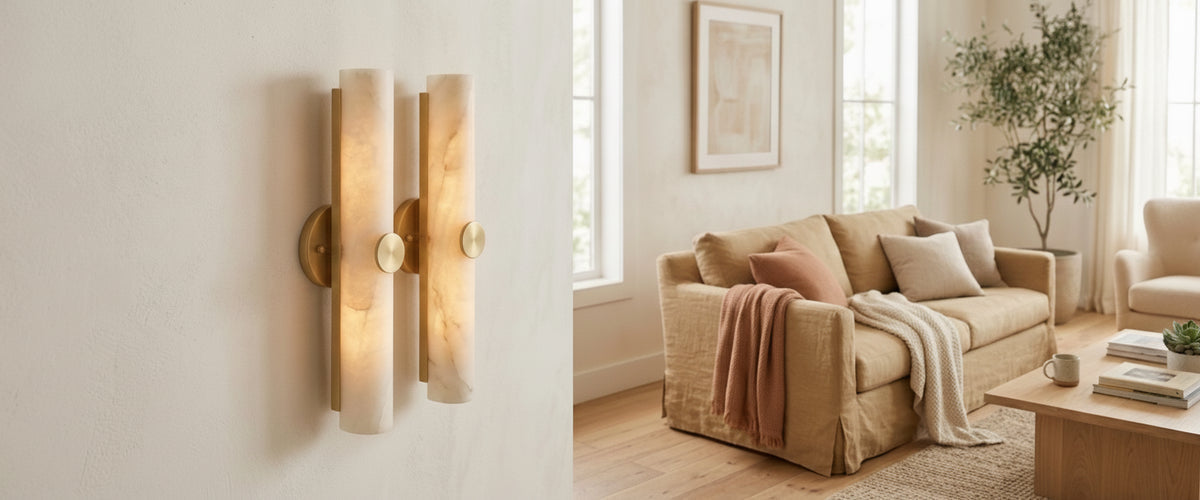

A wall light that hums at half brightness usually has nothing wrong with it. The dimmer sitting behind the plaster is doing the damage. This is the single most common complaint we hear about dimmable wall lights, and it almost never traces back to the fixture on the wall. It traces back to a control module chosen for an older lighting load, a circuit carrying too little wattage, or a driver that was never matched to the dimmer in the first place.

Key Takeaways Before You Buy
- Most buzzing and flickering from dimmable wall lights comes from a dimmer and driver mismatch, not a defective fixture.
- Leading-edge dimmers were built for incandescent and mains halogen loads; trailing-edge dimmers suit most modern LED drivers far better.
- A single low-wattage sconce alone on a circuit often falls below the dimmer's minimum load and stutters or refuses to strike.
- Shade material changes character as you dim. Alabaster holds a warm, readable glow at low output where flat opal glass can look dull and gray.
- Always ask for the driver type, dimming protocol, minimum load, and tested dimmer compatibility before ordering.
- Any hard-wired install should be signed off by a qualified electrician.

Why a Wall Light Sold as Dimmable Can Still Misbehave
"Dimmable" on a product page means the fixture is capable of dimming with the right control. It does not promise that every dimmer on the market will drive it smoothly. Most dimmable wall lights leave the factory perfectly able to fade evenly; what varies is the control module they are asked to work with. Between the wall switch and the light sits a driver, and that driver has opinions. Phase-cut dimmers chop the mains waveform to reduce output, and a driver that is not designed to interpret a chopped waveform will respond with audible buzz from the transformer, visible shimmer, a dead band at the bottom of the dial, or a pop as it drops out entirely around ten percent.
Flicker is worth taking seriously rather than tolerating. Low-level flicker that you barely register consciously can still cause eye strain and headaches over long evenings, which is why lighting bodies including the Illuminating Engineering Society publish guidance on flicker metrics for LED systems. If a bedside sconce shimmers at twenty percent, it is the wrong pairing, and no amount of living with it will settle it down.
Leading-Edge Versus Trailing-Edge: Which Circuit Needs Which
Leading-edge dimmers, sometimes called TRIAC dimmers, cut the front of each mains half-cycle. They were designed for resistive loads: filament bulbs and mains-voltage halogen. They are robust, inexpensive, and still installed in enormous numbers. Paired with a modern LED driver they tend to produce mechanical hum and a coarse dimming curve that jumps rather than glides.
Trailing-edge dimmers cut the back of the waveform and handle capacitive and electronic loads far more gracefully. They run quieter, start lower, and give the slow, even fade most people picture when they imagine dimmable wall lights. For nearly every alabaster or stone fitting with an integrated LED module or a remote driver, trailing-edge is the correct default.
Beyond phase-cut control there are protocol systems: 0-10V, DALI, and the various proprietary smart platforms. These separate the dimming signal from the power feed entirely, which gives you smooth control down to one percent and repeatable scene setting across a room. They need to be specified at the design stage, not retrofitted on a Saturday afternoon. If you are planning a hotel corridor, a restaurant banquette wall, or a large open-plan home where sconces need to track with pendants and downlights, protocol dimming is worth the extra first-fix work. Manufacturer standards work on phase-cut LED compatibility, such as the National Electrical Manufacturers Association dimming specifications, exists precisely because so many early LED and dimmer pairings failed in the field.
Minimum Load: The Reason One Wall Light Alone Often Stutters
Every dimmer has a minimum load, the smallest wattage it needs to see before it behaves predictably. Older leading-edge units often need forty watts or more. A pair of dimmable wall lights in alabaster running efficient LED modules might draw a fraction of that between them. The dimmer never gets enough load to settle, so you get ghosting when off, a buzz when low, or a light that refuses to strike until the dial is already halfway up.
This catches people out most often in hallways and powder rooms, where a single sconce sits alone on its own switch. We shipped a pair of alabaster sconces to a home in Napa where the entry light worked perfectly and the identical unit in the guest bath flickered every evening. Same fixture, same bulb. The difference was that the entry pair shared a circuit and the bathroom light was on its own, below the dimmer's threshold. Swapping to a low-minimum-load trailing-edge module fixed it in twenty minutes.
You have three routes out of a minimum load problem: choose a dimmer rated to start at one or two watts, put more fixtures on the same circuit, or fit a load-correction device. Ask your electrician which is cleanest for your wiring before you start buying control gear.
What Dimming Does to the Character of Stone
Here is where material choice stops being decorative and starts being technical. Two dimmable wall lights with identical drivers can read completely differently depending on what the light passes through on its way out. At full output, most diffusing shades look broadly similar: bright, even, white. Dim to twenty percent and they diverge completely.
Alabaster is a gypsum stone with genuine depth to it, so light travels a short distance through the material before it leaves the surface. As output drops, the stone does not just get darker. The veining reads more clearly, the surface warms toward honey and amber, and the piece continues to look like a lit object rather than a switched-off one. That is the quality people are really buying when they choose stone over glass for bedside and corridor lighting. Onyx behaves similarly with more dramatic banding, while marble backplates and brass detailing pick up the low output as reflected warmth rather than glare. You can see the range of surfaces and how differently they carry light across the alabaster lighting collection.
Two practical notes. If you are using a warm-dim LED that shifts color temperature as it lowers, alabaster amplifies the effect beautifully; the stone's natural cream tone runs with the amber rather than fighting it. And because stone diffuses across its thickness, it hides individual diode hotspots that show through thin acrylic or blown glass at low levels, which matters a great deal on a fitting viewed from three feet (about 0.9 m) away in bed.
Room by Room: Where Dimmable Wall Lights Earn Their Place
Bedrooms
Bedside sconces free the nightstand and put light at reading height. Mount the center of the fixture roughly 30 to 36 inches (76 to 91 cm) above the mattress top, and insist on dimming down to at least five percent so one partner can read while the other sleeps. This is the room where flicker gets noticed fastest. Where the wall needs a slim, low-profile fitting rather than a projecting arm, a factory-matched module and driver such as Aron Dimmable LED Wall Light, White removes one variable from the equation, because the dimming behavior is designed in rather than assembled on site.
Hallways and Stairs
Corridors read best as a rhythm of soft pools rather than a run of ceiling downlights. Alabaster sconces spaced evenly along the wall give that rhythm, and a dimmer lets the same run serve as gentle nighttime wayfinding at fifteen percent. Check the minimum load here, since hallway circuits are frequently under-loaded. A repeated single-lamp form like Arden 1 Light Wall Light, Matt Black keeps each pool small and evenly spaced, which is what you want along a narrow run; a wider two-light head starts to overlap and flatten the rhythm.
Living Rooms
Dimmable wall lights flanking a fireplace or artwork do the job that a single ceiling fitting cannot: they put light at eye level and give the room a horizon. Dim them independently from any pendant or floor lamp so you can shift from bright to low-lit without rewiring your evening.
Dining Rooms and Hospitality Spaces
Restaurants and private dining rooms dim their wall lighting far lower than most homeowners expect, often to a tenth of daytime output. Stone shades hold their presence at those levels where painted metal shades simply disappear. If you are specifying for a venue, browse the wider lighting range to keep pendants, sconces, and table pieces reading as one family.
Bathrooms
Dimmable wall lights flanking a mirror beat lighting from above for shadow-free grooming. Bathroom zones carry their own electrical requirements and IP ratings, so this is a specification conversation with your electrician before you fall in love with a fixture.
Four Spec-Sheet Checks to Make Before Ordering Dimmable Wall Lights
- Driver and dimming type. Integrated LED or replaceable lamp? Phase-cut, 0-10V, or DALI? If the answer is not on the page, ask before you buy. With a lamp-holder fitting such as Lyria Wall Light White Glass Globe 20cm, E27, the dimming performance follows the bulb you choose, which is useful flexibility when you are working around a dimmer you cannot replace.
- Tested dimmer compatibility. Reputable manufacturers publish a list of dimmers they have tested. Match your control module to that list rather than hoping.
- Minimum and maximum load on your dimmer. Add up the total wattage on the circuit and confirm it sits comfortably inside the dimmer's range, allowing for the derating most dimmers require when ganged in a multi-gang plate.
- Dimming range and color behavior. Ask how low the fixture goes and whether the color temperature shifts as it dims. A fixture that stops at thirty percent is not much use over a bed.
Installing and Living With Dimmable Wall Lights
Get the back boxes and cable drops set during first fix, with the mounting heights marked on the wall while the furniture layout is still fluid. Stone backplates need a flat, true surface; a lumpy patch of plaster will show as a shadow gap at low output. Have a qualified electrician handle the connection and the dimmer selection together, since the two decisions are really one decision.
For care, keep it simple. Dust natural stone with a dry, soft cloth, avoid acidic or ammonia-based cleaners, which etch gypsum and marble, and never soak a shade. Alabaster is porous and will mark if liquid sits on it. If you want a closer look at how Niori works with alabaster, onyx, and brass across pendants, chandeliers, and wall lights, the Niori homepage is the easiest place to start.
Specified properly, dimmable wall lights become the most-used lighting in a home. They set the mood without touching the ceiling, they work at every hour of the evening, and in stone they keep looking alive at the bottom of the dial. Get the dimmer right and you will forget the technology entirely, which is exactly the point.