
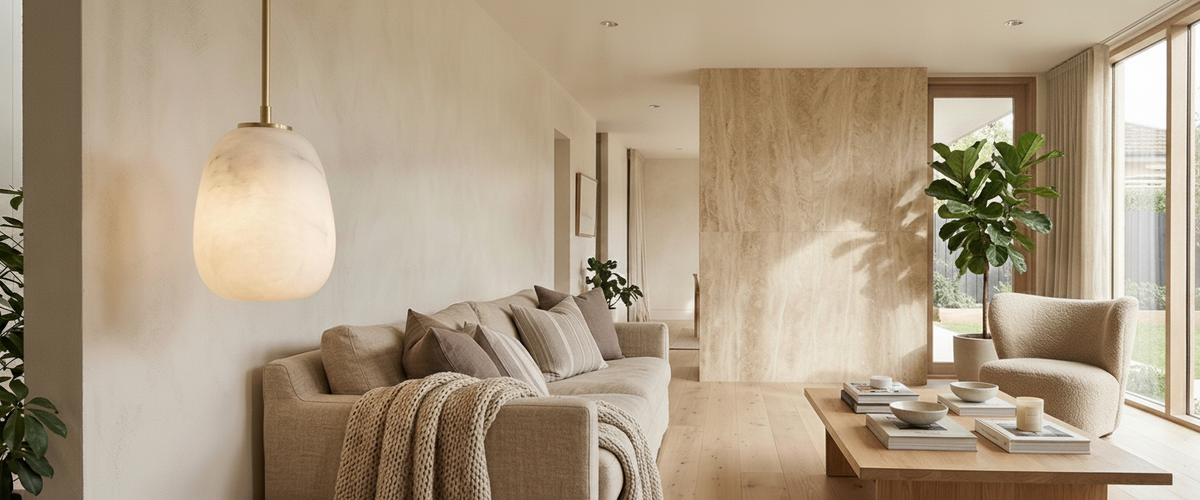

Choosing the right led light bulbs home setups need is really about matching brightness, colour temperature and quality to each room, and it matters even more when light passes through stone. Fit a cold, high-output bulb into a carved alabaster pendant and the stone that looked honey-warm in the showroom turns flat and grey, the veining vanishes, and the whole fitting reads like plastic. In short: for stone fittings, buy warm 2700K to 3000K led light bulbs home schemes rely on, with a CRI of 90 or above, read lumens rather than watts, and confirm the cap fitting first. The bulb inside a stone light matters as much as the stone itself, and most guides skip that entirely. This one does not.
Alabaster and onyx are translucent. They pass light through the material, so whatever colour and quality your led light bulbs home fittings throw is exactly what your piece broadcasts back into the room. Get it right and the stone glows; get it wrong and it sulks.

Quick Answer: Buying LED Lights for Your Home
Read lumens, not watts. Lumens tell you brightness; watts only tell you energy use.
Stick to 2700K to 3000K for living spaces and anything behind stone. Warm led light bulbs home schemes flatter alabaster; cool white greys it out.
Aim for a CRI of 90 or above so colours and veining stay true.
Check the dimming rating and match it to a compatible trailing-edge dimmer to avoid flicker and buzz.
Confirm the cap fitting (E27, E14, GX53 and so on) before you buy.
Choose one colour temperature across the whole home so no room glows a different shade.

Why Lumens, Not Watts, Tell You What You Are Buying
Old habits die hard. Most of us still ask for a "60-watt bulb" out of muscle memory, but watts measure how much energy a bulb draws, not how bright it is. With led light bulbs home shoppers choose, the number that matters is lumens. A modern LED can produce the brightness of a traditional 60W incandescent while drawing 7W or 8W, so watts have stopped being a useful shorthand for output.
As a rough guide: a bedside table lamp is comfortable around 400 lumens, a living-room lamp around 700 to 800, and a kitchen ceiling light considerably more. Behind translucent stone, remember that the material itself absorbs some light. A bulb inside a thick onyx shade will read dimmer than the same bulb in open air, so we often suggest going one small step brighter than you would for a clear glass fitting, then pairing it with a dimmer to pull it back.
Choosing Colour Temperature Room by Room
Colour temperature, measured in kelvin, is where most people go wrong. Lower numbers are warmer and more amber; higher numbers are cooler and bluer. When you pick led light bulbs for the home, and especially for stone fittings, warmth almost always wins.
Kitchens and task areas: 3000K gives clean, useful light without tipping into the clinical blue-white of an office. If you have an alabaster pendant over an island, 3000K keeps the surface warm while still letting you see what you are chopping.
Living and dining rooms: 2700K is the classic warm-white for relaxing spaces. It flatters skin, timber, brass detailing and stone in equal measure. This is the setting most led light bulbs home schemes should default to.
Bedrooms and snugs: stay at 2700K for an amber, candle-like hush. Where a room needs that late-evening glow behind a shade rather than a clean white output, an amber bulb such as the Globe 6W E27 LED Bulb, Amber sits closer to the right design language, warming the stone from within.
The one firm rule: never put 4000K or higher (cool white or daylight led light bulbs home schemes should avoid) inside alabaster or onyx. Cool light strips the material of its warmth and makes lovely veining look like a stain. If you want to browse fittings designed around warm, diffused light, the full range sits in our alabaster lighting collection.
The Bulbs That Flatter Stone, and the Ones That Grey It Out
Beyond colour temperature, look at the CRI, or colour rendering index. It scores how accurately a light source shows colour compared with natural daylight, on a scale to 100. Cheap LEDs often sit around 80, which is fine for a garage and poor for a feature fitting. For stone, the led light bulbs home lovers should reach for sit at CRI 90 or above. It is the difference between alabaster looking alive and looking dead.
Bulb shape and finish matter too. In a fitting where the bulb is visible, a warm amber or clear filament-style LED reads beautifully; the glowing filament echoes the veining in the stone. Where the bulb is hidden inside a shade, shape is less important than output and warmth. For recessed sockets you will often need a specific format such as a GX53 flat bulb rather than a standard screw-in globe; a piece like the LED-LM Warm White 3000K GX53 Bulb is made for exactly those recessed fittings, so check the socket before ordering.
A quick note from the studio: we shipped a large onyx pendant to a client who had bought their own "warm white" led light bulbs home listings promised online. They rang to say the stone looked cold. The bulbs turned out to be 4000K mislabelled on a cheap listing. Two 2700K high-CRI replacements later, the same pendant looked like a different piece entirely. The stone had not changed. The light had.
Dimmable Ratings, and How to Dodge Flicker and Buzz
Not every LED bulb dims, and not every dimmer likes LEDs. This is the single most common source of buzzing fittings and jittery, flickering light in homes fitted with modern bulbs. Two things need to line up.
First, buy led light bulbs for the home marked dimmable. A non-dimmable LED on a dimmer will flicker, hum or simply refuse to dim. Second, use a dimmer designed for LED loads, usually a trailing-edge dimmer rather than the older leading-edge type built for incandescent bulbs. Mismatched dimmers are the usual cause of that low buzz you hear in a quiet room. If you are wiring or replacing a dimmer switch, use a qualified electrician; guidance from Electrical Safety First is worth a read before you touch anything at the consumer unit.
For alabaster fittings, good dimming is not a luxury, it is the point. Stone gives its best glow at lower output, so a smooth dimming curve lets you take a pendant from bright task light down to a warm evening ember without the light stepping or strobing. Dimmable led light bulbs home schemes rely on earn their keep here.
Cap Fittings and Lifespan Claims Worth Double-Checking
The cap, or base, is the part that connects the bulb to the fitting. Get it wrong and the bulb simply will not fit. The common caps you will meet on led light bulbs for the home are E27 (large screw), E14 (small screw), plus bayonet types and specialist caps such as GX53. Our fittings list the cap they take; match it exactly, because an E14 will not thread into an E27 socket. For a small wall or picture fitting, a compact E14 option such as the Golf Ball 4W E14 LED Bulb, Amber makes more sense than forcing a full-size globe into a tight shade.
On lifespan, treat the headline numbers with mild suspicion. A bulb rated at 25,000 hours is tested under ideal conditions. Real-world life depends on heat, how often it is switched, and the quality of the driver inside. Enclosed fittings run hotter, which shortens LED life, so in a fully enclosed stone shade look for bulbs rated for enclosed use. Buy the led light bulbs home fittings deserve from a source that stands behind the rating rather than the cheapest listing you can find.
Building One Coherent Bulb Scheme
Walk through a home where every room glows a slightly different shade and you feel it before you can name it. One room reads yellow, the next reads blue-white, and the whole place feels unsettled. The fix is boring and effective: pick one colour temperature as your house standard, usually 2700K, and buy every led light bulb for the home to match. Consistent led lighting for home is what makes a scheme feel calm, and matching led light bulbs home room to room is the quiet detail that pulls it together.
Where you want a room to feel brighter, change the lumens, not the kelvin. That keeps the colour consistent while letting a kitchen run brighter than a bedroom. Keep a couple of spare led light bulbs for the home of each type in a drawer so a failed one gets replaced like for like, not with whatever the corner shop had. It is a small discipline that keeps a whole home reading as one coherent scheme. Well-chosen led lights for home reward the effort. You can see how we pair bulbs with fittings across the wider lighting collection.
A Short Buyer's Checklist
Confirm the cap fitting (E27, E14, GX53, bayonet) for each fixture.
Choose 2700K to 3000K for warm rooms and anything behind stone.
Insist on CRI 90 or above for feature fittings.
Match lumens to the job, then dim to taste.
Buy dimmable led light bulbs for the home and pair them with a trailing-edge dimmer.
For enclosed shades, choose bulbs rated for enclosed use.
Standardise colour temperature across the whole home.
Choose your led light bulbs home fittings need with the same care you gave the fitting, and an alabaster pendant or onyx table lamp will do exactly what it was made to do: turn light into something soft, warm and worth looking at.