

 Save 25%£22499£30000Unit price Translation missing: en.products.product.price.unit_price_separatorUnavailable
 Free Delivery
 Save 25%£22499£30000Unit price Translation missing: en.products.product.price.unit_price_separatorUnavailableFree Delivery
 Save 25%£25599£34200Unit price Translation missing: en.products.product.price.unit_price_separatorUnavailableFree Delivery
 Save 25%£9899£13200Unit price Translation missing: en.products.product.price.unit_price_separatorUnavailable
 Save 25%£20199£27000Unit price Translation missing: en.products.product.price.unit_price_separatorUnavailableFree Delivery
 Save 25%£23399£31200Unit price Translation missing: en.products.product.price.unit_price_separatorUnavailableFree Delivery
 Save 25%£23399£31200Unit price Translation missing: en.products.product.price.unit_price_separatorUnavailableFree Delivery
 Save 25%£23399£31200Unit price Translation missing: en.products.product.price.unit_price_separatorUnavailableFree Delivery
 Save 25%£23399£31200Unit price Translation missing: en.products.product.price.unit_price_separatorUnavailable
Dryden 1 Light Wall Light - Polished Brass with Ribbed Glass Shade
Free Delivery
 Save 25%£22499£30000Unit price Translation missing: en.products.product.price.unit_price_separatorUnavailableFree Delivery
 Save 25%£22499£30000Unit price Translation missing: en.products.product.price.unit_price_separatorUnavailableFree Delivery
 Save 25%£21099£28200Unit price Translation missing: en.products.product.price.unit_price_separatorUnavailableFree Delivery
 Save 25%£21099£28200Unit price Translation missing: en.products.product.price.unit_price_separatorUnavailableFree Delivery
 Save 25%£21099£28200Unit price Translation missing: en.products.product.price.unit_price_separatorUnavailableFree Delivery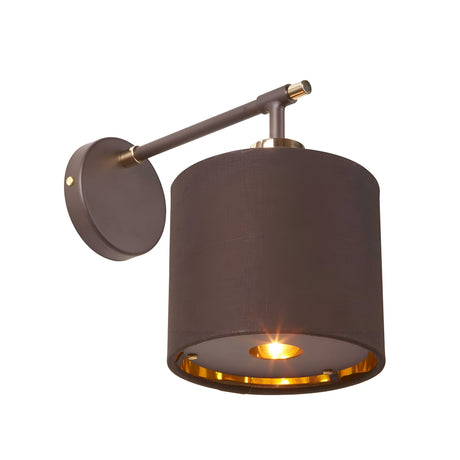
 Save 25%£5399£7200Unit price Translation missing: en.products.product.price.unit_price_separatorUnavailable
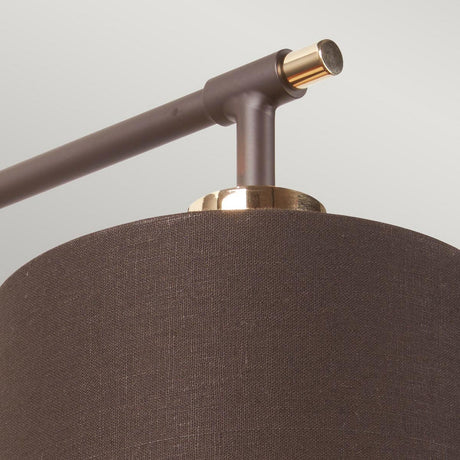
Balance 1 Light Wall Light - Brown Fabric Shade Polished Brass
 Save 25%£7199£9600Unit price Translation missing: en.products.product.price.unit_price_separatorUnavailable
 Save 24%£14599£19200Unit price Translation missing: en.products.product.price.unit_price_separatorUnavailableFree Delivery
 Save 25%£18899£25200Unit price Translation missing: en.products.product.price.unit_price_separatorUnavailableFree Delivery
 Save 25%£8999£12000Unit price Translation missing: en.products.product.price.unit_price_separatorUnavailable
 Save 25%£8999£12000Unit price Translation missing: en.products.product.price.unit_price_separatorUnavailable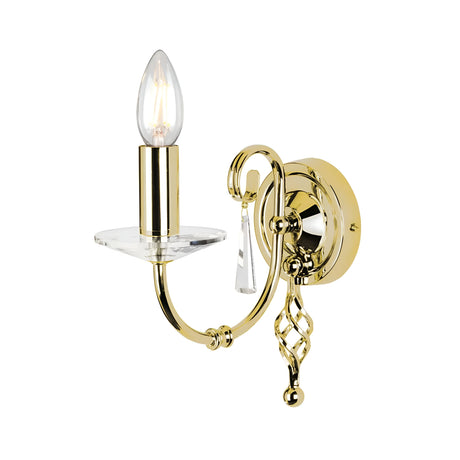
 Save 26%£5799£7800Unit price Translation missing: en.products.product.price.unit_price_separatorUnavailable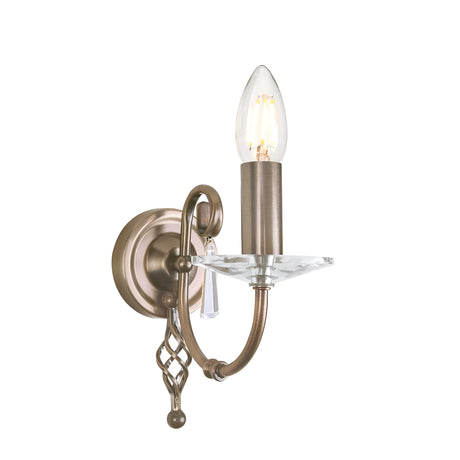
 Save 26%£5799£7800Unit price Translation missing: en.products.product.price.unit_price_separatorUnavailable
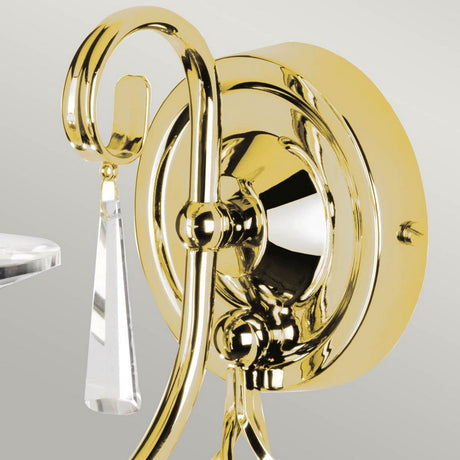
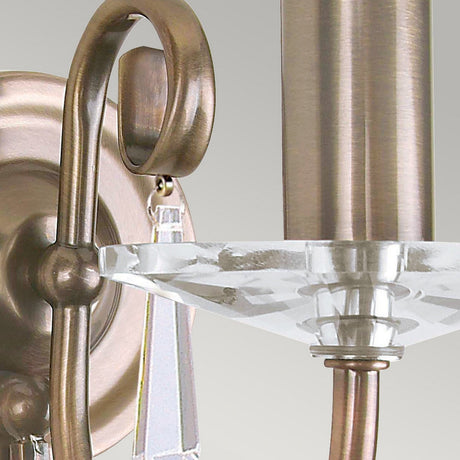
Aegean 1 Light Wall Light - Aged Brass with Cut Glass Sconce

 £17999Unit price Translation missing: en.products.product.price.unit_price_separatorUnavailable10 In StockFree Delivery
 In our showroom
 £23999Unit price Translation missing: en.products.product.price.unit_price_separatorUnavailable10 In StockFree DeliveryIn our showroom
 £27999Unit price Translation missing: en.products.product.price.unit_price_separatorUnavailable
Galaxy 3 Light Semi-Flush Ceiling & Wall Light - Black & Brass
4 In StockFree DeliveryIn our showroom


Wall light or wall sconce?
They are the same fitting under two names. Wall light is the standard British term; wall sconce is used far more widely in North America, and you will find the two used interchangeably across manufacturers and retailers. Historically a sconce meant a bracket holding a candle against a wall, which is why so many designs still carry a candle tube or a flame-shaped lamp, but in current use neither word implies anything about the style. If you are cross-shopping and finding very different results, it is usually the vocabulary rather than the range.
How high, and how far apart
The default for general wall lighting is roughly 1.5 to 1.7m from the floor, which puts the fitting near eye level for someone standing. Flanking a bed, drop that to about 1.5m or to just above the headboard so the light falls where you read rather than on the wall behind you. Beside a mirror, mount at around 1.6m and place a pair either side rather than one above, which is the single change that most improves the light on a face. Along a hallway or up a staircase, space fittings 2 to 2.5m apart and keep the height constant even where the floor rises, so the run reads as deliberate.
Up, down, or both
Where the light goes matters more on a wall fitting than anywhere else, because the wall itself becomes part of the effect. An uplighter throws light onto the ceiling, which bounces back as soft general light and makes a low room feel taller. A downlighter creates a scallop of light on the wall beneath it, useful for texture and for lighting a stair tread. Up-and-down fittings do both and are the most versatile in a hallway. A shaded fitting behaves differently again, projecting light forward into the room in the way a table lamp does, which is what you want beside a bed or an armchair.
Brass at close quarters
A wall light sits within reach in a way a ceiling fitting never does, so the finish gets handled, brushed past and looked at from a foot away. That changes which brass makes sense. Brushed or satin brass is the most forgiving, since its grain hides fingerprints and small marks. Antique or aged brass is better still in a hallway or beside a door, because the finish is already uneven and wear simply adds to it. Polished brass is the most striking and the most demanding, showing every mark, so it suits a formal room rather than a busy corridor.
Switched, unswitched, and the question to ask first
This is the detail that most often derails a wall light purchase. Many fittings are unswitched, meaning they are controlled only from a wall switch on the circuit, and if your existing wiring has no switch on that spur the light will simply be on whenever the circuit is live. Others carry an integral rocker or pull cord on the fitting itself, which solves the problem but puts a visible switch on the design. Before buying, establish whether the existing wall point is switched. Where it is not, either choose a switched fitting or accept that an electrician will need to add a switch, and it is far cheaper to know that beforehand.
Bathrooms and IP zones
A wall light going into a bathroom needs an IP rating suited to where it will sit. IP44 is the usual minimum outside the immediate shower area, and IP65 is required where direct water is possible. Zones are measured from the bath or shower rather than applied to the whole room, so a fitting beside a basin and a fitting beside a bath may need different ratings in the same bathroom. Where a fitting is described only as bathroom-suitable with no IP figure given, treat that as a reason to check rather than to assume.
Looking after brass on a wall
Lacquered brass needs no more than a dry cloth, and metal polish must be avoided entirely, since it cuts through the lacquer and leaves patchy bare metal. Unlacquered brass will patinate around the parts that get touched, which on a wall fitting tends to mean the switch and the lower edge of the backplate. That uneven darkening is normal and, on an antique finish, usually welcome. If you would rather keep it even, a light polish once or twice a year is enough.
Frequently Asked Questions
What is the difference between a wall light and a wall sconce?
What is the difference between a wall light and a wall sconce?
How high should brass wall lights be mounted?
How high should brass wall lights be mounted?
How far apart should they be along a hallway?
How far apart should they be along a hallway?
Do wall lights come with their own switch?
Do wall lights come with their own switch?
Which brass finish is best for a hallway?
Which brass finish is best for a hallway?
Can I use a brass wall light in a bathroom?
Can I use a brass wall light in a bathroom?
How do I clean a brass wall light?
How do I clean a brass wall light?
Related Collections


BestSellers
-

 £44999Unit price Translation missing: en.products.product.price.unit_price_separatorUnavailable
Caelith LED Medium Carved Alabaster Wall Light - Brushed Brass
Limited StockFree DeliveryIn our showroom -

 £45999Unit price Translation missing: en.products.product.price.unit_price_separatorUnavailableFree Delivery
 -

 £10,79999Unit price Translation missing: en.products.product.price.unit_price_separatorUnavailableFree Delivery
 -

 £1,29999Unit price Translation missing: en.products.product.price.unit_price_separatorUnavailable
Seraphis LED Medium Alabaster Ring Chandelier - Brushed Brass
Free Delivery -

 £2699Unit price Translation missing: en.products.product.price.unit_price_separatorUnavailable
Panasonic Eneloop AA HR6 Rechargeable Batteries 2000mAh - 8 Pack
-

 Save 8%£49999£54299Unit price Translation missing: en.products.product.price.unit_price_separatorUnavailable
Helia 100cm LED Circular Pendant Light 55W 3000K - Matte Black
14 In StockFree Delivery -

 £1,19999Unit price Translation missing: en.products.product.price.unit_price_separatorUnavailableFree Delivery
 -

 Save 25%£65199£87000Unit price Translation missing: en.products.product.price.unit_price_separatorUnavailableFree Delivery
 -

 £1,49999Unit price Translation missing: en.products.product.price.unit_price_separatorUnavailableFree Delivery
 -

 £2,69999Unit price Translation missing: en.products.product.price.unit_price_separatorUnavailableFree Delivery
 -

 £2,09999Unit price Translation missing: en.products.product.price.unit_price_separatorUnavailable
Stratalux LED Stacked Alabaster Column Floor Lamp - Matt Black
Free Delivery -

 £1,79999Unit price Translation missing: en.products.product.price.unit_price_separatorUnavailable
Caelith LED Large Panel Alabaster Chandelier - Brushed Brass
Free Delivery


Recommended For You
Our Reviews
-

Birmingham Based
British heritage. Worldwide delivery.
