
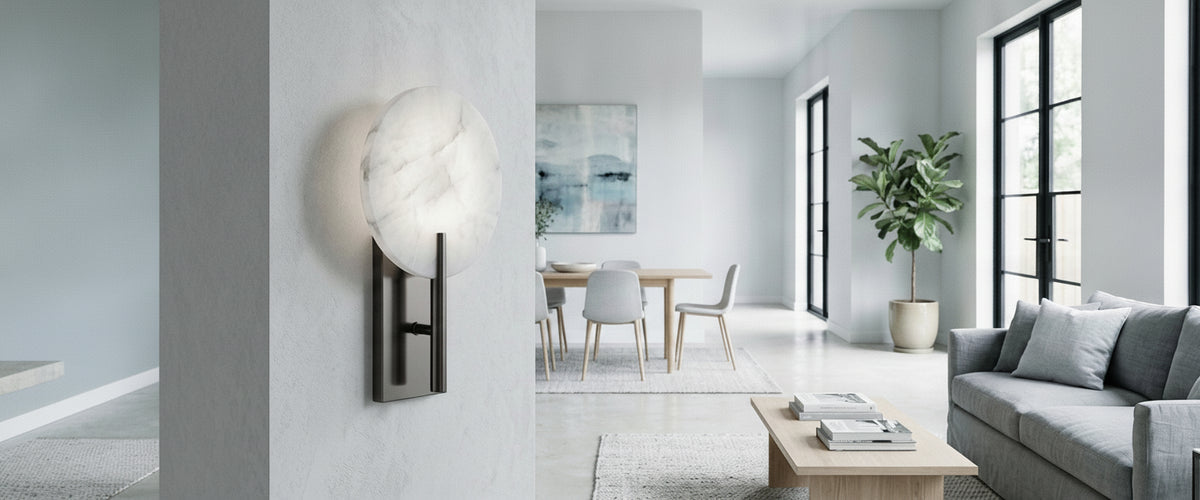

Pin a black nickel lighting to a mood board and it looks decisive. Fit the same piece under a north-facing rooflight with a 4000K lamp in it and the finish can drain to a flat blue-grey, like chrome left out in the rain. The finish has not changed. The conditions around it have. That gap between the sample chip and the installed fitting is where most black nickel light schemes come unstuck, and it is entirely avoidable if you understand what the plating is actually doing.

Key Takeaways
- Black nickel is a thin plated finish with genuine reflectivity, so a black nickel light picks up colour from the room. Matte black does not.
- Under warm lamps it reads pewter. Under cool lamps it slides towards graphite and can look cold.
- It flatters slim, linear and architectural forms; it flattens heavily modelled castings that need highlight contrast.
- Against alabaster and honed marble it acts as an outline, drawing the eye to the stone's veining rather than competing with it.
- The lacquer wears before the metal does, so care is about what you clean it with, not how often.
- Switch plates and sockets are the real commitment, because you touch and see them far more often than the black nickel light itself.

What Black Nickel Actually Is
Black nickel is an electroplated decorative finish, usually laid over brass or steel and then sealed with a clear lacquer. The dark tone comes from the chemistry of the deposit rather than from paint sitting on the surface, which is why a black nickel light keeps a faint metallic lustre instead of going dead flat. Plating thicknesses for decorative work are measured in microns, so this is a surface treatment rather than a structural layer; the Nickel Institute is a useful starting point if you want the metallurgy behind decorative and engineering nickel deposits.
Practically, that means three things. The finish follows every curve and chamfer of the component underneath, so good machining shows and poor machining shows worse. It reflects, softly, so a black nickel light borrows the colour of the walls and the lamp. And it has a sheen level that sits between satin and gently polished, never truly matte.
This is where it separates from its two nearest neighbours. Matte black, typically a powder coat, is opaque and absorbs light; it is a silhouette finish. Dark bronze carries a brown undertone and is often hand-antiqued so the high points catch light and the recesses stay dark, which is why it suits ornate castings. A black nickel light sits between the two: darker than pewter, warmer than gunmetal, and far more responsive to its surroundings than either.
Warm Versus Cool Light: Why a Black Nickel Light Shifts Tone
The single biggest variable is the lamp. At 2700K the finish picks up the amber in the light and reads as a soft pewter, almost mineral. Push to 3500K or 4000K and the same fitting cools to graphite, occasionally with a blue cast on the flatter surfaces. Designers who have only ever seen a black nickel light in a showroom lit at 3000K are often surprised by how much colder it looks in a kitchen specified for task lighting.
We ship a lot of alabaster pieces with darkened metalwork, and the pairing settles this question quickly. Alabaster transmits a honey-toned glow with a natural warm bias, so the stone itself warms the metal touching it. A black nickel light backplate behind a lit alabaster panel almost always reads pewter, never cold. Where it goes wrong is when the fitting is off and the room is lit by daylight or by a separate cool downlight; then the metal reverts to grey and the contrast with the stone can feel abrupt.
Practical guidance: specify 2700K for living spaces and bedrooms, 3000K where you need a little more crispness in kitchens and bathrooms, and hold CRI at 90 or above so the finish keeps its depth. Dim-to-warm lamps are worth the extra outlay in dining rooms, because the metal warms in step with the stone as the evening goes on. Always check the fitting accepts your chosen dimming protocol before ordering; a trailing-edge dimmer paired with the wrong driver is the usual cause of flicker.
Wall Colours and Materials That Let the Finish Read Deliberate
A black nickel light needs something to push against. Set it on a cool builder's white and it looks like an afterthought, a fitting that happened to arrive in that finish. Give it a wall with pigment and it becomes a considered choice.
Backgrounds that work: warm off-whites with a clay or stone base, mushroom and putty tones, deep inky blue-greens, smoke greys with a brown undertone, and limewash or polished plaster where the wall already has texture. Backgrounds that fight it: bright cool white, pale silver-greys, and anything with a lilac cast.
Material pairings follow the same logic. Honed marble, travertine, walnut, oiled oak and unpolished brass hardware all sit comfortably alongside it. Alabaster is the strongest partner of the lot, because the stone's translucency gives the eye somewhere soft to land while the metal holds the edges. If you want to see how darkened metalwork behaves against translucent stone at different scales, the alabaster lighting collection is the clearest place to compare pendant, wall and table forms side by side.
One rule worth keeping: do not run black nickel and polished chrome in the same sightline. Chrome is brighter and cooler, and it makes the nickel look tired. Mixing it with aged or brushed brass is fine, provided the brass is the accent and the nickel is the structure, or the other way round. A two-tone fitting handles that hierarchy for you: on something like the Winchfield 4 Light Large Picture Light, Aged Brass & Matte Black, the warm metal carries the visible frame while the dark metal holds the shadow line, which is the same balance you are trying to strike across a whole room. Two dark finishes at equal weight in one room reads as indecision.
Fixture Types Where the Finish Earns Its Place
A black nickel light rewards clean geometry. Slim wall lights, picture lights, linear pendant bars, stems and rods, exposed canopies against a pale ceiling, and open-frame chandeliers all benefit, because the plating traces the line of the metal rather than filling it in. On a suspension with a long drop, a black nickel stem against a white ceiling reads as a drawn line; the same stem in matte black reads as a gap. For a hallway or a bedside wall where the fitting sits close to the eye, a narrow single-arm form such as the Bray 1 Light Wall Light, Black is the kind of profile darkened metal flatters, because there is nothing on the casting for the finish to blur.
Where it struggles is on heavily modelled castings. Ornate arms, scrollwork and deep relief need a finish that varies across the surface so the modelling shows. Antiqued bronze or aged brass does that job better. A black nickel light with dense detailing tends to blur into one dark mass at anything over three metres (about 10 feet) of viewing distance.
Two more cases worth flagging. First, if you want a fitting to disappear into a dark ceiling void, matte black is the better call, because the low reflectivity of powder coat kills the highlight that nickel will always catch. Second, on table and floor lamps, black nickel bases work best when the shade is translucent stone or glass rather than opaque fabric; the finish needs a light source behind or above it to show its warmth. If the scheme calls for a dark shade that reads as mass rather than lustre, a fabric drum like the Aethera 1 Light Drum Pendant, Black Fabric Shade is doing a different job to plated metal, and the two should not be asked to stand in for one another. A full sweep of the lighting collection is a quick way to see which fixture types carry darkened metal well.
How Black Nickel Ages Against Brushed Brass and Polished Chrome
The plating itself is hard and stable. The lacquer over it is the wear point, and that changes how you should think about longevity.
Unlacquered brushed brass patinates. It goes browner and softer over years, and most buyers come to like it; it is a living finish, and a tradition with a very long history in decorative metalwork, as any survey of historic lighting in a collection such as the V&A makes clear. Polished chrome barely changes at all, but it holds every fingerprint and reads cold in a warm room. A black nickel light sits between them: it hides marks better than chrome, it does not develop a patina the way raw brass does, and its failure mode is localised wear at contact points rather than an overall shift in tone.
That means pull cords, pendant stems that get gripped during dusting, and anything near a door handle are the places to watch over a decade. Care is straightforward. Dry microfibre for dust, a barely damp cloth for marks, then dry immediately. No ammonia, no vinegar, no metal polish, no abrasive pads. Polish is designed to remove a micron of surface, which is precisely the layer you are trying to keep. Where the metalwork meets alabaster or marble, keep liquids off the stone entirely; a dry brush along the joint is safer than any spray.
Why the Switch Plate Is the Real Commitment Test
Here is the part most schemes skip. You look at a pendant a few times a day. You touch a switch plate dozens of times, at hand height, under the most unflattering light in the room. If you commit to black nickel light fittings and then fit standard white plastic plates, the scheme reads as half-finished.
Screwless black nickel plates solve it, but they bring their own considerations. Finger marks show more at hand height than anywhere on the fitting itself, so satin variants generally live better than the more reflective ones. Tone also varies between manufacturers; two plates from different suppliers rarely match exactly, and they will not necessarily match your fittings either. Order a single plate and a single fitting, hold them together on the actual wall colour under the actual lamp, and only then commit to a whole house.
Any change to switches, sockets or fixed wiring should be carried out by a qualified electrician working to current UK wiring regulations. This is a finish decision with an electrical consequence, and the two need to be signed off together rather than in sequence.
Black Nickel Buying Checklist
- Confirm the base metal and whether the black nickel is plated over brass or steel.
- Ask for the sheen level in words, not just a swatch name: satin, semi-lustre or near-polished.
- Check whether the finish is lacquered, and what the supplier recommends for cleaning.
- Sample against your actual wall colour, not a white studio card.
- Test the black nickel light under the lamp you intend to install, at the colour temperature you have specified.
- Decide the switch plate finish before you order the fittings, not after.
- Avoid running black nickel alongside polished chrome in the same sightline.
- For fittings that combine metal with alabaster or marble, ask how the stone is fixed and whether the metal can be cleaned without touching the stone.
- Confirm dimming compatibility and driver type in writing.
- Budget varies with the material, the scale, the complexity of the metalwork, the engineering and the finishing involved, so request a tailored quote rather than working from an assumed figure.
Getting the Specification Right First Time
A black nickel light is a finish that behaves well when the room agrees with it and badly when it does not. Get the lamp temperature and the wall colour right and it looks quietly expensive. Get either wrong and it looks like grey plastic from four metres (about 13 feet) away. That sensitivity is a feature, not a fault; it simply means the finish wants a decision rather than a default.
If you are pairing darkened metalwork with translucent stone, the stone should carry the light and the metal should carry the structure. That is the balance we work to across the range at Niori, where alabaster, marble and onyx do the glowing and the metalwork holds the geometry. Send through your room dimensions, wall colours and lamp specification and we can talk through how a given finish will behave before anything is made.