
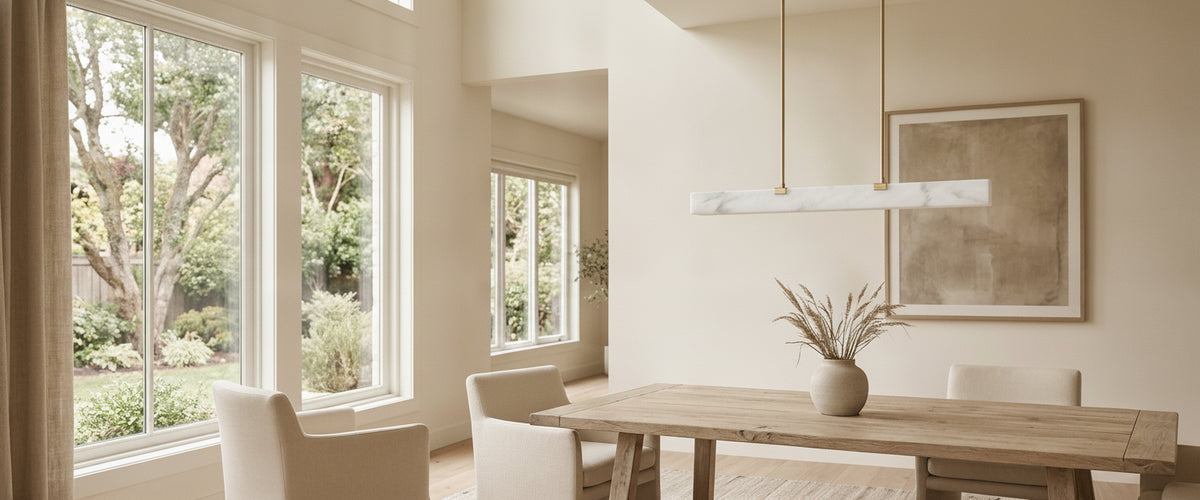

Brass takes the blame for a lot of disappointing dining rooms, and it almost never deserves it. The metal is rarely the problem. Scale is. Height is. Bulb color is. Traditional brass dining lighting fails when a fixture chosen from a catalog photo lands over a table it was never sized for, hung at a height someone guessed, running a lamp that pushes the finish toward a hard sulfur yellow. Fix those four decisions and a traditional brass dining fixture does what brass has done for two centuries: hold warm light at seated eye level without going cold, flat or clinical.

Key Takeaways Before You Shop
Size to the table, not the room. A round traditional brass dining chandelier should read roughly half to two-thirds the width of the table below it.
Hang low. Around 30 to 36 inches (76 to 91 cm) from tabletop to the lowest point of the fixture, adding a little more drop for ceilings above 8 feet (2.4 m).
2700K, always. Cooler bulbs make warm brass look sallow and drain alabaster of its glow.
Decide on the finish early. Lacquered brass stays put, unlacquered brass changes, antiqued brass arrives pre-aged and mostly stays that way.
Check the ceiling before you check out. Weight rating, fixing point and chain or rod length are the specs most buyers leave until the delivery has already landed.

Why the Dining Room Is Where Traditional Brass Finally Makes Sense
Brass is a difficult material in a lot of rooms. In a bathroom it fights the tiling. In a kitchen it competes with hardware, appliances and taps that are usually a different metal entirely. In a bedroom it can read heavy. The dining room is the one space where the material has a clear job and very little competition: a single hung fixture, centered over a table, working at close range under genuinely low light levels. That is why traditional brass dining lighting still earns its place when other rooms have moved on.
That close range matters. Dining is one of the few domestic activities where people sit still for two hours directly beneath a light source, looking at each other's faces across a reflective surface. Brass warms the reflected light in a way that painted steel and chrome cannot. It also handles candle-style forms honestly, because the material has been doing exactly that since long before electrification. A traditional brass dining fixture with alabaster shades takes that history and softens it; the stone diffuses the source so no one across the table is looking at a bare filament.
This is where our own range sits. At Niori we build around alabaster and natural stone, with brass used as structure and detail rather than decoration for its own sake. If you are working out what form suits your room before you commit to a traditional brass dining scheme, the broader lighting collection is a useful place to compare pendants, chandeliers and wall lights side by side.
Lacquered, Unlacquered and Antique: How Each Finish Behaves a Decade Above Your Table
These three words get used interchangeably by retailers, and they describe three very different ten-year outcomes for a traditional brass dining fixture.
Lacquered Brass
A clear coating seals the metal from air and moisture, so the color you receive is broadly the color you keep. It is the low-maintenance choice and the right one for anyone who wants their traditional brass dining chandelier to match brass hardware elsewhere in the house indefinitely. The trade-off is that lacquer can eventually craze or wear thin in spots, particularly near heat, and a patchy lacquer is harder to live with than honest patina.
Unlacquered Brass
Bare metal, left to react, and the least predictable route to a traditional brass dining fixture you will still recognize in a decade. Copper alloys tarnish as sulfur compounds and moisture in the air work on the surface, which is why the change is faster in coastal and humid homes than in dry ones. The Smithsonian's Museum Conservation Institute has published extensively on how copper alloys corrode and why aggressive polishing removes original surface along with the tarnish. Above a dining table, unlacquered brass darkens unevenly, brightest where hands touch it and deepest in the recesses. Some buyers love that. Some call us eight months later asking how to stop it. Decide honestly which one you are.
Antique or Aged Brass
Chemically darkened at the workshop, then sealed. You get the depth of an old fixture on day one without the ten-year wait, and without the unpredictability. Aged and burnished brass tones also sit beautifully against warm alabaster, because both materials carry variation rather than a flat uniform color. A burnished finish on an open form, as on the Corinne 6 Light Orb Chandelier, keeps the metalwork visible without the hard reflections a bright lacquered brass throws under low light. For period homes, prewar apartments and anywhere with dark joinery, this is usually the safest of the three routes into traditional brass dining lighting.
Arm Count and Diameter Mapped to Table Length, Not the Ceiling Rose
Most sizing mistakes happen because people measure the room and ignore the table. A traditional brass dining chandelier has to relate to the tabletop below it, not to the walls.
For a round table, aim for a fixture diameter of roughly half to two-thirds the table's width. A 60-inch (152 cm) round table sits comfortably under a traditional brass dining fixture in the 30 to 40 inch (76 to 102 cm) range. Go smaller and the chandelier looks marooned; go wider and people knock their heads standing up.
For a rectangular table, stop thinking in single fixtures above about 7 feet (2.1 m) of table length. A five or six arm chandelier can carry a table up to that point. Beyond it, two or three matched pendants spaced evenly along the table axis will light the surface far more consistently, and they let you use smaller alabaster shades that read delicate rather than bulky. Where a long table needs repeated, modest points of light rather than one centerpiece, a single-light traditional brass dining pendant such as the Provence 1 Light Pendant in Aged Brass is closer to the right design language, hung in a pair at roughly a third and two-thirds of the table length so light falls where plates actually sit rather than pooling in the middle.
Arm count is partly aesthetic and partly about light distribution. Three arms suit a small round table or a breakfast area. Five and six arm traditional brass dining chandeliers suit the standard six to eight seat table, spreading the output so no single seat is glared at; a six-arm form like the Arco 6 Light Chandelier in Brass gives you that spread without the visual bulk of a tiered fixture. If the fixture uses alabaster or onyx shades, remember the stone is doing the diffusing, so you can often use fewer, lower-wattage lamps than you would with clear glass.
2700K and Shade Choice: The Combination That Stops Brass Reading Yellow
Color temperature is the single most common reason a traditional brass dining fixture disappoints after installation. Buyers fit a 4000K LED because it was in the drawer, and the warm metal suddenly looks green-gold and cheap. Brass needs warm light to look like brass.
Set 2700K as the default for dining. If your fixture uses exposed candle lamps, 2400K to 2700K with a high color rendering index is worth the small premium per bulb; skin tones, wine and wood all fall apart under poor rendering. Work from the Lighting Research Center supports what most people notice anyway: warmer sources tend to be preferred at low illuminance levels, which is exactly the condition a dining room operates in after dark.
Shade material then decides how that warmth arrives. Alabaster transmits light through the stone itself, so the shade becomes a soft glowing object rather than a screen. That gives you a low-glare source you can sit under for hours. Opal glass does something similar but flatter, without veining. Fabric shades push light down and leave the brass frame dark. If the point of buying traditional brass dining lighting is to enjoy the metalwork, avoid anything that hides it.
Dimming is non-negotiable. Specify dimmable lamps and a compatible trailing-edge dimmer, and check compatibility before installation rather than after; mismatched LED and dimmer combinations cause the flicker and buzz people wrongly blame on the fixture. A traditional brass dining chandelier on a properly matched dimmer holds its warmth from first course to last.
Centre of the Room Versus Centre of the Table
Here is the placement error a surprising number of homes are quietly living with, and it undoes even a well-chosen traditional brass dining fixture. Builders install the ceiling rose at the geometric center of the room. Tables almost never sit at the geometric center of the room, because sideboards, doorways, radiators and traffic routes push them off-axis.
An offset of six or seven inches (15 to 18 cm) is easy to miss and more than enough to leave one end of the table in permanent shadow. That is usually the room people describe as feeling awkward without being able to say why, and the fixture almost never deserves the blame. Moving it, rather than replacing it, tends to be the whole fix.
Before you buy a traditional brass dining chandelier, tape the table footprint on the floor, find its actual center, and compare it to the existing rose. If they disagree, your options are to move the fixing point (a qualified electrician's job), to use a swag hook and redirect the chain, or to use a ceiling plate or track designed for offset hanging. Pretending the discrepancy does not exist is the one option that never works.
Chain Length, Weight Rating and Ceiling Rose: The Spec Checks Buyers Leave Until Last
Run this list before you order a traditional brass dining fixture, not after the crate arrives.
Ceiling height and drop. Measure floor to ceiling, subtract table height, then subtract your target 30 to 36 inches (76 to 91 cm). That number is your available drop. Confirm the fixture's chain or rod can be shortened or extended to reach it.
Weight and fixing. Stone and brass are heavier than glass and steel. Ask for the fixture weight and have a qualified electrician confirm the ceiling fixing, joist position and mounting hardware are rated for it. Never hang a stone fixture from a plasterboard-only fixing.
Ceiling rose and canopy. Check the canopy diameter covers any existing hole or old rose. Sloped ceilings need a canopy or gimbal rated for the pitch.
Lamp holders and count. Confirm base type, maximum wattage per lamp and whether dimmable LEDs are supported.
Stone variation. Alabaster and onyx are quarried, not printed. Veining varies piece to piece, and that is the point. Ask what tolerance the maker works to if you need shades closely matched.
Access for cleaning. Can you reach it with a step ladder, or will you need a scaffold tower every time? This decides whether the fixture gets maintained.
Budget. Cost tracks material, scale, engineering, finishing and installation complexity, so a comparable-looking photo tells you very little. Ask for a quote against your actual dimensions.
Living With It: Care That Actually Preserves the Finish
Dust brass with a dry microfiber cloth. That is most of the job. Skip proprietary metal polishes on aged or lacquered finishes, because they are abrasive and will cut straight through a patina or coating you paid for. Unlacquered brass can be lightly polished if you genuinely want it brighter, but accept that you are resetting a clock, not cleaning it.
Alabaster asks for a different discipline. Never use vinegar, citrus cleaners or anything acidic; calcite-based stone etches on contact. A dry cloth, or a barely damp one followed immediately by drying, keeps the surface even. Keep stone fixtures away from steam paths and direct heat, and let lamps cool before handling shades. Done this way, a traditional brass dining fixture with alabaster shades ages gracefully for decades. You can see how the material behaves across different forms in our alabaster lighting collection, where the same stone reads differently as a pendant, a chandelier or a wall light.
The short version: buy the finish you will still like in ten years, size it to the tabletop, hang it low, and light it warm. That is the whole discipline behind traditional brass dining lighting, and almost every room that gets it wrong has missed one of the four.